
Martin Lees, Chair of the OECD-IIASA Strategic Partnership on Systems Approaches, returned to IIASA earlier this month to deliver a thought-provoking lecture, revisiting the origins and future of systems thinking in international policymaking and reflecting on decades of collaboration between IIASA and the Organisation for Economic Co-operation and Development (OECD).
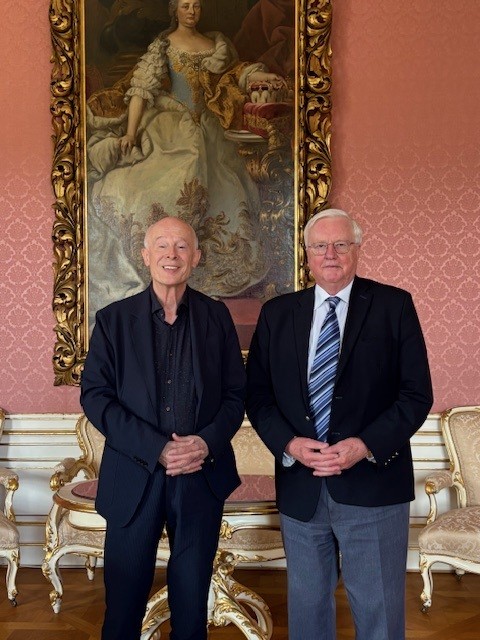 © IIASA
IIASA Director General Hans Joachim (John) Schellnhuber with Martin Lees
Opening the event, IIASA Strategic Initiatives Program Director, Steffen Fritz welcomed Lees back to the Institute, noting that his association with IIASA extends over more than three decades.
“Martin has been following IIASA closely for many years,” said Fritz. “As Chair of the OECD–IIASA Committee, he has played a key role in advancing our joint efforts to bridge science and policy through systems approaches.”
A partnership rooted in systems thinking
Lees began his lecture by outlining the origins and purpose of the OECD-IIASA Strategic Partnership on Systems Approaches, established in December 2017.
“The partnership,” he explained, “was created with three broad aims: first, to advance a coherent systems approach in the formulation and implementation of policy; second, to strengthen the role of science and evidence in policymaking; and third, to promote innovation in institutions and systems leadership to meet changing needs.”
Over the first five years of the partnership, five high-level meetings brought together experts from both organizations to explore systems thinking and resilience in policymaking. A key outcome of this collaboration was the OECD publication, Systemic thinking for policymaking, prepared by more than 70 experts from IIASA and OECD. The publication describes the application of systems thinking in practice in 14 fields of policy, and stands as a concrete demonstration of the value of collaboration between the two organizations.
In 2023, the partnership expanded under the leadership of OECD Secretary-General Mathias Cormann to include 10 prestigious international organizations. This broadened coalition, Lees said, was intended to generate innovative proposals for the development of an integrated systemic approach for rapid action on the risks, impacts, and global implications of climate change.
He emphasized that the expanded partnership reflects the varied realities, capabilities, and aspirations of different cultures and nations and is designed to ensure a balanced global approach to the intertwined challenges of climate, economy, and sustainability.
Lessons from the science-policy interface
In a wide-ranging talk, Lees reflected on six examples from his career that demonstrate the power and challenges of applying systems thinking in practice. From the OECD Interfutures Project of the 1970s to the creation of the China Council for International Cooperation on Environment and Development, Lees traced how systems approaches have helped shape policy frameworks for sustainable development around the world.
“I was first introduced to systems thinking in 1962 as an undergraduate in mechanical sciences at Cambridge,” he recalled. “Once you have been contaminated by the systems approach, it’s very hard to approach issues in any other way.”
He highlighted the historical link between OECD and IIASA, dating back to the Institute’s founding:
“During the Interfutures project, I had the privilege of meeting Dr. Howard Raiffa, the first Director General of IIASA in Vienna. That led to IIASA’s participation in the project in the field of energy policy, so the OECD–IIASA relationship goes way back to the beginning of IIASA.”
Urgency, complexity, and institutional innovation
Throughout his lecture, Lees emphasized the urgency of systemic change to confront today’s interconnected global crises.
“We are confronted by a wide array of systemic challenges in a period of transformation and immense turbulence in world affairs,” he said. “We also face, for the first time, an unprecedented assault on the value and the role of science and factual analysis in the formulation and implementation of policy.”
Drawing on his experiences with governments and international organizations, Lees noted that successful policy innovation requires strong institutions capable of integrating science, economics, and long-term strategy. He also warned that time is running out to manage the accelerating environmental and social crises.
“We are in a race against time to avert the threats of climate destabilization and ecological breakdown before human activities push the interconnected natural systems of our planet beyond critical thresholds,” Lees said. “Incremental improvement, although necessary, will not be sufficient. We need transformative economic and social change.”
Looking ahead
In his concluding remarks, Lees expressed hope that IIASA can continue to play a central role in shaping the future of systems-based policymaking.
“IIASA, with its long experience and intellectual capabilities, can play a seminal role in developing the new ideas and approaches we urgently need and in laying out a positive and motivating vision for the future of us all,” he said.
Following the lecture, Lees met with several IIASA Program Directors to discuss opportunities for deeper collaboration within the OECD-IIASA framework. The afternoon concluded with a meeting with IIASA Director General Hans Joachim (John) Schellnhuber, joined by Deputy Director General Karen Lips and senior IIASA scientists where discussions centered on the future of the OECD Strategic Partnership, IIASA’s potential role in global science diplomacy, and the importance of China in advancing systemic approaches to sustainable development.
News

13 October 2026
Connecting disciplines and inspiring new ideas with the Environment and Climate Research Hub
IIASA Deputy Director General Karen Lips delivered a keynote at the University of Vienna's recent Environment and Climate Research Hub (ECH) Research Frontiers Workshop in Bad Vöslau, Austria, emphasizing the importance of interdisciplinary collaboration in addressing complex environmental and climate challenges.
12 October 2026
Connecting science across borders: IIASA Committee meets University of Salzburg
How can universities and international research organisations work together to address the complex challenges of a changing world? This question shaped a full day of scientific exchange at the University of Salzburg on 6 October, when the Austrian IIASA Committee met with members of the University community to discuss research, collaboration and opportunities for researchers and students.
06 October 2026
Nanjing University delegation visits IIASA to explore future collaboration
A high-level delegation from Nanjing University (NJU), led by Professor Tan Zhemin, President of NJU and Fellow of the Chinese Academy of Sciences, visited IIASA to discuss opportunities for strengthening scientific cooperation and advancing joint research on global challenges.