

The project Quantifying Migration Scenarios for Better Policy (QuantMig) has launched three freely-accessible, open online tools.
The QuantMig Migration Scenarios Explorer, prepared by team of IIASA researchers, presents population and labour force indicators for 2020-2060 related to the QuangMig migration scenarios under different assumptions on rare migration events in the early 2020s. The scenarios extend those from the Wittgenstein Centre Data Explorer by focusing on migration assumptions.
The QuantMig Migration Estimates Explorer includes the probabilistic estimates of migration within, into and out of Europe, prepared by QuantMig team at Southampton University. The estimates are available by a range of demographic characteristics, prepared for the period 2009-2019, and are integrating earlier estimates for 2002-2008 developed in the IMEM project.
The DEMIG-QuantMig Policy Database, prepared by Mathias Czaika and his team at the Donau University in Krems, documents over 7,600 migration policy changes enacted by 31 European countries in the period 1990-2020. The database extends and updates the original DEMIG POLICY database assembled by the International Migration Institute.
The Open Data deposits related to these tools, as well as to other data collections produced within the project are also freely available for download from the QuantMig Community on Zenodo.
For feedback on any of our tools, please email their respective authors, or write to the generic QuantMig address, at [email protected]
News

24 September 2026
IIASA researcher joins Austrian Academy of Sciences working group on integrated carbon neutrality
On 15 September, Principal Research Scholar Thomas Schinko represented IIASA at a high-level event of the Commission on the De-Fossilization and Carbon Neutrality of the European Energy Systems (DEE) of the Austrian Academy of Sciences (OEAW). The meeting denoted the kick-off workshop of the newly established DEE Working Group "Transsectoral and Transcontinental Integration”.
23 September 2026
Eco-Welfare Network Conference
Julia Beier participated in the first in-person Eco-Welfare Network Conference, held in Brussels from 9-11 September at the Université Libre de Bruxelles as part of the Transform-Labor project.
14 September 2026
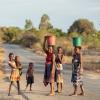
Can a warming climate put women at greater risk?
Unusually warm periods could have a link to an increased risk of intimate partner violence against women, according to a new IIASA-led study covering 31 countries in sub-Saharan Africa. The findings highlight how rising temperatures may compound existing risks of violence, with effects varying between demographic groups.