



Engaging the local stakeholders in policy crafting and co-development of decision support systems can result in policies tailored for local socioeconomic, and environmental characteristics. The effective stakeholder’s engagement hinges on understanding their vision and expectation from the decision-making process, among others. SEVA is an open access tool developed by IIASA researchers for exploratory analysis of stakeholders’ roles and their visions.
The inclusive decision-making process can increase the sustainability of decisions and adopted policies, particularly for policies that address societal issues or have a social dimension. The inclusive approach to decision-making creates the opportunity to include different aspects of the issue being tackled as well as the existing knowledge. As such, stakeholder engagement is essential for informed decision-making and sustainable policy crafting, whether its tackling disaster risk reduction, climate adaptability or any other resilience building. Policies designed by including the stakeholders in the decision-making process can reflect the local social characteristics, since they include the concerns, visions, and priorities of local stakeholders. The first step in engaging the stakeholders in decision-making processes is to understand their roles, responsibilities, their goals and expected outcomes for decision-making, and their vision of the addressed issue.
The analysis of the stakeholders' characteristics and their vision is a crucial first step in stakeholder engagement for decision-making. The main goal of analyzing stakeholder characteristics and their vision is to explore and understand the different stakeholders involved in the decision-making process from different perspectives. In this manner, the stakeholder characteristics and vision should be analyzed with exploratory methods. The result of this exploratory analysis can be used to design the effective stakeholder engagement framework, analyze the diversity of included stakeholders, and construct hypotheses where necessary. The comprehensive analysis calls for including different aspects of the stakeholders’ characteristics as well as the potential decisions that are planned to be evaluated. However, the large dimensions of such data can pose a challenge in analyzing stakeholders' data.
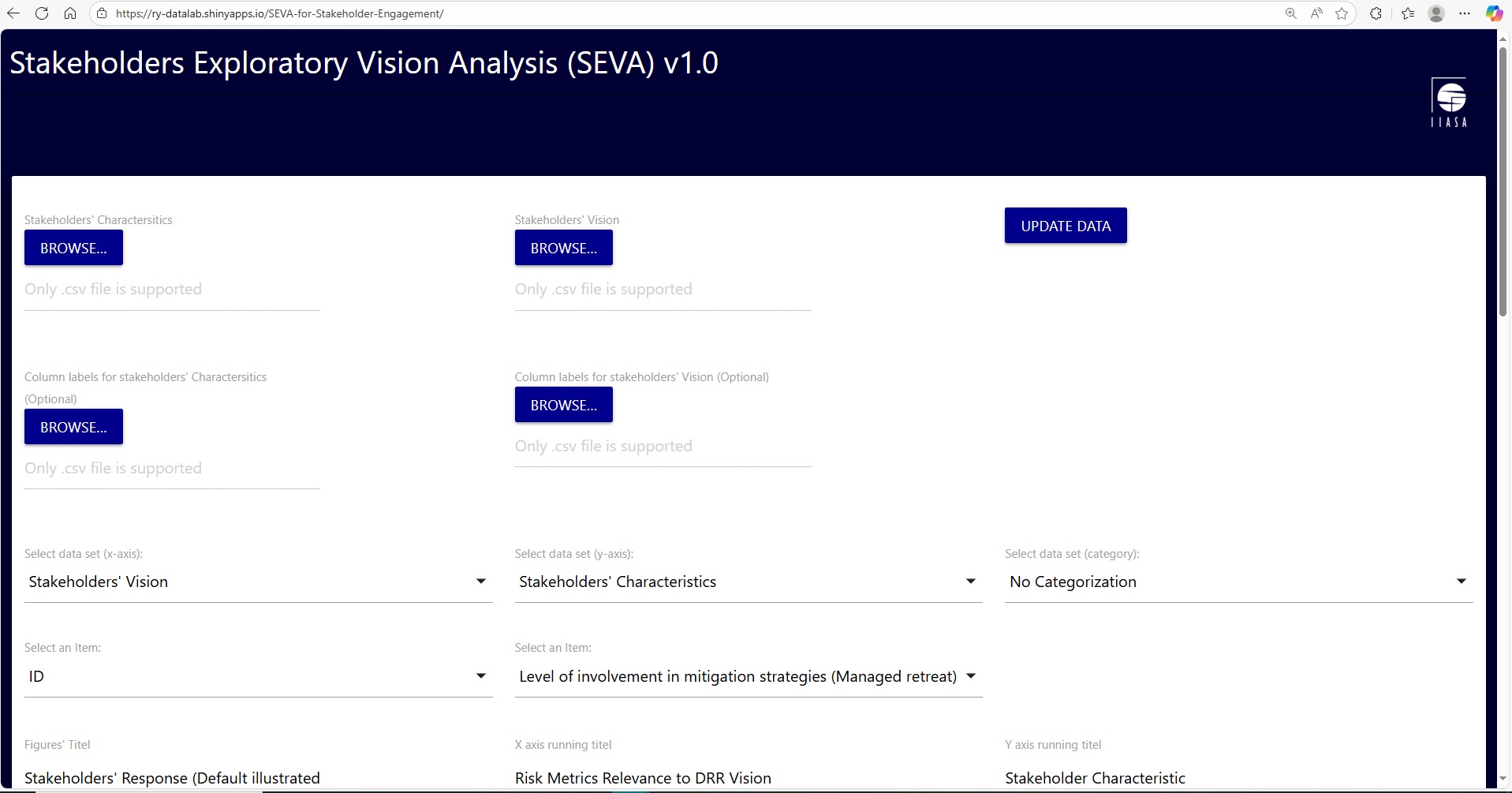
Cooperation and Transformative Governance (CAT) released the first version of Stakeholders Exploratory Vision Analysis (SEVA), new tool for Stakeholders’ vision analysis. SEVA is a flexible web app for exploring the stakeholder’s characteristics and visions ant their relations. The first version of SEVA was developed and used as part of the stakeholder engagement efforts in Multi-hazard and Risk-informed System for Enhanced Local and Regional Disaster Risk Management (MEDiate) project. SEVA is designed to be a simple and practical practically usable for effective stakeholder engagements.
 © IIASA
SEVA tool’s flexible interface
Read more about SEVA here.
To use SEVA, click here.
News

15 October 2026
MowingQuest system-test campaign 2026 concludes, data collection continues
IIASA’s MowingQuest citizen-science campaign has wrapped up its August–September 2026 system test, with 25 pioneer users submitting almost 800 observations across eight countries. The results will help improve the app and data-quality workflows ahead of the main 2027 campaign. Two participants have also won Garmin GPS watches in the campaign raffle.

06 October 2026
Nanjing University delegation visits IIASA to explore future collaboration
A high-level delegation from Nanjing University (NJU), led by Professor Tan Zhemin, President of NJU and Fellow of the Chinese Academy of Sciences, visited IIASA to discuss opportunities for strengthening scientific cooperation and advancing joint research on global challenges.

23 September 2026
IIASA researchers strengthen cooperation with Kyrgyzstan on AI and industrial development
IIASA Cooperation and Transformative Governance (CAT) Research Group Leader and Senior Research Scholar Nadejda Komendantova and CAT Research Scholar Dmitry Erokhin have contributed to a series of scientific and policy forums in Kyrgyzstan in 2026. Their research on artificial intelligence in the production sector builds on IIASA’s longstanding cooperation with the country on sustainable industrial development.