


Dmitry Erokhin, Research Scholar at the IIASA Cooperation and Transformative Governance (CAT) Research Group, presented the study “Using Google Trends to Analyze Public Sensitivity to Climate-Related Natural Hazards and its Correlation with Nuclear Topics: A Proxy Approach for Societal Impact and Risk Communication”, coauthored with Nadejda Komendantova, Leader of the IIASA CAT Research Group, at the International Conference on Resilience of Nuclear Installations against External Events – Focus on Climate Change, organized by the International Atomic Energy Agency (IAEA).
On October 20, Dmitry Erokhin, Research Scholar at the IIASA Cooperation and Transformative Governance (CAT) Research Group, presented a study titled “Using Google Trends to Analyze Public Sensitivity to Climate-Related Natural Hazards and its Correlation with Nuclear Topics: A Proxy Approach for Societal Impact and Risk Communication” conducted in collaboration with Nadejda Komendantova, Leader of the IIASA CAT Research Group, at the International Conference on Resilience of Nuclear Installations against External Events – Focus on Climate Change (NIRC–2025), organized by the International Atomic Energy Agency (IAEA).
The presentation focused on using Google Trends to examine how information-seeking behavior around natural hazards (e.g., floods, earthquakes, tsunamis, typhoons, wildfires) correlates with searches on nuclear topics (e.g., safety, accidents, energy). By systematically analyzing search data across countries and time, the study identifies what topics rise together, the intensity of public attention, and patterns that can inform risk communication during sensitive events.
Reflecting on the conference, Erokhin remarked on the breadth of perspectives and the forward-looking discussions about strengthening the resilience of nuclear installations to external events and the implications for public communication and policy. The event provided a valuable platform to exchange ideas and deepen understanding in an evolving energy and climate context.
To read more on the International Conference on Resilience of Nuclear Installations against External Events – Focus on Climate Change https://www.iaea.org/events/rni2025
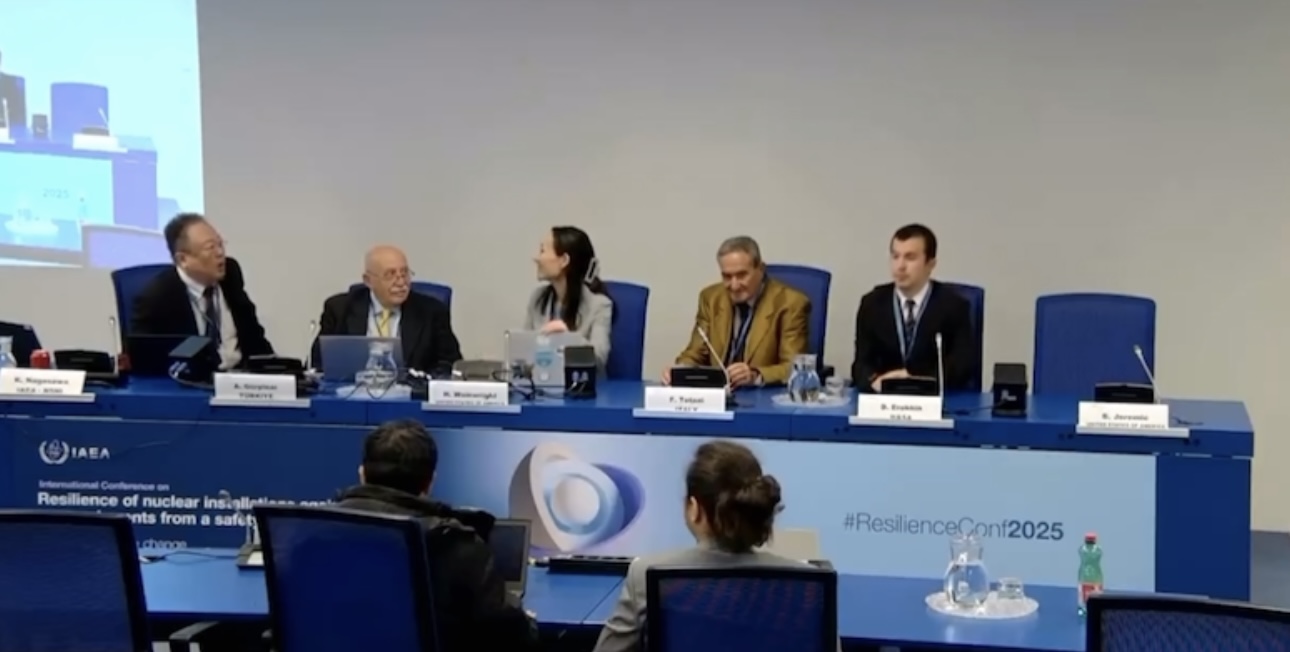 © IAEA
Panel discussion at the Conference
News

24 September 2026
IIASA researcher joins Austrian Academy of Sciences working group on integrated carbon neutrality
On 15 September, Principal Research Scholar Thomas Schinko represented IIASA at a high-level event of the Commission on the De-Fossilization and Carbon Neutrality of the European Energy Systems (DEE) of the Austrian Academy of Sciences (OEAW). The meeting denoted the kick-off workshop of the newly established DEE Working Group "Transsectoral and Transcontinental Integration”.

23 September 2026
IIASA researchers strengthen cooperation with Kyrgyzstan on AI and industrial development
IIASA Cooperation and Transformative Governance (CAT) Research Group Leader and Senior Research Scholar Nadejda Komendantova and CAT Research Scholar Dmitry Erokhin have contributed to a series of scientific and policy forums in Kyrgyzstan in 2026. Their research on artificial intelligence in the production sector builds on IIASA’s longstanding cooperation with the country on sustainable industrial development.

10 September 2026
Emotionalization of Political Discourse: IIASA Researcher Presents Study at the Day of Parliamentary Research 2026
Dmitry Erokhin, PhD, Research Scholar at IIASA, presents a poster on the emotionalization of political discourse at the Day of Parliamentary Research 2026 at the Austrian Parliament. His study analyzes public comments on YouTube videos related to major Austrian political parties and applies sentiment and topic analysis to examine how emotions, facts, polarization, and toxicity shape online political debate. The findings provide insights into how digital media influences public perceptions of parties and democratic processes, and how parliaments can better respond to emotionally charged political communication.