



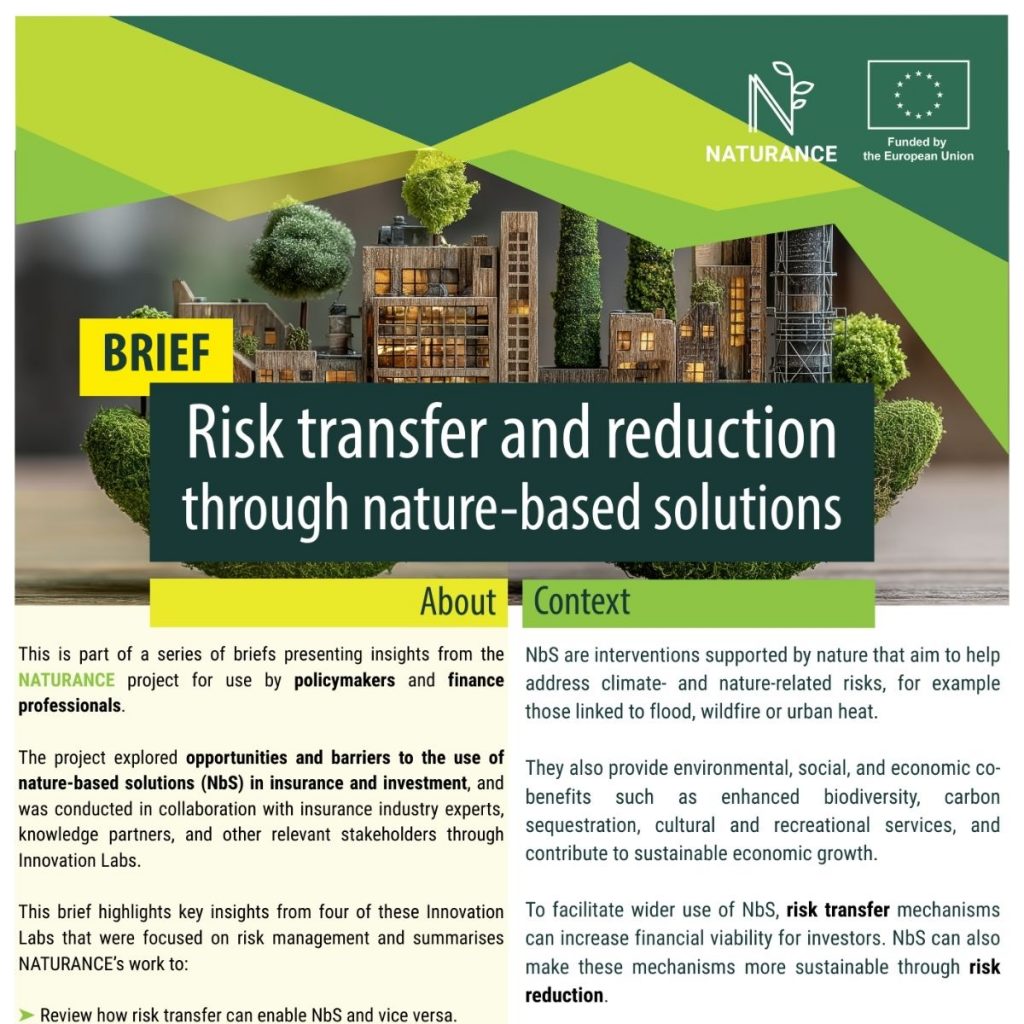
New insights from four NATURANCE Innovation Labs show how risk transfer and nature-based solutions can work hand in hand to address escalating climate risks. From flood resilience in the UK and Italy to wildfire and urban heat challenges across Europe, the brief highlights practical opportunities to scale NbS where they are needed most.
This brief is part of a NATURANCE series for policymakers and finance professionals, exploring how nature-based solutions (NbS) can be integrated into insurance and investment. Drawing on four Innovation Labs, it examines how risk transfer and NbS can support each other and highlights opportunities across flood resilience in the UK and Italy, wildfire risk, and urban heat in Europe.
Nature-based solutions (NbS) use natural processes to address risks like flooding, wildfires, and urban heat while delivering environmental, social, and economic benefits. Risk transfer can improve their financial viability, while NbS can enhance the sustainability of these mechanisms by reducing risk.
The IIASA NATURANCE team from the Equity and Justice (EQU) Research Group in the Population and Just Societies (POPJUS) Program is leading Work Package 3 which will analyse governance, policy and market/business enablers and barriers of innovative and equitable nature-based insurance and investment solutions and identify good practice and policy reforms for unlocking the business potential of NbS and scaling up.
 © NATURANCE
This brief is part of a NATURANCE series for policymakers and finance professionals, exploring how nature-based solutions (NbS) can be integrated into insurance and investment. Drawing on four Innovation Labs, it examines how risk transfer and NbS can support each other and highlights opportunities across flood resilience in the UK and Italy, wildfire risk, and urban heat in Europe.
News

24 September 2026
IIASA researcher joins Austrian Academy of Sciences working group on integrated carbon neutrality
On 15 September, Principal Research Scholar Thomas Schinko represented IIASA at a high-level event of the Commission on the De-Fossilization and Carbon Neutrality of the European Energy Systems (DEE) of the Austrian Academy of Sciences (OEAW). The meeting denoted the kick-off workshop of the newly established DEE Working Group "Transsectoral and Transcontinental Integration”.
23 September 2026
Eco-Welfare Network Conference
Julia Beier participated in the first in-person Eco-Welfare Network Conference, held in Brussels from 9-11 September at the Université Libre de Bruxelles as part of the Transform-Labor project.
14 September 2026
Can a warming climate put women at greater risk?
Unusually warm periods could have a link to an increased risk of intimate partner violence against women, according to a new IIASA-led study covering 31 countries in sub-Saharan Africa. The findings highlight how rising temperatures may compound existing risks of violence, with effects varying between demographic groups.