


IIASA researcher suggests a fundamentally different way for governments to plan for the future: using population as a common framework to connect health, education, food, jobs, housing, social protection, and climate risk. The approach integrates demographic data with sectoral planning to help governments make more coordinated, evidence-based decisions and improve population wellbeing.
Countries around the world face increasingly interconnected challenges, including population ageing, fertility change, migration, urbanization, labor-market transitions, food and water security, climate risk, and more. However, the evidence used to address these challenges can often be fragmented across ministries, offices, departments, administrative systems, and research projects. In a new paper, titled “Population-Based Systems Models for National Planning: A Proposal for Country-Owned Demographic Systems Infrastructure,” IIASA researcher Samir KC proposes the Population-Based Systems Model (PopSyM) as a country-owned analytical tool that places population dynamics at the center of integrated policy planning.
“Education systems need to anticipate births, school-age cohorts, migration, retention, dropout, and transitions to higher education or work. Food systems need to understand the number, location, household structure, income, and consumption patterns of people who will require food and nutrition security. Urban planners need to know where households will form, where settlements will expand, where infrastructure demand will rise, and where population decline may leave houses or schools unused,” says KC. “Climate adaptation requires knowing not only where hazards occur, but who is exposed, who is vulnerable, and how that exposure may change under alternative demographic and development pathways. Despite this common population basis, these systems are frequently planned separately.”
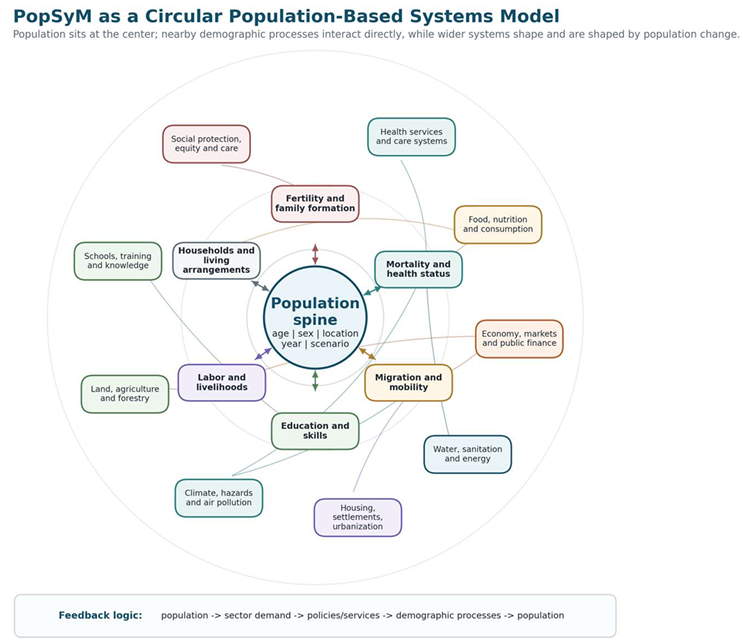
KC suggests that the development and use of PopSyM should begin with the establishment of a “demographic spine” covering population by age, sex, location, year, according to various scenarios, which can then be linked to modules for health, education, food, labor, housing, social protection, the environment, and local infrastructure.
The aim of PopSyM is not only to produce more accurate population projections, but to create an infrastructure that connects demographic change to the systems that shape people’s livelihoods and measures whether those systems contribute to longer, healthier, and more secure lives. The model would not replace national statistical systems or specialized sector models. Instead, it would provide a shared population infrastructure through which different ministries and agencies could work from consistent demographic assumptions while retaining their own data, models, and policy questions. It would therefore operate at national and subnational levels, supporting provinces, municipalities, and wards as they plan, budget, and evaluate services.
KC highlights that PopSyM is deliberately designed to be country-owned, arguing that global demographic and environmental datasets remain valuable, but cannot capture every feature of national and local realities. Seasonal migration, informal settlements, local flood histories, service bottlenecks, social norms, and community perceptions of risk may all matter for planning but remain difficult to represent in global datasets. Moreover, KC suggests that a country-owned system would allow national statistical offices, government agencies, universities, and research institutions to define priorities, validate assumptions, and progressively improve the evidence base, strengthening accountability and helping to identify knowledge gaps.
 © IIASA
PopSyM circular feedback view.
In the paper, KC explores the case of Nepal and the potential of PopSyM deployment in the country. “Nepal already has the hardest piece: an annual, single-year-of-age population projection by sex for all 6,743 wards, built from the 2021 Census,” says KC. “Once such a spine exists, health, education, food, and flood-exposure applications become extensions of the same system rather than separate projects.”
The paper highlights that the 2021 Census, earlier censuses, the Demographic and Health Surveys (DHS), Multiple Indicator Cluster Surveys (MICS), Nepal Living Standards Surveys (NLSS), migration records, administrative health and education data, geospatial layers, and hazard data have the potential to support a phased PopSyM in Nepal. Early applications could include health target populations, remaining life expectancy, school planning, food and consumption vulnerability, and rainfall or flood-exposure screening. More advanced applications could include migration-sensitive local population estimates, gridded population surfaces, flood and heat exposure, air pollution, land use, housing, social protection, and a wellbeing outcome layer that adapts the Years of Good Life logic to Nepal’s available data and policy priorities.
“Population is not a number you divide by — it is the framework you plan with. Every country should own one, and Nepal is close enough to show it can be done.”, highlights KC. “Almost all public policy is population policy, even when it isn't called that — who will need care, schooling, work, food and shelter, and where. The point is not more accurate projections for their own sake, but whether people live better lives; PopSyM makes wellbeing the outcome the planning system is actually measured against.”
Reference:
K.C., S. (2026). Population-Based Systems Models for National Planning: A Proposal for Country-Owned Demographic Systems Infrastructure. Populations 2 (3) e16. 10.3390/populations2030016. [https://pure.iiasa.ac.at/21794]
News
04 July 2025
IIASA research informs new World Bank Report on Nepal’s air pollution crisis
Air pollution has become the leading health risk in Nepal, contributing to around 26,000 premature deaths each year. IIASA researchers provided scientific tools and analysis for a new World Bank report presenting the country’s first comprehensive clean air plan to address the problem.