

On 30 May 2025, IIASA, the United Nations Population Fund (UNFPA), and the National Institute for Economic Research of Moldova (NIER) signed a Memorandum of Understanding (MoU) to improve national migration research and demographic projections to address radical population decline in the country.
Moldova is currently experiencing a rapid population decline. Working-age population is leaving the country, leading to a number of associated challenges, including a shrinking labor force and an aging population.
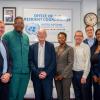
To address those challenges, a delegation from Moldova visited IIASA in February 2025 to discuss potential avenues for future collaboration in the fields of migration research and population dynamics. The delegation was headed by Olga Gagauz, Director of the National Institute of Economic Research of Moldova and consisted of researchers from the Center for Demographic Research from the Republic of Moldova (CDR), as well as UNFPA representatives. The delegation met with IIASA Director General Hans Joachim Schellnhuber, scientists from the IIASA Population and Just Societies Program, and their Program Director Anne Goujon.
Building on the discussions held as part of the visit, a trilateral MoU between IIASA, UNFPA, and NIER was signed on 30 May 2025. Some of the key areas for future collaborations outlined in the MoU include:
- Joint research on migration and migration projections, with a particular focus on return migration;
- Joint research on population aging and its economic impact, as well as the development of an Active Aging Index;
- Projecting future demands for resources and social services;
- Potential participation of Moldovan early-career researchers in the IIASA Young Scientists Summer Program;
- Participation of Moldovan demographers in international events and conferences organized by IIASA and the Wittgenstein Centre for Demography and Global Human Capital.
“This agreement will strengthen IIASA’s research partnerships with Moldova and UNFPA, helping to build up national capacity in the fields of migration research and population dynamics,” says IIASA Deputy Director General Karen Lips. “By combining expertise and resources, this partnership has the potential to generate valuable insights into demographic trends and migration patterns, as well as support policymaking in the country.”
In the past, the Moldovan government had invited a diverse scientific consortium, including IIASA researchers Nickolas Gailey and Samir KC, to produce an analytical report summarizing demographic change projection to inform policymaking. The report was published in 2024.
News

30 June 2026
Scenarios across borders: 100 meetings of the Austrian IIASA Committee
On 26 June 2026, the Austrian IIASA Committee gathered at the Austrian Academy of Sciences in Vienna for its 100th session – an afternoon focused on systems, science diplomacy, and the question of how to fit an entire world into a model.

24 June 2026
Small island, big systems: Barbados and IIASA sign letter of intent to pioneer regenerative economy partnership
The Government of Barbados and IIASA have signed a letter of intent, formally launching Barbados’ path toward membership in the Institute and establishing a new partnership to apply advanced systems analysis and global modeling to the design of a regenerative economy.
12 June 2026
The physics of good vibrations: IIASA and Barbados explore a new model for resilient and thriving societies
IIASA Director General Hans Joachim (John) Schellnhuber visited Barbados at the end of May to deepen engagement with government, academic, diplomatic, and international partners and explore new opportunities for collaboration on resilience, innovation, and sustainable development for Small Island Developing States (SIDS).