



IIASA researchers joined experts from around the world in Rome for the Forest Sector Outlook Study 2030 and 2050 Scenario Design Workshop to support the development of long-term scenarios for sustainable forest use, restoration, and the forest-based bioeconomy. This initiative aims to inform forest policy planning through science-based modeling.
The Forest Sector Outlook 2030 and 2050 study explores scenarios for sustainable forest use, large-scale restoration, and the emergence of a forest-based bioeconomy that supports international objectives such as climate and biodiversity goals. It draws on economic, environmental, and technological trends including wood product markets, forest-based bioeconomy innovations, and climate mitigation, to offer strategic foresight for decision makers. The study builds on a long-standing tradition of global forest outlooks dating back to the 1950s. What makes the study unique is its integrative approach – it doesn’t just focus on the role of forests in climate change but also examines how expanding forest bioeconomies can be harmonized with food security, ensuring that land remains available for agriculture while enhancing livelihoods. This is done by evaluating the feasibility and impacts of increased forest cover, forest management changes, and increased forest-based biomass production.
The scenario development workshop for the 2030 and 2050 outlook, co-organized by IIASA and the Food and Agriculture Organization of the United Nations (FAO), took place at the FAO Headquarters in Rome from 8–9 July 2025. The event brought together 36 participants from other modeling teams, international organizations, NGOs, industry, regional representatives from Africa, Latin America, and South Asia, as well as the private sector to co-design scenarios that can support informed decision-making in the forest sector.
Using preliminary results of IIASA’s forest sector models, particularly the Global Biosphere Management Model (GLOBIOM) and the Global Forest Model (G4M), participants examined potential developments in land use, forest product markets, and climate policy. The discussions emphasized the value of context-specific approaches, regional perspectives, and coordinated data-sharing. Several participants also contributed datasets to support the modeling work.
“This workshop is a good example of how scientific modeling and diverse policy expertise can be brought together to inform future planning,” says IIASA Biodiversity and Natural Resources Program Director, Petr Havlik. “Our aim is to provide evidence-based insights that are useful to stakeholders working on sustainable forest use.”
Key outcomes from the workshop include the identification of priority scenario elements such as land use trade-offs, carbon pricing mechanisms, deforestation targets, and bioeconomy drivers. Participants also highlighted the importance of using standardized indicators across regions and sectors and called for stronger links between mitigation and adaptation strategies. There was broad support for tracking co-benefits like agroforestry and trees outside forests, reflecting the multifunctional role forests play in climate and development goals.
“It was helpful to hear from experts from different regions and sectors about their interests and concerns regarding the elements that need to be included in the scenarios,” notes IIASA researcher Andrey Lessa Derci Augustynczik, Principal Investigator of the project. “The exchange helped identify which indicators and assumptions are most relevant when thinking about forests as part of climate and development strategies.”
IIASA regularly works with international partners like the FAO to ensure that science and modeling inform global sustainability policy. For over four decades, the Institute has collaborated with the FAO on initiatives such as the development and application of the Global Agro-Ecological Zones (GAEZ) modeling framework. This longstanding partnership was further strengthened in April with the signing of a new Memorandum of Understanding, reaffirming a joint commitment to providing decision makers with tools to navigate complex environmental and socioeconomic challenges.
The workshop marked the beginning of a collaborative process and ongoing engagement with the experts who participated. The process will continue through virtual follow-up meetings, where the scenarios will be reviewed and validated. Global scenario outcomes will also be summarized by regions and used to explore implications of potential future forest policies. Preliminary results will feed into discussions at the upcoming 2025 United Nations Climate Change Conference (COP30) in Belém, Brazil, from 10 to 21 November 2025. A complete set of results will be presented at the summit “Advancing Sustainable Forest-based Bioeconomy Approaches (CLI-ASFBA) in Vienna in February 2026 and will feed into multiple FAO products going forward.
“This is the beginning of a participatory process through which, by developing different scenarios using GLOBIOM and G4M, we can inform policymakers, the private sector, academia, and other key stakeholders about the possible future pathways the forest sector may take within the bioeconomy,” concludes IIASA researcher Zuelclady Araujo, who participated in the workshop.
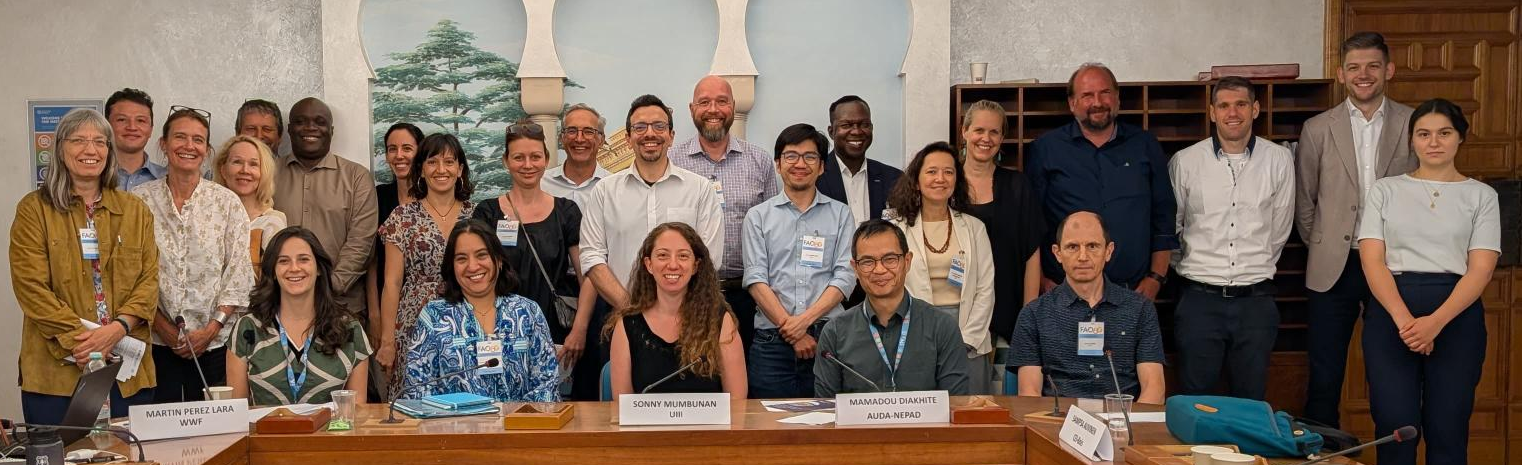 © IIASA
Group photo of the workshop participants.
News

07 October 2026
MOSAIC results highlighted during Austria’s Protective Forest Week 2026
MOSAIC project results and IIASA research on climate-resilient protective forests are featured during Austria’s Protective Forest Week 2026, including work on wildfire risk, decision-support tools, and the Alpine Resilience Web Atlas.
06 October 2026
Nanjing University delegation visits IIASA to explore future collaboration
A high-level delegation from Nanjing University (NJU), led by Professor Tan Zhemin, President of NJU and Fellow of the Chinese Academy of Sciences, visited IIASA to discuss opportunities for strengthening scientific cooperation and advancing joint research on global challenges.
06 October 2026
IIASA celebrates long-term partnership with MSc European Forestry Program
Coordinators, partners and graduates of the MSc European Forestry program visited IIASA on 29 September 2026. Twenty visitors from at least eight countries came as part of the alumni event held alongside the program's graduation ceremony at BOKU University in Vienna.