

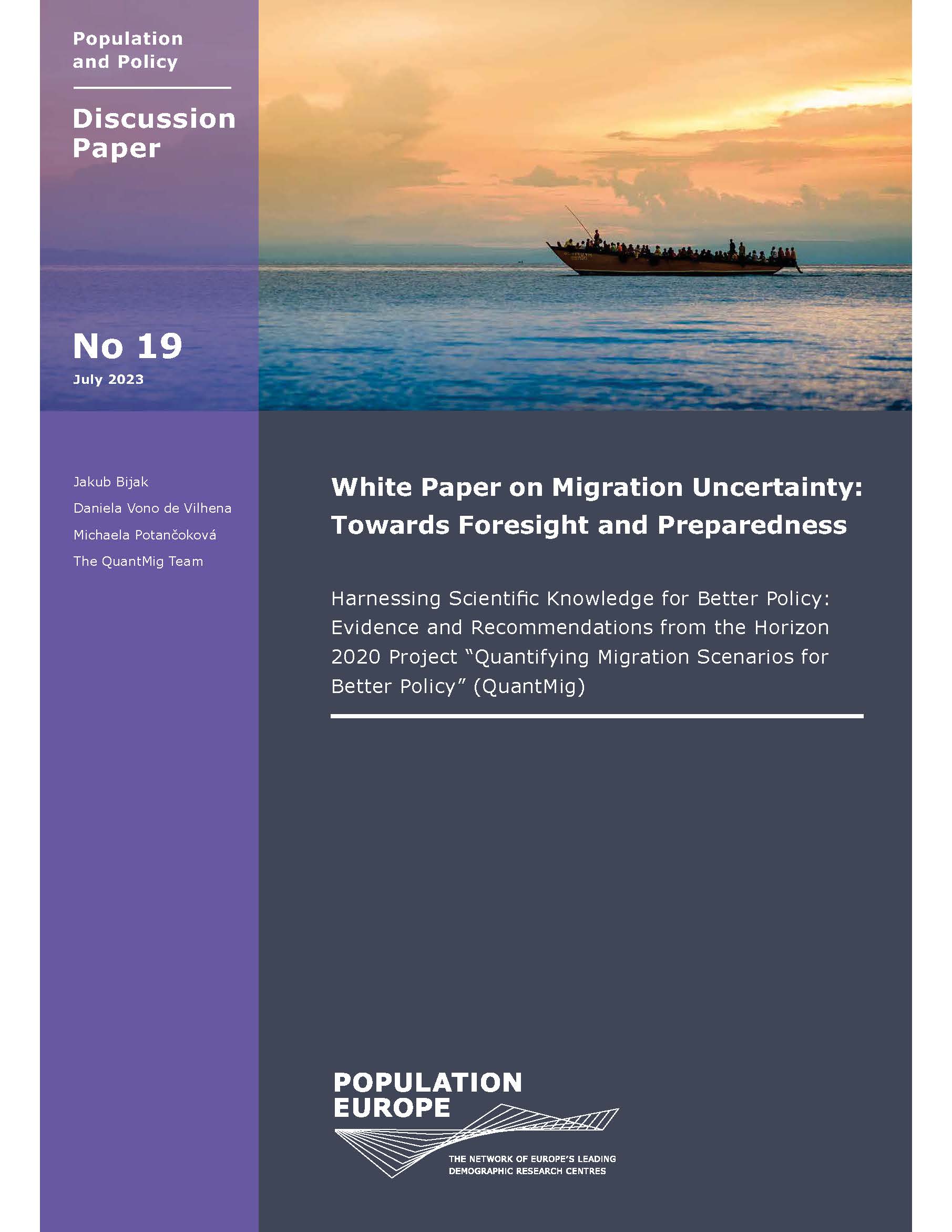
IIASA researcher Michaela Potancokova together with project team members, present evidence and recommendations from the QuantMig project in Population Europe's Discussion Paper.
 © Population Europe
This White Paper, co-authored by IIASA researcher Michaela Potancokova from Multidimensional Demographic Modeling Research Group (MDM), presents the main results and policy recommendations from the Horizon 2020 project “Quantifying Migration Scenarios for Better Policy” (QuantMig).
It discusses the uncertainty and complexity of migration processes, assesses selected theoretical approaches for explaining migration, reviews migration drivers in the origin, destination and transit countries, evaluates data and migration measurements for scenario-building on future migration and presents ways to inform and construct migration scenarios followed by the project’s main conclusions and recommendations.
News

24 September 2026
IIASA researcher joins Austrian Academy of Sciences working group on integrated carbon neutrality
On 15 September, Principal Research Scholar Thomas Schinko represented IIASA at a high-level event of the Commission on the De-Fossilization and Carbon Neutrality of the European Energy Systems (DEE) of the Austrian Academy of Sciences (OEAW). The meeting denoted the kick-off workshop of the newly established DEE Working Group "Transsectoral and Transcontinental Integration”.

23 September 2026
Eco-Welfare Network Conference
Julia Beier participated in the first in-person Eco-Welfare Network Conference, held in Brussels from 9-11 September at the Université Libre de Bruxelles as part of the Transform-Labor project.
14 September 2026
Can a warming climate put women at greater risk?
Unusually warm periods could have a link to an increased risk of intimate partner violence against women, according to a new IIASA-led study covering 31 countries in sub-Saharan Africa. The findings highlight how rising temperatures may compound existing risks of violence, with effects varying between demographic groups.