
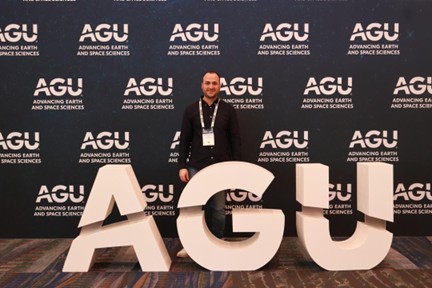
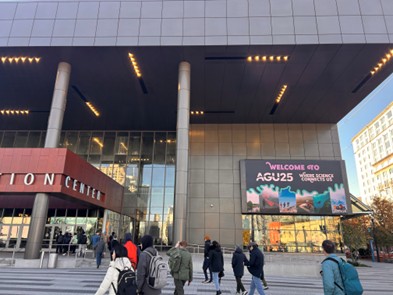
Participation in leading international scientific conferences is an important element of IIASA’s engagement with the global research community. In December, IIASA researchers participated in the American Geophysical Union Fall Meeting 2025 (AGU25) in New Orleans, one of the world’s largest annual conferences in Earth, climate, and environmental sciences. IIASA researcher Andre Nakhavali shares some reflections and experiences from the event.
 © Andre Nakhavali
AGU25 brought together researchers working across a wide range of disciplines, including empirical and observational studies, Earth system and forest modeling, and data-intensive approaches. For IIASA researchers, the meeting provides a valuable opportunity to contribute to scientific dialogue while remaining closely connected to emerging research developments across fields.
Contribution to the scientific program
IIASA’s participation included both coordination and presentation activities. I served as convener for a session titled, Recent Developments in Empirical and Modeling Studies of Forest Ecosystems: Implications for Management and Climate Change.
The session brought together empirical and modeling perspectives on forest ecosystem dynamics, with a focus on their implications for forest management and climate change research. Convening this session provided an opportunity to facilitate interdisciplinary exchange and engage with recent methodological and data-driven advances in forest science.
 © Andre Nakhavali
Presenting IIASA research infrastructure
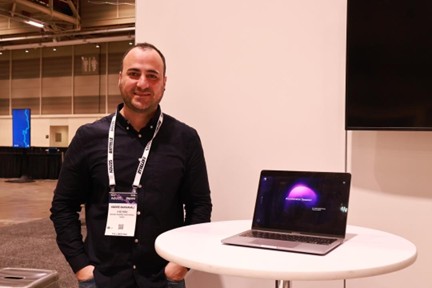
IIASA’s research infrastructure was also presented through an oral presentation under the title, IIASA-Accelerator: A High-Performance Open Science Environment.
The IIASA Accelerator brings together scalable computing, shared data/computing services, and collaborative tooling so teams can run reproducible, end-to-end scientific workflows in a consistent environment. It is designed to support data- and compute-intensive work (for example, large model ensembles and high-resolution geospatial analyses) while making methods easier to document, share, and reuse across projects and partners. This combination helps shorten the path from prototyping to robust, production-ready analyses while maintaining transparency and reproducibility.
This presentation introduced the IIASA Accelerator as an open, high-performance research environment supporting advanced modeling, large-scale data analysis, and collaborative scientific workflows. The discussion highlighted growing interest in scalable and open infrastructures that enable interdisciplinary and international research collaboration.
 © Andre Nakhavali
Broader engagement and exchange
In addition to these formal contributions, my colleagues and I attended sessions throughout the week covering topics ranging from Earth system modeling, forest and climate science, observational and satellite-based studies, to emerging data-driven methods. This broad engagement reinforced the importance of linking observations and models, addressing uncertainty, and ensuring reproducibility, which are all key themes aligned with IIASA’s systems-based research approach.
AGU25 also provided opportunities for informal exchange with researchers from universities, research institutes, and international organizations, supporting knowledge sharing and strengthening connections within the global Earth system science community.
Reflections
Overall, participation in AGU25 supported IIASA’s continued engagement with international scientific forums and contributed to ongoing dialogue on advances in climate and environmental research. For me, the conference offered a valuable combination of active contribution and broader scientific exchange, reinforcing the importance of interdisciplinary collaboration in addressing complex global challenges.
Note: This article gives the views of the author, and not the position of the Nexus blog, nor of the International Institute for Applied Systems Analysis.