
The reappearance of Budapest's “Rock of Starvation” is a visible sign of a drought months in the making. IIASA researchers have traced its progression from missing rainfall and parched soils to exceptionally low flows across the Danube basin.
For most of the year, the ominously named Ínség-szikla, or “Rock of Starvation”, lies hidden beneath the Danube in Budapest. But when the river falls far enough, the rock breaks the surface.
This August, it has appeared again.
Historically, the rock's appearance was a warning that low water could bring poor harvests, food shortages and hunger. Today, it is a striking marker of how far the water level in the Danube has fallen.
Using more than three decades of climate and hydrological data, IIASA researchers Peter Burek and Emilio Politti have examined just how exceptional this year's conditions have become. The story began long before the rock appeared above the water.
First, the rain didn't come – but the heat did
The drought began taking shape in spring.
Across much of the Danube basin, rainfall between April and July 2026 was far below the 1990–2025 average. The region has experienced similarly dry years before, including 2003, 2007, and 2022. What stands out in 2026 is how early the dry conditions began.
Then came the heat.
June brought substantially more days above 30°C across large parts of the basin. Combined with low rainfall, the heat intensified the developing drought. The heat is also part of a longer-term pattern: records from 1990 to 2026 show a clear warming trend across the basin.
For a river system as large as the Danube, however, what happens in the atmosphere is not immediately evident in the river. The effects first work their way through the landscape.
Then the soil began to dry
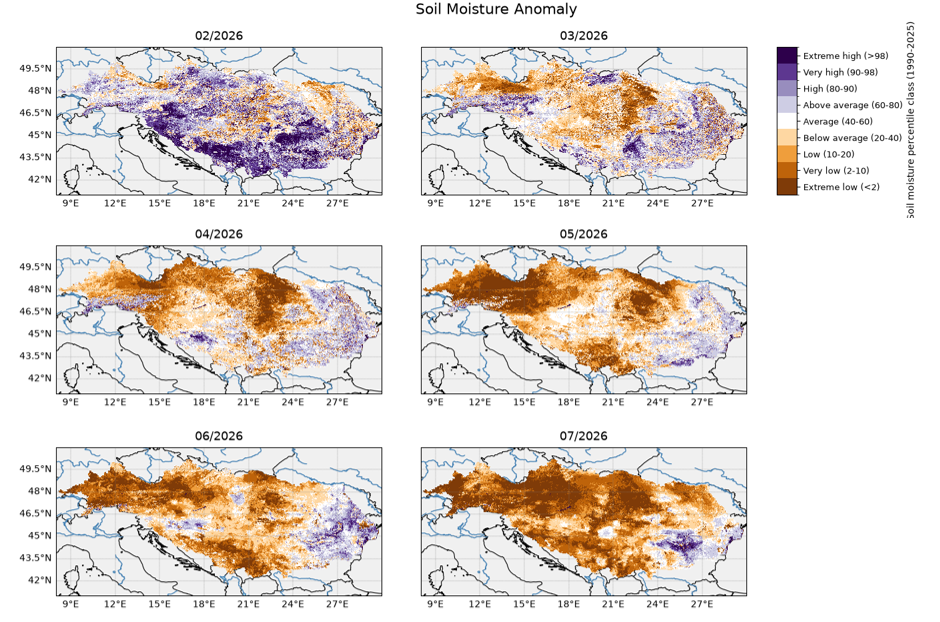
February had actually been relatively wet, but by March, soil moisture was falling.
Using the IIASA Community Water Model (CWatM), researchers followed moisture levels in the top 30 cm of soil, where many plants draw their water. As spring turned to summer, the deficit grew.
By July, extreme soil-water shortages covered most of the Danube basin, and as soils lose moisture, drought begins to affect agriculture. Crops become stressed, yields can fall, and pastures dry out. Austria, Czechia, and Hungary have been particularly affected by water stress and reduced agricultural yields.
Across the basin, 2026 is one of the driest years for soil moisture in the IIASA analysis going back to 1990, surpassed only by 2003. But in Austria, Czechia, and Hungary, July soil-moisture conditions were even more severe this year than in July 2003.
And the drought was still moving.
 © .
© .
Fig 1: Soil moisture anomaly - February to July 2026, average monthly soil moisture compared to 1990-2025 (based on CWatM, ERA5 Land calculation)
Eventually, the drought reached the river
Rivers eventually show what has been happening across the landscape. As rainfall dwindles and soils dry out, less water reaches streams, groundwater and, ultimately, the Danube.
By July, the effects were unmistakable.
IIASA modeling shows exceptionally low minimum flows across the Danube and most of its tributaries in July 2026. Across the basin as a whole, the July low-flow situation was the most extreme in the researchers' calculations going back to 1990, surpassing even the major hydrological drought of 2003.
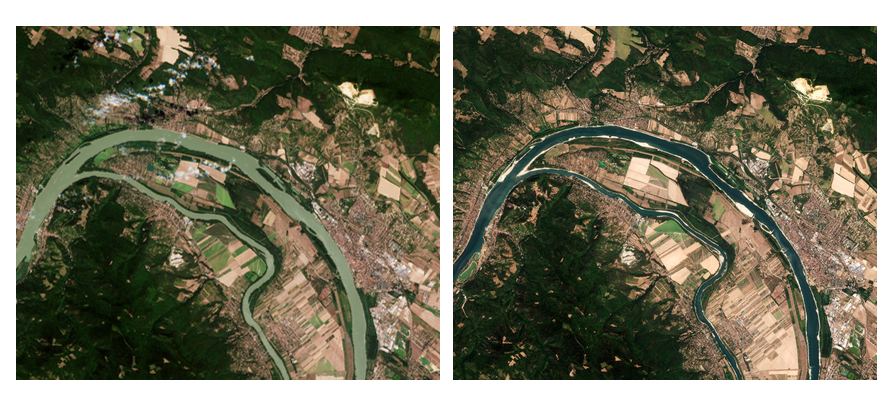
Satellite images taken just one year apart by Copernicus’ Sentinel 2 in August, make the change visible from space, showing the river retreating as water levels fell.
 © ESA
© ESA
Fig 2: Copernicus Sentinel-2 images show a stretch of the Danube River about 45 km north of Budapest, with the Danube River on the left on 4 August 2025 and on the right on 9 August 2026 at a lower water level (Contains modified Copernicus Sentinel data (2025/26), processed by ESA, licensed under CC BY-SA 3.0 IGO)
For the more than 80 million people living in the Danube basin, falling river levels have consequences far beyond the riverbank. The river sustains agriculture and ecosystems, supports industry and energy production, and provides one of Europe's most important transport routes.
Those consequences are already being felt: energy and water shortages, disruption to cruise and freight shipping, and the shutdown of a nuclear power plant. Aquatic ecosystems are also under pressure, as warmer water holds less oxygen.
From physical drought to impacts on society
The Rock of Starvation recalls a time when low water and poor harvests could translate directly into hunger. Modern societies are far better equipped to cope with drought, but how severe its consequences become still depends on the choices they make – from allocating scarce water to preparing agriculture, energy, and transport systems for prolonged dry conditions.
While the drought is already affecting society and the economy, a severe physical drought does not inevitably have to become a severe socioeconomic one. How serious the consequences become also depends on how societies respond. As the IIASA analysis concludes, it is “a matter of policy, not climate alone.”
That distinction is becoming increasingly important. IIASA climate projections indicate that dry periods could become more frequent in the future, and understanding how drought moves from sky, to soil, to river can help decision makers recognize risks before the most visible warning signs appear.
IIASA researchers are combining ERA5-Land meteorological data from the Copernicus Climate Change Service with the IIASA Community Water Model (CWatM), calibrated for the Danube basin. This allows them to track how changes in temperature and precipitation translate into changes in soil moisture, runoff, and river discharge.
The team plans to update the analysis in September with results covering August.
Note: This article gives the view of the author, and not the position of the IIASA Insights blog, nor of the International Institute for Applied Systems Analysis.