


As climate change intensifies, heat stress is becoming a growing threat to Austria’s health, wellbeing, and essential services. Care and construction workers — critical for elderly care, housing, and climate adaptation — are among the most exposed and vulnerable. This project explores how rising heat impacts these sectors and identifies pathways to protect workers while securing sustainable service provision in a warming Austria.
Austria Faces Rising Heat Stress in Essential Sectors
Austria faces growing health and wellbeing risks from heat stress as climate change intensifies, with severe implications for labor in care and construction. These sectors are critical for the provision of essential services like mobile long-term care (LTC) and housing, also given increasing demands for climate-proofing buildings and addressing the needs of an aging population. However, the very workforce tasked with addressing these needs is particularly exposed to heat stress and is itself highly vulnerable. This highlights the urgency of addressing heat stress in ways that can improve workers’ wellbeing and support the equitable and sustainable provision of essential services in the care and housing sectors.
Key objectives and methodology of Transform-Labor
The project operationalizes transformative adaptation using the provisioning systems perspective in the context of Austria’s construction and long-term care sector. Both sectors are characterized by gendered divisions of labor, physically demanding working conditions, labor shortages, and high levels of heat exposure. Thereby, Transform-Labor compares a female-dominated (mobile long-term care) and male-dominated (construction) sector to understand and address differential vulnerability.
In collaboration with the Chamber of Labor and the Construction and Woodworkers’ Union, BOKU University, the Austrian National Public Health Institute (Gesundheit Österreich GmbH, GÖG), and the University of Leeds, Transform-Labor aims to: i) develop a provisioning systems framework for transformative adaptation with a focus on labor, ii) elicit root causes of workers’ vulnerability to heat stress (i.e. structural factors like labor conditions, gender relations, institutional dynamics), iii) develop holistic indicators on transformative adaptation effectiveness, and iv) co-develop transformative adaptation policy options to secure workers’ wellbeing and sustainable provision of essential services. Transform-Labor specifically looks at
To this end, the project employs the following methodology:
- WP2 creates an integrated framework combining adaptation and provisioning systems scholarship, identifying structural drivers of vulnerability.
- WP3 and WP4 analyze institutional dynamics, develop indicators, and involve stakeholders via interviews, focus groups, and workshops.
- WP5 employs framework analysis and qualitative systems mapping for synthesis across case studies.
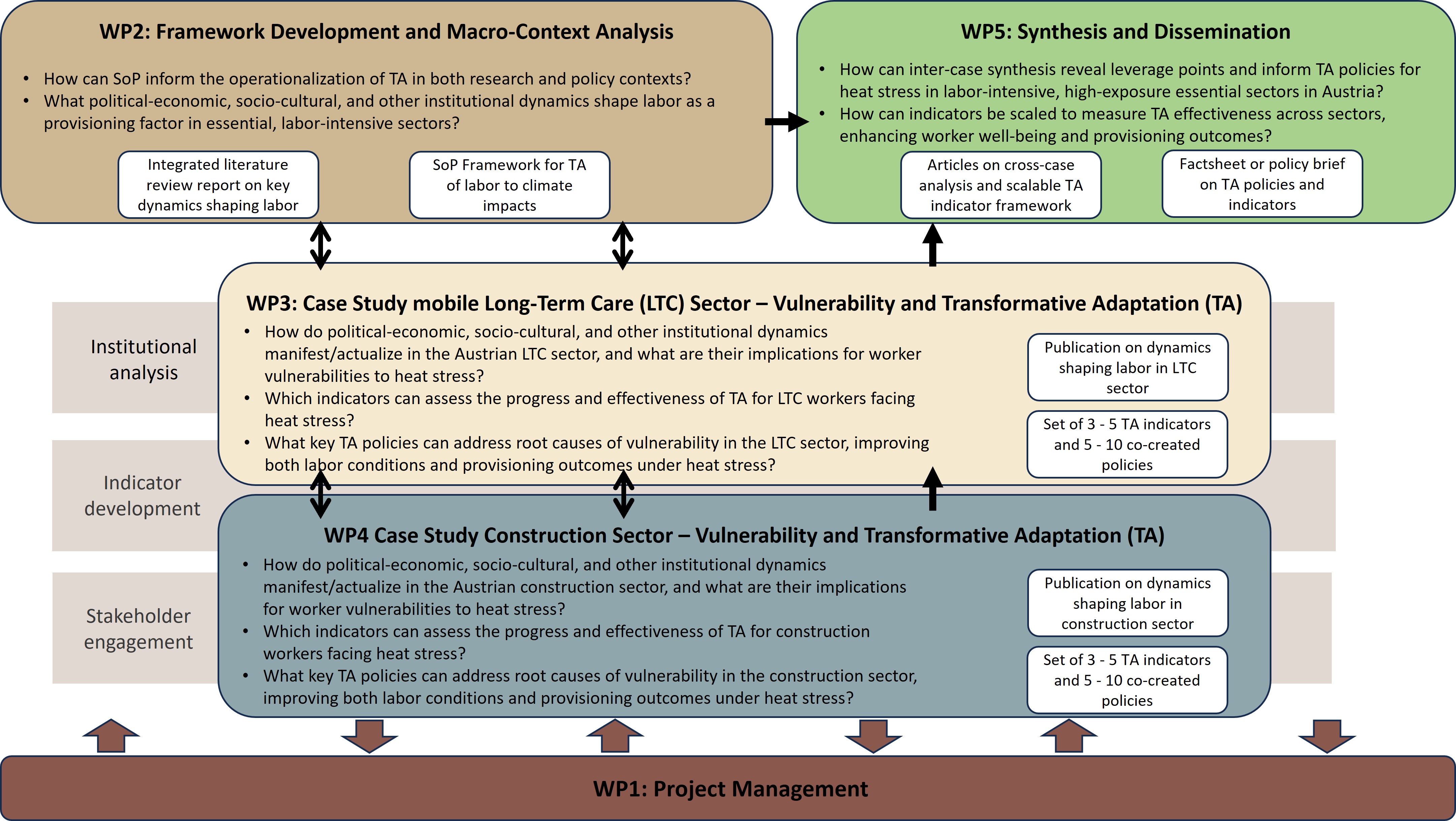 © Transform-Labor
Thereby, Transform-Labor provides important insights and benefits in terms of advancing transformative climate adaptation in the context of labor for stakeholders in academia, politics, administration, trade unions and civil society and aligns with key priorities outlined in the Austrian National Adaptation Strategy (2024), APCC (2023), and the IPCC (2022).
IIASA's Key Roles
| Area | IIASA's Role |
| Project Management | Consortium leader, overall coordination, reporting, communication |
| Conceptual Framework | Lead literature review, develop and refine SoP-TA framework (WP2) |
| Synthesis & Dissemination | Lead synthesis of findings, produce outputs for science, policy, and practice (WP5) |
| Stakeholder Engagement | Coordinate meetings, workshops, and ongoing stakeholder exchanges (WPs 3 & 4) |
| Institutional Analysis | Conduct interviews, document reviews, qualitative systems mapping, indicator development |
| Infrastructure | Provide office and meeting space for project activities |
Consortium Structure and Partner Roles
- University of Leeds leads the conceptual analysis and framework development.
- BOKU-SEC conducts empirical analysis and stakeholder engagement in the construction sector.
- GÖG conducts empirical analysis and stakeholder engagement in the long-term care sector.
 © FFG
© FFG
This project has received funding from the Climate and Energy Fund, represented by the Austrian Research Promotion Agency (FFG) under grant agreement 58343600.