



ADEPT project focuses on optimizing the supply chain for e-fuels in three biggest aviation markets US, EU and China by evaluating the impact of ecosystem, techno-economic, and policy factors. The goal is to minimize the overall supply chain costs of e-fuels while ensuring scalability and sustainability.
The aviation industry remains one of the most challenging sectors to decarbonize, primarily due to long aircraft lifespans and the lack of viable low-carbon alternatives to high-density liquid fuels. However, significant advancements have been made in developing sustainable aviation fuels (SAF) with low or even zero emissions, such as advanced biofuels and electrofuels (e-fuels) derived from renewable electricity and captured carbon dioxide (CO₂).
While e-fuels offer a lower land footprint compared to biofuels, their production requires capital-intensive processes like Direct Air Capture (DAC) and electrolysis, as well as access to vast amounts of affordable, carbon-neutral electricity and water.
ADEPT Project (1 January 2020 – 31 December 2020)
ADEPT2 builds upon the foundation laid by the original ADEPT project — a collaborative effort between the International Institute for Applied Systems Analysis (IIASA) and the Environmental Defense Fund (EDF) to estimate the potentials of aviation fuel (i.e., e-fuel) production in Europe and the U.S. via direct-air capture (DAC). EDF modeled the electricity potential in North America to produce Hydrogen with renewable energies, which results have been used for the techno-economic analysis carried out by IIASA. With the input from EDF on the production cost of technologies and the renewable electricity availability in the U.S., IIASA modeled and estimated the potential of e-fuel production in Europe and the U.S. under sustainable and economic conditions.
The project findings indicate inter alia that the potentials of e-fuels for Europe and the U.S. very much depend on the availability and price of both water and electricity, both parameters with high uncertainties. Europe results indicate a stronger reliance on desalination plants due to limited freshwater, while the U.S. may benefit from relative high groundwater potential.
Finally, the cost of e-fuel can fluctuate between 20 to 45 US$/GJ in 2050 depending on the rate of development assumed for the respective technology, which in turn is dependent on policy measures applied, such as the cost of CO2.
Document
Results from the IIASA-EDF study on Direct Air Capture to Fuel ADEPT - Assessing DAC Fuel Potentials
The ADEPT II research assesses the role of three key factors in the production of DAC-based e-fuels in China.
(a) ecosystem resource availability (renewable energy and water availability),
(b) techno-economics of various technology scales and transportation networks (transportation network expansion, technology scale-up, and energy prices), and
(c) policy measures such as carbon tax and fossil fuel pricing.
This work estimates the projected cost of DAC and green hydrogen-based e-fuel. The objective is to minimize the overall supply chain cost of e-fuels which is the summation of feedstock cost, operational and capital cost of different technologies, and transportation cost. Different scenarios are modelled and are shown to evaluate the impact of these factors comprehensively.
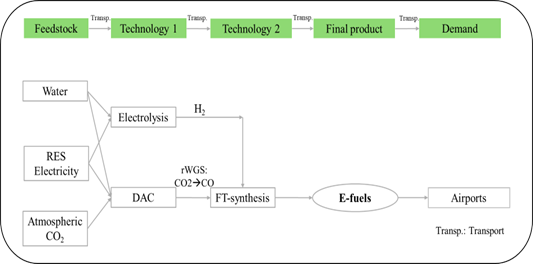
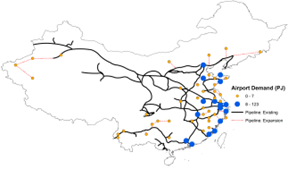
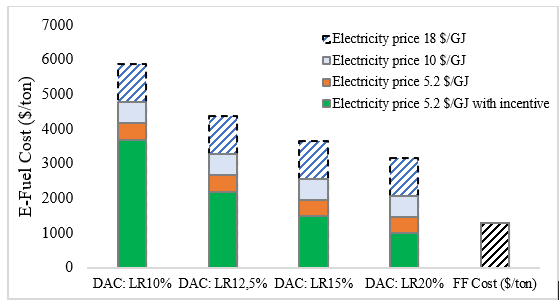
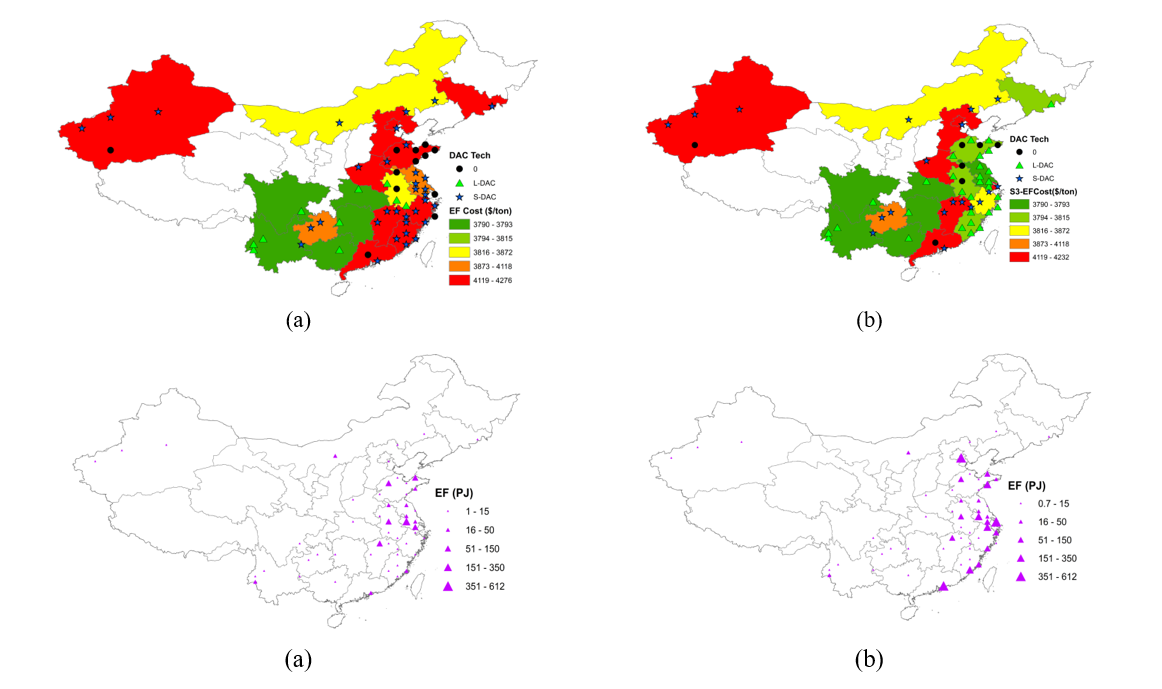
The comprehensive e-fuel production supply chain framework is highlighted in Fig. 1. This study specifically analyzes the techno-economic feasibility of constructing new CO₂ transportation pipelines and retrofitting existing oil and gas infrastructure (Fig. 2). Results show that the energy cost is the driving factor to reduce the e-fuel cost (Fig. 3). With low electricity prices (~5 $/GJ), DAC costs (80-50 $/ton), and electrolyzer costs (5-3 $/GJ), e-fuels could reach competitive prices of ~1300-1000 $/ton (Fig. 4). China can produce 34 billion gallons of e-fuels (84% of demand) requiring 3457 TWh of renewable electricity and 597 billion liters of water (~238,000 Olympic swimming pools). While transportation costs contribute only 4% to the overall levelized e-fuel cost, it plays a crucial role in determining the optimal placement of DAC facilities and scaling up e-fuel production in China (Fig.5). This study has been published in Energy Conversion and Management (Elsevier, 2025): “Fuel from Air: A technoeconomic assessment of e-fuels for China’s aviation sector” (Tiwari et al., 2025).
 © IIASA
Fig.1. Model structure of e-fuel production supply chain
Figure 1 Model structure of e-fuel production supply chain
 © IIASA
Fig. 2 Potential CO2 transportation pipeline network
| Figure 2 Potential CO2 transportation pipeline network |
 © Shubham Tiwari | IIASA
Fig. 3 E-fuel levelized cost breakdown using solid DACs and alkaline electrolysers
(Assumptions: high FF price factor; extreme carbon tax, desalination allowed, medium DAC cost (LR12.5%), RES-2, PPL-2 and electricity price reduction-1% annually).
Figure 3 E-fuel levelized cost breakdown using solid DACs and alkaline electrolysers (Assumptions: high FF price factor; extreme carbon tax, desalination allowed, medium DAC cost (LR12.5%), RES-2, PPL-2 and electricity price reduction-1% annually).
 © Shubham Tiwari | IIASA
Fig.4 Potential cost of e-fuels over 2050 due to DAC learning rates and energy prices
Figure 4 Potential cost of e-fuels over 2050 due to DAC learning rates and energy prices
 © Shubham Tiwari | IIASA
Fig. 5 Spatial distribution of DACs and e-fuel production under (a) without desalination (b) with desalination (Assumptions: high FF price factor; extreme carbon tax, med DAC cost (LR12.5%), RES-2, PPL-2 and electricity price reduction-1% annually)
Figure 5 Spatial distribution of DACs and e-fuel production under (a) without desalination (b) with desalination (Assumptions: high FF price factor; extreme carbon tax, med DAC cost (LR12.5%), RES-2, PPL-2 and electricity price reduction-1% annually)
Publications
Tiwari, S. , Patrizio, P., Leduc, S., Stratton, A., & Kraxner, F. (2025). Fuel from air: A techno-economic assessment of e-fuels for low-carbon aviation in China. Energy Conversion and Management 333 e119796. 10.1016/j.enconman.2025.119796.