

The 2C-RISK project explores the complex relationship between climate change and human mobility, focusing on how interconnected risks—both climatic and non-climatic—affect people’s decisions to migrate or remain immobile. By combining innovative data sources and advanced methodologies, this project aims to uncover the hidden dynamics behind climate-induced migration and immobility, offering valuable insights to inform policies that protect vulnerable populations in a rapidly changing world.
Climate change is increasingly affecting global populations through extreme weather events, rising sea levels, and ecosystem degradation, impacting human mobility by influencing livelihoods, security, and well-being. While climate-related risks can drive migration and displacement, they can also lead to immobility, trapping vulnerable populations in high-risk environments. Mobility outcomes are shaped by multiple interacting factors, yet current research lacks a comprehensive understanding of how compound and cascading risks jointly influence mobility and immobility over time and space.
Background and innovative contribution of the 2C-RISK project
The 2C-RISK project addresses critical gaps in understanding climate-related (im)mobility by examining when, how, and why households move—or remain immobile—under climatic and non-climatic stressors. Unlike previous research, which often isolates environmental factors, this project takes a comprehensive approach by integrating underrecognized risks, co-stressors, and insecurities. Its innovative contributions include high-resolution data integration, the use of digital trace data, the first global assessment of immobile populations, and novel modeling techniques for nowcasting and projecting climate-driven mobility. By bridging these knowledge gaps, 2C-RISK will provide valuable insights for policy-making and resilience-building in vulnerable communities.
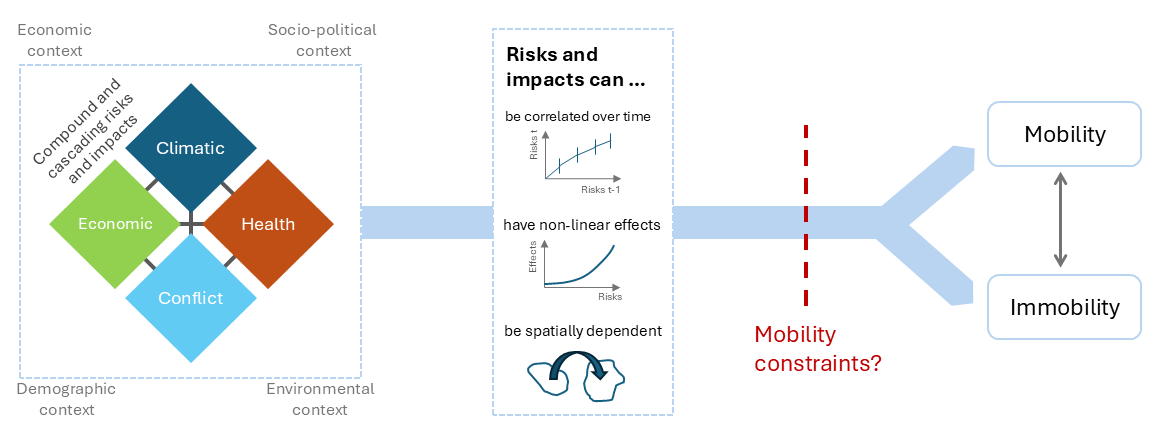 © IIASA
Conceptual framework illustrating the links between different compound risks and related impacts within local economic, socio-political, demographic, and environmental contexts and their role in shaping (im)mobility.
Project Goals
- Analyzing the impact of climate risks on mobility
- Understanding the role of compound and cascading risk factors
- Exploring and quantifying immobility worldwide
- Exploring regional and socioeconomic variations
- Develop future projections and nowcasting mobility in high-risk situations
Methodological Approach
The 2C-RISK project employs a multi-scale analysis, integrating longitudinal data across various levels to examine how compound and cascading risks influence mobility and immobility. It develops novel empirical estimates, leverages advanced data sources to quantify immobility, analyzes regional and demographic differences to identify vulnerable groups, and utilizes traditional and digital trace data to enhance predictive modeling. By addressing critical knowledge gaps, the project aims to improve our understanding of climate-related (im)mobility and inform policies that enhance resilience in affected communities.
The 2C-RISK project consists of four complementary work packages that examine climate-related (im)mobility and the role of compounding and cascading risks. It integrates macro-level analyses to compare regional and population-specific impacts and micro-level analyses to explore individual mobility decisions in local contexts. Differential vulnerabilities and impacts are a cross-cutting theme, ensuring a comprehensive understanding of mobility dynamics across diverse settings.
Related Publications
Hoffmann, R., Andriano, L., Striessnig, E., Rüttenauer, T., Borderon, M. , & Grace, K. (2024). Climate change and population: Demographic perspectives on the 21st century’s defining challenge. Vienna Yearbook of Population Research 22 1-22. 10.1553/p-nfjc-z82h.
Hoffmann, R. (2024). Climate Change, Adaptation, and Migration. In: Routledge Handbook of Climate Change and Society. Eds. Brechin, S. & Lee, S., London: Routledge. ISBN 9781003291206 10.4324/9781003291206.
Hoffmann, R., Abel, G. , Malpede, M., Muttarak, R. , & Percoco, M. (2024). Drought and aridity influence internal migration worldwide. Nature Climate Change 14 1245-1253. 10.1038/s41558-024-02165-1.
Marginean, I., Crespo Cuaresma, J., Hoffmann, R., Muttarak, R. , Gao, J., & Daloz, A.S. (2024). High‐Resolution Modeling and Projecting Local Dynamics of Differential Vulnerability to Urban Heat Stress. Earth's Future 12 (10) e2024EF004431. 10.1029/2024EF004431.
Hoffmann, R., Wiederkehr, C., Dimitrova, A., & Hermans, K. (2022). Agricultural livelihoods, adaptation, and environmental migration in sub-Saharan drylands: a meta-analytical review. Environmental Research Letters 17 (8) 083003. 10.1088/1748-9326/ac7d65.
Hoffmann, R., Dimitrova, A., Muttarak, R. , Crespo Cuaresma, J., & Peisker, J. (2020). A meta-analysis of country-level studies on environmental change and migration. Nature Climate Change 10 (9) 904-912. 10.1038/s41558-020-0898-6.
 © ERC-EU
This project has received funding from the European Union’s Horizon 2020 research and innovation program under grant agreement No 101162653. Project Name: Climate Change and Human (Im)Mobility: The Role of Compound and Cascading Risks.
News

16 May 2025
Roman Hoffmann honored with awards and Academy membership
IIASA researcher Roman Hoffmann has been honored with two prestigious awards and elected as a member of the Young Academy of the Austrian Academy of Sciences, recognizing his contributions to climate change research and environmental social sciences.