
The Task Force’s main focus is to combine information produced by the various scientific working groups of the LRTAP Convention and through computer models assist in the development of legal instruments.
The Task Force on Integrated Assessment Modelling (TFIAM) was established by the Executive Body of the Convention on Long-range Transboundary Air Pollution at its fourth session in 1986. In the following years integrated assessment models were developed that provided the basis for negotiation of the 1994 Oslo Protocol and the Gothenburg Protocol in 1999. The Task Force is co-chaired by France and Sweden.
The Task Force’s main focus is to combine information gathered from the Parties and from other Convention bodies and through computer models assist in the development of legal instruments (protocols).
This web site provides access to the documents and presentations of the meetings of the Task Force.
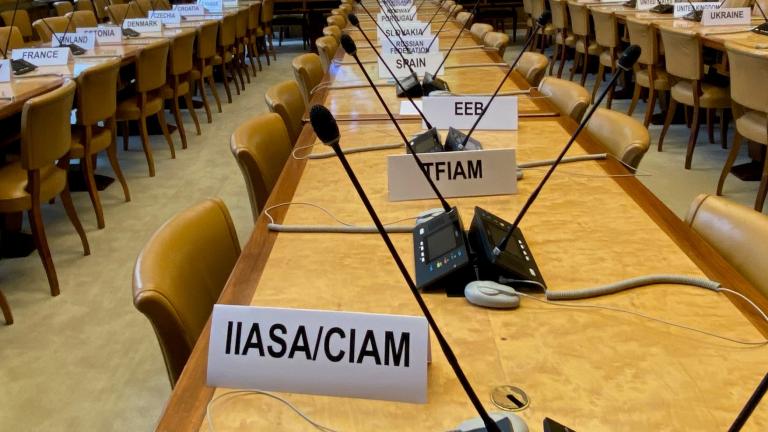
Centre for Integrated Assessment Modelling (CIAM)
Since 1999 IIASA has been hosting the Centre for Integrated Assessment Modelling (CIAM), one of the four centres assigned for the European Monitoring and Evaluation Programme (EMEP) of the Convention on Long-range Transboundary Air Pollution. Read more
Reports, Presentations and Data related to the Gothenburg Protocol Revision
At its 61st meeting (Geneva, 4-6 September 2023), the Working Group on Strategies and Review requested a policy brief on the potential implications of introducing collective risk-based targets for the UNECE region to address air pollution impacts on health and ecosystems. Such a document has been jointly prepared by the Task Force on Integrated Assessment Modelling and the Centre for Integrated Assessment Modelling (CIAM). An overview of the comments received on an early draft, the latest revised version (18 May 2025) of the policy brief, and country emissions and costs by GNFR sector for selected scenarios are available below:
- Draft guidance document on non-technical measures
- Overview of comments on earlier version of the Policy Brief
- Policy brief on potential targets to reduce risks for health and ecosystems
- EPCAC position paper on clean air in cities (27 November 2024)
- Available scenarios (descriptions & allocation to download groups)
- CIAM/TFIAM note on the comparability of emission scenarios (10 October 2025)
| Group | Files for download | Date |
|---|---|---|
| Country emission and cost totals and summaries by GNFR sector | 3 Feb / 18 June 2025 | |
| Set 1 | Country emissions by GNFR sector | 3 February 2025 |
| Country costs by GNFR sector | 18 June 2025 | |
|
|
|
|
| Country emission and cost totals and summaries by GNFR sector | 18 June 2025 | |
| Set 2 | Country emissions by GNFR sector | 18 June 2025 |
| Country costs by GNFR sector | 18 June 2025 | |
|
|
|
|
| Country emission and cost totals and summaries by GNFR sector | 5 November 2025 (MTFR updated) | |
| v6b | Country emissions by GNFR sector | 5 November 2025 (MTFR updated) |
| Country costs by GNFR sector | 5 November 2025 (MTFR updated) | |
|
|
|
|
| Country emission and cost totals and summaries by GNFR sector | 28 September 2026 | |
| v7a | Country emissions by GNFR sector | 28 September 2026 |
| Country costs by GNFR sector | 28 September 2026 |
Forthcoming Meetings
None announced.
Past Meetings
6th EPCAC-meeting, 18 to 19 November 2025, held online.
The 6th meeting of the Expert Panel on Clean Air in Cities (EPCAC) focused on discussing experiences in cities to improve their air quality and on how to comply with the EU ambient air quality directive (AAQD).