
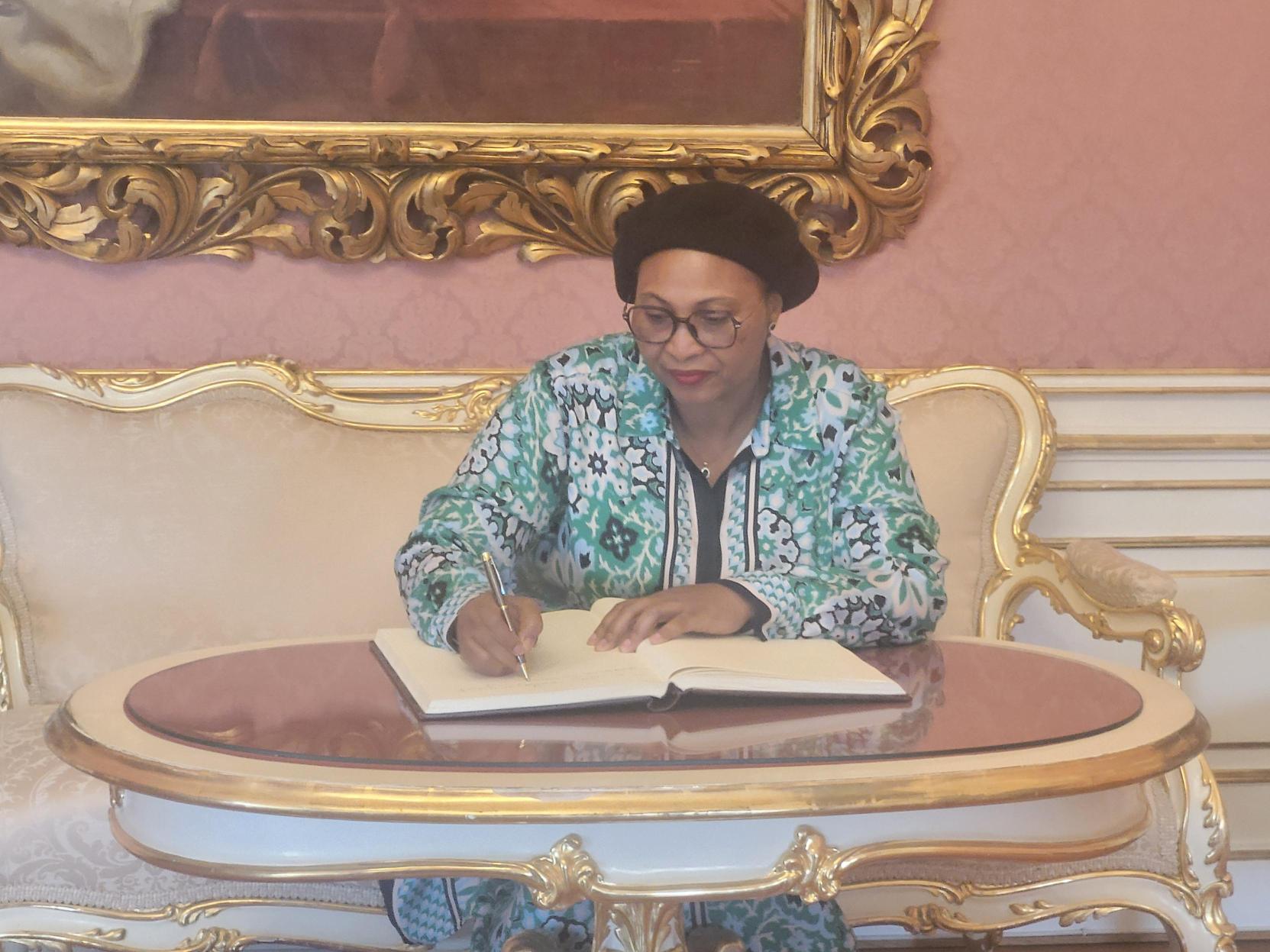
Last week, IIASA welcomed H.E. Maimounata Ouattara, Ambassador Extraordinary and Plenipotentiary, Permanent Representative of Burkina Faso to the United Nations, for a visit that reinforced a shared commitment to advancing systems analysis for sustainable development across Sub-Saharan Africa.
The visit, hosted by IIASA Deputy Director General, Karen Lips, provided an opportunity to strengthen dialogue on collaboration between the Institute and Burkina Faso under the framework of IIASA’s Sub-Saharan Africa Regional Member Organization (SSARMO).
Ambassador Ouattara met with IIASA researchers to discuss ongoing projects that address interconnected challenges such as climate change, food and water security, and health system resilience. Presentations by Health, Aging, and Health Systems Research Group Leader, Josephine Borghi, and Felicity Addo, a Research Scholar in the Institute’s Integrated Biosphere Futures Research Group, showcased IIASA’s interdisciplinary research, including the REACH project, which investigates how climate extremes affect maternal and child health systems in Zambia and Brazil, and new modeling approaches to strengthen food security under changing climate conditions using the IIASA Global Biosphere Management Model (GLOBIOM).
A key focus of the visit was the role of SSARMO in supporting regional scientific cooperation. Established in 2021, SSARMO enables 18 Sub-Saharan African countries – including Burkina Faso – to participate collectively in IIASA’s membership structure. The organization was developed to strengthen the ability of national science systems to collaborate on shared development challenges and to foster the use of systems analysis in policy and decision making. Through SSARMO, IIASA works closely with partners across the region to advance joint research, capacity building, and science-policy dialogue in areas such as climate adaptation, sustainable land use, and renewable energy transitions.
Speaking during the visit, Lips highlighted the importance of such engagements for deepening science-policy cooperation:
“We are honored to host Ambassador Ouattara and explore opportunities to expand our collaboration with Burkina Faso. IIASA and our partners in the Sub-Saharan Africa Regional Member Organization share a vision of co-developing knowledge and tools that support sustainable, inclusive, and evidence-informed policymaking. Through joint research and capacity building, we aim to work with African countries to design resilient pathways toward achieving the Sustainable Development Goals.”
During the discussions, Ambassador Ouattara shared insights on Burkina Faso’s current priorities, noting the country’s goal of becoming self-sufficient in food production. She highlighted that Burkina Faso achieved self-sufficiency in grains last year and expects to do so for rice in the coming year. However, she also emphasized the ongoing challenges posed by droughts across West Africa, which continue to threaten agricultural productivity and rural livelihoods. She noted that food security must be viewed through a systems lens, where agriculture, health, water, and political stability are interlinked and that evidence-based approaches, such as those developed by IIASA, can help inform holistic food systems policies with regional and global impact.
Looking ahead, the Ambassador highlighted the importance of aligning research and collaboration with broader continental frameworks, such as the African Union’s Agenda 2063, and suggested exploring opportunities for IIASA to engage strategically at the African level, highlighting that a regional and participatory approach to policymaking could facilitate impactful, sustainable outcomes across Africa.
The visit concluded with discussions on future areas of cooperation, marking another step in the growing partnership between Burkina Faso and IIASA to advance science-based decision-making for sustainable development.
Find out more about IIASA’s work with SSARMO
https://iiasa.ac.at/members/ssarmo
 © IIASA
H.E. Maimounata Ouattara signing the IIASA guestbook during her visit to IIASA
News
18 May 2026
African Human Capital Data Sheet 2026
The African Human Capital Data Sheet 2026: Past Trends, Skills, and Future Pathways presents new evidence on population trends by level of education, skills, and demographic transitions across the African continent.