

IIASA researcher Ali Kharrazi contributed to the Expert Group Meeting on Food System Risk Assessment at the United Nations Economic and Social Commission for Asia and the Pacific (UNESCAP) and the World Food Program (WFP).
Bangkok, 18-19 September 2023
Ali Kharrazi, a senior research scholar at the Advancing Systems Analysis program (ASA/SYRR), was a panelist and moderator during the recent Expert Group Meeting on "Strengthening Food System Risk Assessment: INFER and Its Application." This meeting of experts conducted on September 18 and 19, 2023, both in Bangkok and online, convened experts specializing in food system monitoring, analysis, policymaking, and risk assessment. Hosted by UNESCAP and the WFP Regional Bureau for Asia and the Pacific, the event generated wide-ranging discussion on the future of food system risk assessment.
The focus of the event was the comprehensive assessment framework and index, INFER (INsights on Food SystEm Risks), co-developed by Ali Kharrazi as part of the core team members at UNESCAP and WFP. INFER provides critical insights into multidimensional risks influencing three key food system outcomes: human health and nutrition, ecosystem health and sustainability, and shared prosperity. It enables stakeholders to monitor risk trends and their drivers across nations and through time, supporting effective food system monitoring and building resilience.
As this framework garners interest from various governments, some of which were represented at the meeting, active participation is crucial to ensure the sustainability and continued development of this effort. Ideally, this would also secure a more pronounced role for IIASA in this collaborative endeavor among multiple agencies.
Ali Kharrazi facilitated in-depth discussions on vital aspects of food system risk assessment, focusing on data validation, language accessibility, policy relevance, and capacity building. He also ensured a productive interchange of ideas and insights among participants. The objectives were to share insights, tools, and methodologies related to food system risk assessment and to solicit constructive feedback on the INFER framework.
Participants included experts from various United Nations agencies, including UNEP, UNDP, UNFCCC, UNESCAP, WFP, UNITAR, UNEP-WCMC, and as well as professionals specializing in food system monitoring and analysis. Their collective expertise and perspectives contributed to a rich and informative discussion, ultimately advancing the field of food system risk assessment.
IIASA's significant contribution and ongoing commitment to the development of the INFER model have accentuated the importance of advancing food system risk assessment for a more resilient and sustainable future.
For more information on the INFER model and its applications, interested parties can visit: https://unescap.org/projects/infer/
 © IIASA
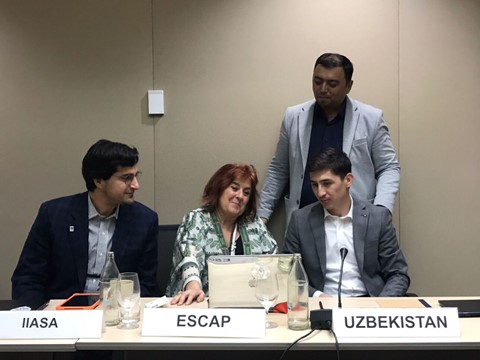
Participants in the Expert Group Meeting on "Strengthening Food System Risk Assessment: INFER and Its Application."
 © IIASA
Ali Karrazi moderating a session at the Expert Group Meeting on "Strengthening Food System Risk Assessment: INFER and Its Application."
 © IIASA
Discussion during the Expert Group Meeting.
News

23 September 2026
IIASA researchers strengthen cooperation with Kyrgyzstan on AI and industrial development
IIASA Cooperation and Transformative Governance (CAT) Research Group Leader and Senior Research Scholar Nadejda Komendantova and CAT Research Scholar Dmitry Erokhin have contributed to a series of scientific and policy forums in Kyrgyzstan in 2026. Their research on artificial intelligence in the production sector builds on IIASA’s longstanding cooperation with the country on sustainable industrial development.

14 September 2026
IIASA's CAT Group Co-Chairs Key Resilience Track at International Conference on Resilient Systems 2026
Nadejda Komendantova, Research Group Leader of the Cooperation and Transformative Governance (CAT) Group at IIASA, co-chaired a landmark track at the International Conference on Resilient Systems 2026 at the Delft University of Technology, titled "Complex Adaptive Social Systems and Natural Hazard Resilience: Application, Methods, and Future Directions." This event served as key dissemination of results from IIASA's contributions to the PARATUS project, showcasing advanced systems analysis for disaster resilience.

14 September 2026
IIASA researcher Nadya Komendantova contributes to UN STI Forum 2026 side event on digital public infrastructure for the common good
IIASA researcher Nadya Komendantova participated in a side event to the 2026 UN Forum on Science, Technology and Innovation for the SDGs, which took place at United Nations Headquarters in New York on the 7th May 2026. The event, organized by International Association for the Advancement of Innovative Approaches to Global Challenges (IAAI GloCha), focused on Global Challenges Action ID and Global Challenges Action Registry solutions for youth-led action, healthy communities, and climate-resilient development through digital public infrastructure.