


IIASA Cooperation and Transformative Governance (CAT) Research Group Leader and Senior Research Scholar Nadejda Komendantova and CAT Research Scholar Dmitry Erokhin have contributed to a series of scientific and policy forums in Kyrgyzstan in 2026. Their research on artificial intelligence in the production sector builds on IIASA’s longstanding cooperation with the country on sustainable industrial development.
Komendantova and Erokhin’s work examines how public policy can help Kyrgyzstan’s producers use AI to improve productivity, with a focus on the practical conditions for adoption. Access to reliable data, finance, technical expertise, and training is particularly important for smaller enterprises, which may struggle to develop these capabilities independently.
The researchers have brought these questions into policy discussions in Kyrgyzstan, including the Discussion Economic Club’s meeting on state support for the production sector, held on 9 June 2026. The meeting was jointly organized by the Ministry of Economy and Commerce of the Kyrgyz Republic, the National Institute for Strategic Initiatives under the President of the Kyrgyz Republic, and the Research Institute of Economics at the Kyrgyz Economic University named after M. Ryskulbekov.
In September, Komendantova and Erokhin continued to share this work through their contributions to the XI Kumskov Readings at the Kyrgyz-Russian Slavic University on 10 September and the Science Tech 2026 international conference in Bishkek on 18 September. These events provided opportunities to discuss the role of state support for AI with researchers, policymakers, businesses, and international partners working on industrial modernization and innovation.
The research shared at these events was developed with Marat Usupov, adviser to the director for international development at the Research Institute of Economics of the Kyrgyz Economic University named after M. Ryskulbekov. The study “State Support for Artificial Intelligence in the Production Sector as a Factor of Economic Growth in the Kyrgyz Republic” draws on international evidence and the characteristics of Kyrgyzstan’s economy to identify priorities for applied AI. It focuses on agriculture and irrigation, energy and electricity networks, and the textile and garment industries, examining how targeted public support could help producers test suitable technologies and assess their economic value.
The applications are closely tied to everyday production needs. Intelligent irrigation systems could help farmers manage water more efficiently, while image analysis could support the diagnosis of plant diseases. In electricity networks, AI could assist with forecasting demand and detecting faults. Textile and garment producers could use machine vision to identify defects and improve quality control. The study proposes testing these applications under local conditions, with their value assessed through changes in water use, supply interruptions, product quality, and other operational measures.
Making these technologies accessible to small and medium-sized enterprises is a central policy concern. The research considers shared services, such as quality-control facilities used by several textile producers, as a way to reduce individual costs and build sectoral expertise. It also proposes support for assessing firms’ digital capabilities, preparing data, training staff, and evaluating pilot projects. An implementation center involving universities, technology parks, and industry associations could help businesses select appropriate solutions and apply them in practice.
The analysis emphasizes that these measures require careful design. Weak data, limited institutional capacity, and insufficient training can prevent investment in AI from delivering useful results. Energy requirements and changes in employment and skills also need to be considered. The authors therefore recommend linking public support to agreed production outcomes, including lower losses and downtime, fewer defects, and more efficient resource use. Pilot projects would be evaluated before wider adoption, with continued support depending on demonstrated results.
This focus on implementation follows earlier IIASA cooperation with Kyrgyzstan on sustainable industrial development. In 2018, IIASA worked with the United Nations Industrial Development Organization (UNIDO) and the country’s State Committee for Industry, Energy and Subsoil Use on a strategic foresight initiative. Economic analysis, stakeholder interviews, and regional consultations in Bishkek, Osh, Karakol, and Jalal-Abad informed scenarios and recommendations for industrial development. The work contributed to Kyrgyzstan’s industrial development strategy for 2019–2023 and its accompanying action plan, adopted in September 2019.
The foresight study received further recognition in 2025, when it was featured in a joint report by the International Science Council and the UN Futures Lab on futures thinking in the Global South. The contributions in 2026 continue this cooperation by examining how AI can be incorporated into industrial policy and adapted to the needs and capabilities of Kyrgyz producers.
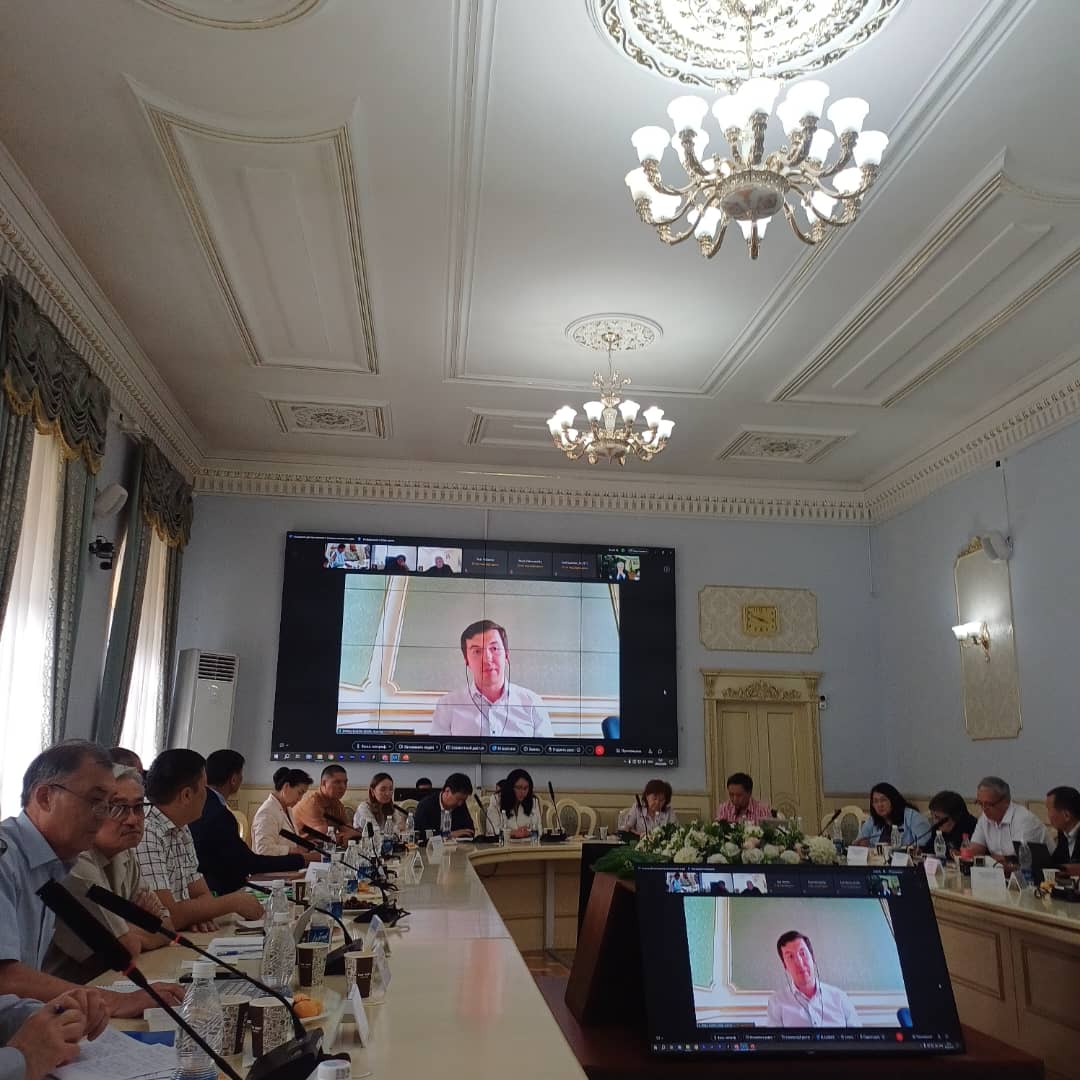 © Dmitry Erokhin | IIASA
Discussion Economic Club’s meeting on state support for the production sector, held on 9 June 2026.
News
10 September 2026
New IIASA–UNCCD report, Prospects for Carbon Farming in Greater Central Asia, launched at UNCCD COP17
The International Institute for Applied Systems Analysis (IIASA) and the United Nations Convention to Combat Desertification (UNCCD) launched a new report exploring opportunities to advance carbon farming in Greater Central Asia at a UNCCD COP17 side event in Ulaanbaatar, Mongolia.

10 February 2026
IIASA–UNCCD Workshop Explores Carbon Farming Opportunities and Constraints in Greater Central Asia
The International Institute for Applied Systems Analysis (IIASA) and the United Nations Convention to Combat Desertification (UNCCD) convened the virtual workshop “Prospects of Carbon Farming in Greater Central Asia” to examine pathways for implementing carbon farming across the region. The event brought together scientists, policymakers, and practitioners to exchange evidence, share experience, and discuss pragmatic approaches to advancing carbon farming and related land-based climate solutions.

11 November 2025
Feasibility Study on Carbon Farming Solutions in Greater Central Asia Kicks Off
The International Institute for Applied Systems Analysis (IIASA) and the United Nations Convention to Combat Desertification (UNCCD) have officially launched a "Feasibility Study on Carbon Farming Solutions in Greater Central Asia", marking a new milestone in the region’s efforts toward sustainable land management and climate-resilient development.