


How will populations around the world change over the next three centuries, and what will those changes mean for future societies? In a new study, IIASA researcher Samir KC explores how populations and human capital across 200 countries and territories could evolve in the years leading up to 2300.
The study builds on the Shared Socioeconomic Pathways (SSPs), a framework widely used to explore future socioeconomic development and its relationship with climate change. The SSPs include population and human capital projections that describe not only how many people will live in different countries, but also their age, sex, education, fertility, life expectancy, and migration patterns.
Most population projections used in climate and global-change research extend only to 2100, around the time the global population is expected to peak. In the study published in Populations, KC extends these projections to 2300, examining how population dynamics could change under the established SSP scenarios. The projections retain detailed breakdowns by age, sex, and six educational attainment categories.
“Few projections look past the peak, and those that reach 2300 were built outside the SSP framework and leave out education. In addition, a population that peaks in the late twenty-first century does not stabilize at that level,” explains KC. “Different development scenarios can lead to very different outcomes. Sea-level rise, land use, and long-lived infrastructure are studied well beyond 2100, and those models need population figures that match.”
The study examines four of the five SSP scenarios. In each of them, countries and educational groups gradually converge toward a common fertility level and life expectancy, although the fertility level differs between scenarios. SSP4 is not included because its premise of persistent inequality, both between and within countries, is inconsistent with this convergence.
Key findings
 © Samir KC | IIASA
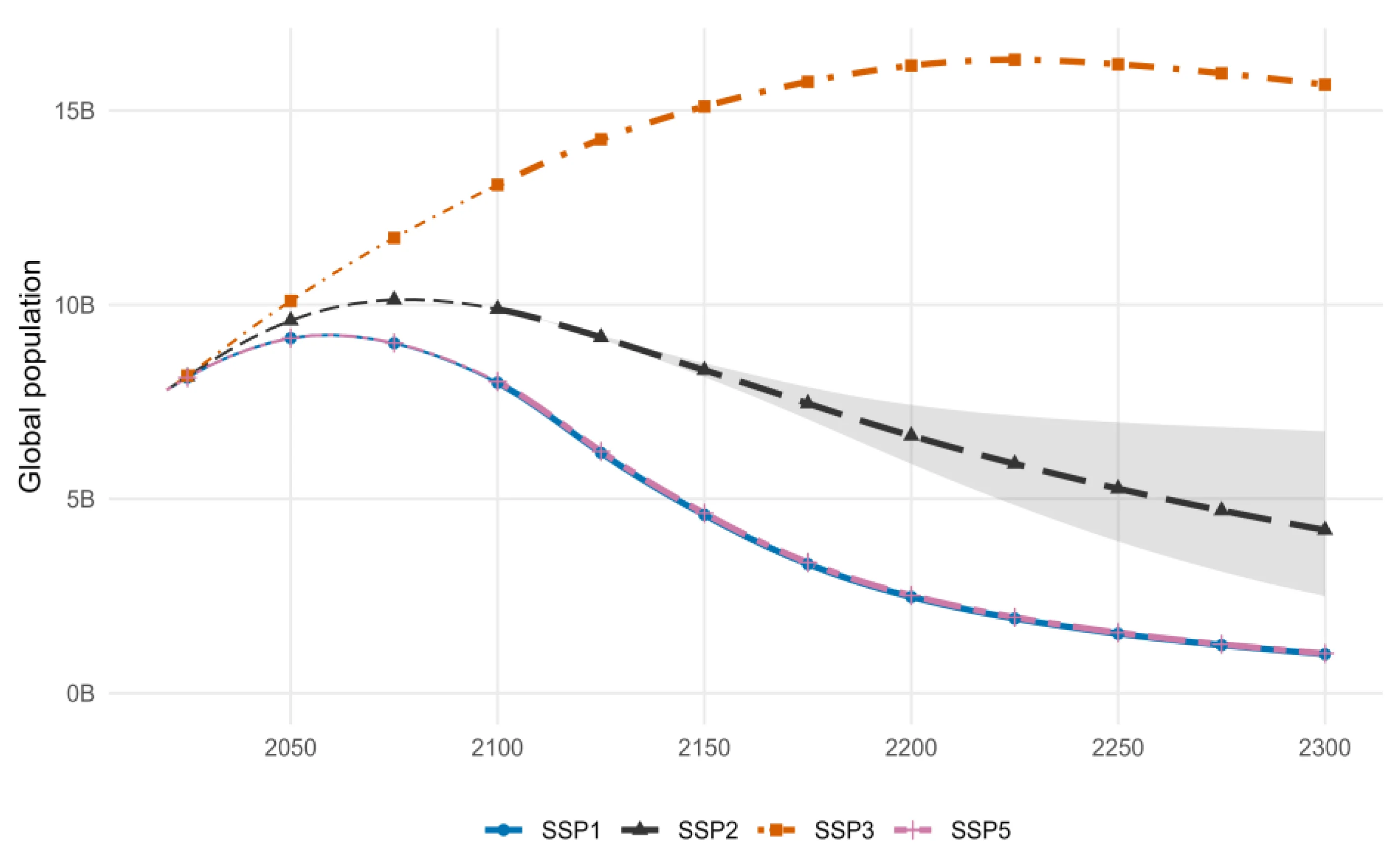
Caption: Global population trajectories, 2020–2300. The thinner segments show WIC/SSP trajectories to 2100 and the thicker segments show the extension after 2100. The shaded band around SSP2 spans the two sensitivity variants in which the long-run total fertility rate converges to 1.50 and 2.00 children per woman instead of 1.75.
Under SSP2, the central scenario commonly used as a reference in climate research, the global population declines by just 2.4% between its projected peak around 2080 and 2100. By 2300, however, it is projected to have fallen by 58% from its 2100 level, to about 4.2 billion. Twenty-three of the 200 countries, which are home to 28% of the world's population in 2100, reach their own peak only after 2100 under that scenario, and 169 countries do so under the high-fertility scenario (SSP3). Across the four scenarios, the 2300 population ranges from about 1 billion under SSP1 and SSP5 to more than 15 billion under SSP3, a 16-fold gap, compared with 1.6-fold in 2100.
Despite their contrasting development pathways, the sustainability-focused SSP1 and fossil-fueled development SSP5 scenarios produce nearly identical world population totals in the long run.
“Extending the projection horizon to 2300 reveals demographic transformations that are only beginning to unfold by 2100,” notes KC. “In the reference scenario (SSP2), almost three quarters of the change in population size between 2020 and 2300 comes after 2100, and so does about half of the rise in the share aged 80 or older and in post-secondary education. By 2300 there are more people over 80 than under 20, and nearly four in five adults hold a post-secondary qualification. People live long lives, and numbers fall gradually, by less than 0.5% annually on average after 2100, with no sudden drop. Regional differences in age structure largely disappear: Africa ages later than Europe but ends up in a similar place.”
On three of the four pathways, the findings point to a world that is smaller, older, and better educated. The high-fertility SSP3 is the exception: its population is larger in 2300 than in 2100, and post-secondary education stays at about 23% of adults.
As populations decline, societies can no longer rely on each generation being larger than the last to provide workers, caregivers, and taxpayers. At the same time, essential services and infrastructure, from elderly care to coastal defenses, water supplies, and power grids, will still need to be staffed, maintained, and financed. A healthier and better-educated population could also create new opportunities. Longer working lives, technological advances that take over some tasks, and lower overall demand for land, food, and energy could help societies adapt to demographic change. These benefits are not guaranteed, however, particularly if rising consumption per person offsets reductions in total demand.
“What matters is whether institutions adapt to a world in which they can no longer count on population growth,” KC concludes.
The pathways described above are scenarios rather than forecasts. Given the exceptionally long-time horizon and the associated the results should be interpreted as possible demographic futures rather than predictions.
Reference:
KC, S. (2026). Humanity After the Peak: Extending Shared Socioeconomic Pathway Population and Human-Capital Projections to 2300. Populations 2(4), 23. DOI: 10.3390/populations2040023
News

22 October 2026
Global agricultural productivity growth is in decline
Global agricultural productivity growth has hit its lowest level since the 1970s, threatening future food security. IIASA researchers contributed to Chapter 3 of the 2026 GAP Report published by the Global Agricultural Productivity (GAP) Initiative at Virginia Tech, exploring how regenerative agriculture could help reverse this trend while improving farm profitability and resilience.

16 October 2026
Getting back on track to reduce methane emissions
A new study, led by IIASA researchers and coauthored by UNEP colleagues, finds that if governments fully implement their methane reduction plans, they could reduce global emissions by 11% between 2020 and 2030. This would reverse the current trend of increasing methane emissions, but would not be sufficient to achieve the goal of the Global Methane Pledge.

01 October 2026
Where the waters meet: Connecting global limits and local water management
Human activity and climate change are putting growing pressure on water resources, disrupting the predictability of the water cycle, and changing the availability and quality of freshwater. IIASA researchers and partners have developed a new framework for guiding water management and planning at the river-basin level, derived from the existing Global Water Planetary Boundary.