




The Government of Tuvalu and the International Institute for Applied Systems Analysis (IIASA) have announced a partnership to develop a country-led roadmap for transitioning away from fossil fuels. The roadmap will assess practical transition pathways, their investment needs, and their implications for energy security, affordability, economic development, and climate resilience.
The Exploring Real Zero initiative aims to translate the global commitment made at COP28 to transition away from fossil fuels into actionable national strategies, identifying policy priorities, investment opportunities, and implementation milestones.
Led by Tuvalu and developed in close collaboration with national experts, the roadmap will combine local knowledge with IIASA's expertise in energy systems modeling, climate impacts, and socioeconomic analysis. It will examine alternative pathways for reducing fossil fuel dependence, including their costs, benefits, and trade-offs, while also assessing the climate damages Tuvalu could face under different global emissions futures.
The partnership will also strengthen national research capacity, including opportunities for Tuvaluan experts to undertake research residencies at IIASA.
The announcement coincides with Tuvalu and Ireland assuming their roles as co-hosts of the international Transition Away from Fossil Fuels (TAFF) process at COP31. Building on the Belém Declaration and the first TAFF conference in Santa Marta, Colombia, in April 2026, the two countries will co-host the second conference in July 2027.
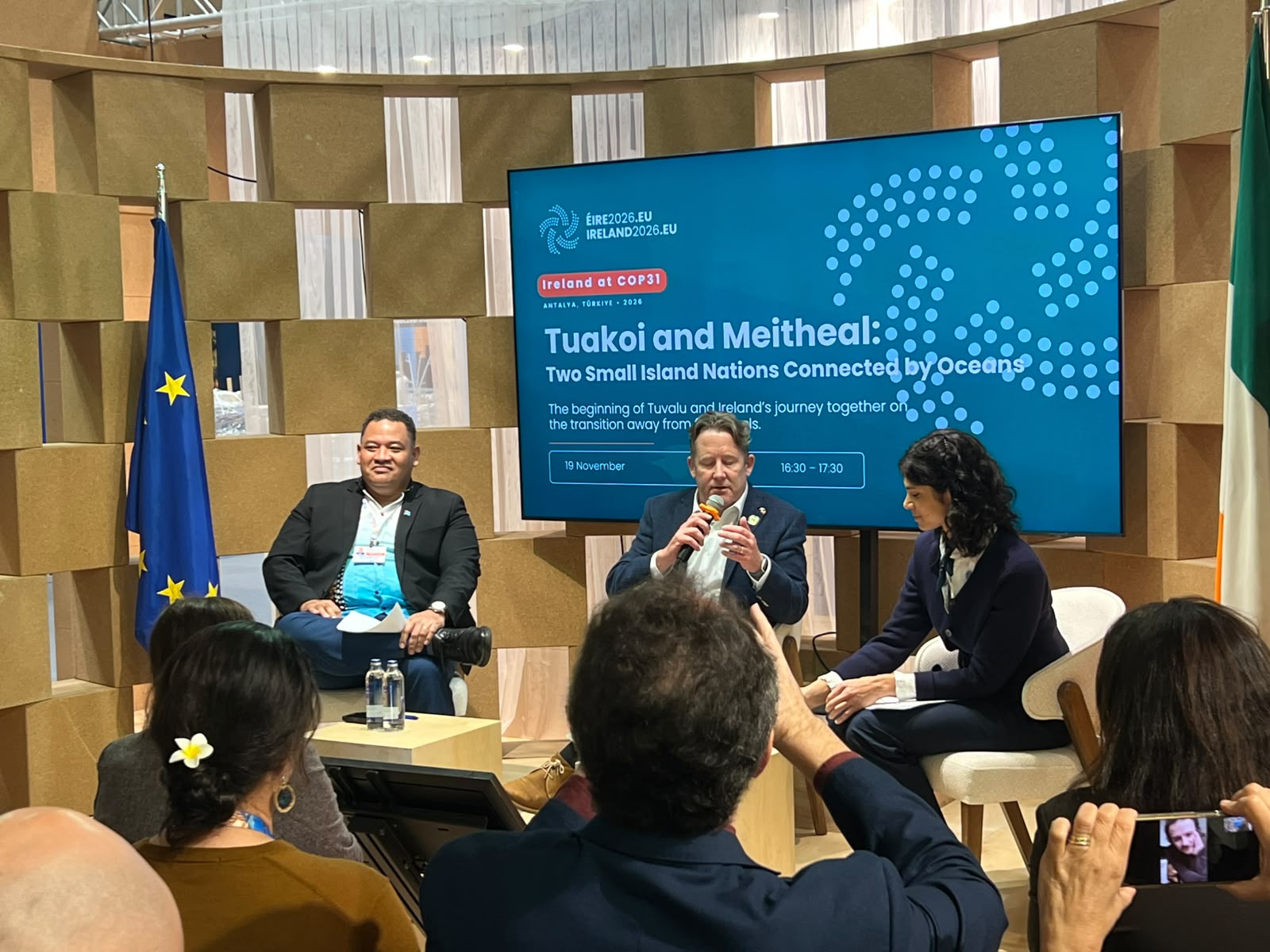 © IIASA
Announcement of the initiative at COP31 in Antalya, Türkiye.
“For Tuvalu, transitioning away from fossil fuels is about far more than reducing emissions. It is about national survival, energy security, and affordability. We want to demonstrate that even the world's smallest and most vulnerable nations can lead this transition. This roadmap will help us understand the choices before us, the investments required, and the opportunities to deliver lasting economic and social benefits for our people,” said the Honorable Dr Maina Vakafua Talia, Tuvalu’s Minister for Home Affairs, Climate Change, and Environment.
“Tuvalu and Ireland are demonstrating the leadership needed to turn the global commitment to transition away from fossil fuels into national action. By combining local expertise with scientific analysis, these roadmaps can help countries identify practical, equitable, and investment-ready pathways, while strengthening the capacity to implement them,” said Shanta Barley, Director of the Real Zero Hub at IIASA.
“Tuvalu's roadmap will be country-led, combining local expertise with IIASA's scientific tools to explore pathways and their implications for people. We hope this partnership model will inspire other countries to develop roadmaps tailored to their own circumstances,” noted IIASA Energy, Climate, and Environment Program Director and co-lead of Exploring Real Zero, Keywan Riahi.
“A national roadmap shows what a country can do today and where affordable alternatives to fossil fuels do not yet exist. Closing these innovation gaps is beyond any single country. We hope Tuvalu's roadmap, and others we co-develop, will help direct international cooperation on technology, finance and research to where it is needed most,” added Setu Pelz, co-lead of Exploring Real Zero at IIASA.
“Small islands are often treated as a footnote in global energy modeling. Tuvalu’s roadmap puts them at the center. We hope it shows that rigorous, long-term decarbonization planning is possible for any country and gives larger emitters fewer reasons to wait,” concluded Siddharth Joshi, Research Scholar and Lead for Modeling for National Transformations at IIASA.
About Exploring Real Zero
Minderoo Foundation has committed A$9 million in seed funding to establish the Real Zero Hub and support Exploring Real Zero, a flagship climate science research initiative based at IIASA.
The initiative focuses on developing credible, innovation-informed scenarios for eliminating fossil fuel emissions, assessing climate impacts and damages, and supporting governments and local experts in developing country-led transition roadmaps. By connecting scientific analysis with national priorities, it aims to identify both practical near-term solutions and the innovation and international cooperation needed to achieve a fossil fuel-free future.