



A new IIASA-led study finds that climate strategies that cut energy and resource demand tend to improve quality of life across a broader range of dimensions than supply-side alternatives and shows that communicating these wider benefits can strengthen public support.
Climate strategies are still judged largely across two dimensions: how much they cost and how many tonnes of CO₂ they save. A new study published in Communications Sustainability argues that this narrow lens overlooks much of what is at stake – and much of what the public actually cares about.
An international team led by IIASA within the Energy Demand changes Induced by Technological and Social innovations (EDITS) network assessed how six climate mitigation strategies in buildings, transport, and industry affect six dimensions of quality of life, from household income and jobs, to health, energy security, and fairness. Using energy-system simulations for 18 countries, the researchers compared supply-side strategies (cleaner fuels and technologies, including heat pumps, electric vehicles, and hydrogen substitution) with demand-side strategies (using less energy and materials through insulation and thermostat adjustments in buildings, modal shifts in transport, and greater material efficiency in industry). Each strategy was designed to deliver an identical 10% cut in greenhouse gas emissions.
The study is among the first to combine these objective modeling results with evidence from public surveys using the same strategies and impact data, allowing researchers to compare quantified quality-of-life benefits with citizens’ perceptions.
"Mitigating climate change is too often framed as a burden, when in fact it can raise people's quality of life," says study lead Arnulf Grubler, Distinguished Emeritus Research Scholar at IIASA. "Strategies that reduce how much energy and materials we use deliver benefits across a remarkably broad range, including cleaner air, greater energy security, and fairer outcomes for poorer households, yet these gains remain consistently undervalued in policy debates."
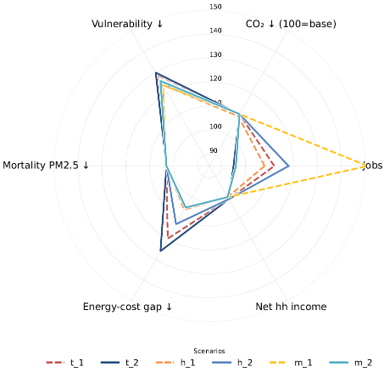 © Grubler et al. (2026), Communications Sustainability
Demand- and supply-side climate strategies compared across six dimensions of quality of life
All six strategies improved quality of life, but demand-side options scored slightly higher across a wider set of dimensions. Among the demand-side measures examined, improvements in building efficiency through insulation and modest thermostat adjustments emerged as the most robust performer across the study’s sensitivity tests. The authors caution that their estimates, if anything, understate the true benefits, since the analysis could not capture the full spectrum of wellbeing effects.
"By modeling supply- and demand-side strategies that achieve exactly the same emissions cut across 18 very different countries, we could compare them on a level playing field," says coauthor Nuno Bento of the University Institute of Lisbon (ISCTE-IUL), who developed the simulation tool. "What stands out is how widely the benefits are shared – both higher- and lower-income countries stand to gain, which matters for international climate negotiations."
The team then tested a widespread assumption: that people reject demand-side measures because these require personal effort, time, and money. Representative surveys in the Netherlands, Brazil, and China – countries with different income levels and positions in the climate debate – found the opposite.
"People expected both supply and demand-side strategies to improve their lives and found them acceptable in all three countries," note coauthors Linda Steg (University of Groningen) and Anne van Valkengoed (Wageningen University), who designed the surveys. "And simply showing people the evidence made their views more positive, highlighting the importance of assessing and communicating climate action beyond emissions reductions and economic costs."
The results challenge the common assumption that demand-side climate action is unpopular and suggest that communicating wider quality-of-life benefits could strengthen public support. The findings also carry clear messages for policy.
“Demand-side strategies deserve more weight in policy portfolios than they currently receive, and transparently communicating their quality-of-life benefits can build public support,” notes coauthor Benigna Boza-Kiss, a Research Scholar in the IIASA Energy, Climate, and Environment Program and EDITS network coordinator. “The fact that both richer and poorer countries gain could help break the ‘developed versus developing’ stalemate in climate talks,” she concludes.
The study was carried out under the Energy Demand changes Induced by Technological and Social innovations (EDITS) network, "Well-with-Low" fast-track project, coordinated by RITE and IIASA and funded by Japan's Ministry of Economy, Trade, and Industry (METI).
Reference
Grubler, A., Steg, L., Bento, N., Boza-Kiss, B., De Stercke, S., McCollum, D., Nick, S., Pachauri, S., Van Valkengoed, A., Zimm, C., Louro Alves, T., & Qin, C. (2026). The undervalued quality-of-life benefits of demand-side energy and climate strategies. Nature Communications Sustainability DOI: 10.1038/s44458-026-00101-2
News

16 October 2026
Getting back on track to reduce methane emissions
A new study, led by IIASA researchers and coauthored by UNEP colleagues, finds that if governments fully implement their methane reduction plans, they could reduce global emissions by 11% between 2020 and 2030. This would reverse the current trend of increasing methane emissions, but would not be sufficient to achieve the goal of the Global Methane Pledge.

06 October 2026
Nanjing University delegation visits IIASA to explore future collaboration
A high-level delegation from Nanjing University (NJU), led by Professor Tan Zhemin, President of NJU and Fellow of the Chinese Academy of Sciences, visited IIASA to discuss opportunities for strengthening scientific cooperation and advancing joint research on global challenges.

21 September 2026
Fairness informs how the world cuts emissions
Who cuts emissions fastest, and who supports others do so, are central questions in global climate action. New IIASA-led research shows that building fairness into climate models from the start can inform deliberations without changing the overall climate goal.