

IIASA recently welcomed Toshiyasu Ichioka, Director of the RIKEN Europe Office, to Schloss Laxenburg for a half-day program aimed at strengthening scientific ties and exploring potential avenues for future collaboration.
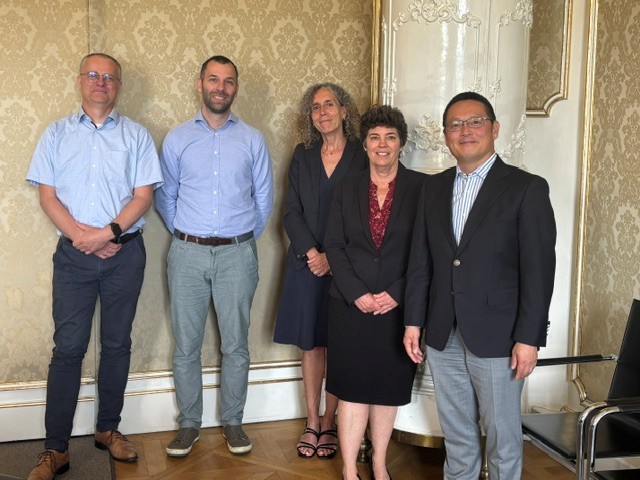 © IIASA
RIKEN is Japan’s largest and most comprehensive research organization for basic and applied science, and Japan has maintained a strong partnership with IIASA since the Institute’s founding in 1972 through the Japan Committee for IIASA.
On the occasion of Ichioka’s first visit to the Institute, Deputy Director General Karen Lips opened the program by providing an overview of the Institute’s mission, international partnerships, and ongoing engagements with scientific and policy communities worldwide.
“It is a great pleasure to welcome RIKEN to IIASA. Our long-standing partnership with Japan provides a strong foundation for expanding collaboration,” said Lips. “In an increasingly interconnected world, multilateral scientific partnerships are essential, and we look forward to exploring new ways to connect our research communities and strengthen our collective contributions to global science.”
Institute representatives presented a cross section of IIASA’s current research portfolio and highlighted some of the key work being undertaken by IIASA across energy, climate, biodiversity, population research, and capacity development, followed by a presentation by RIKEN on its history, ongoing research and current priorities and challenges.
Participants discussed overlaps and potential areas of collaboration between RIKEN and IIASA’s strategic priorities, major research initiatives, and existing areas of international cooperation. Participants emphasized the shared commitment of their institutions to advancing global, interdisciplinary science and noted the importance of deepening international cooperation in an era of evolving challenges.
IIASA looks forward to continued dialogue with RIKEN and to exploring avenues to jointly advance science in service of global wellbeing.
News

18 May 2026
Full fossil fuel phase-out by 2050 would require up to 80% more electricity generation
New research by an international team of scientists finds that fully phasing out fossil fuels worldwide by 2050 would require global electricity generation to expand by roughly 60 to 80% beyond the levels projected in conventional 1.5°C climate pathways. The study also shows that eliminating fossil fuels could significantly reduce dependence on CO2 removal technologies and underground carbon storage.

16 October 2025
Democratizing global climate modeling
A new international study co-led by IIASA researchers and Japanese partners aims to democratize the way global climate scenarios are developed. The authors propose a transparent, inclusive research platform that invites participation from scientists worldwide – especially from emerging and developing regions – to ensure that the foundations of climate policy analysis are globally representative and equitable.
06 May 2025
Japan’s Minister of Environment visits IIASA
IIASA had the great honor of welcoming His Excellency Mr. Keiichiro Asao, Minister of the Environment and Minister of State for Nuclear Emergency Preparedness of Japan, for a high-level visit and strategic dialogue with IIASA leadership and researchers.