
Researchers from the Forest Fire Research Division of the National Institute of Forest Science (NIFoS), Republic of Korea, visited the FLAM team in IIASA’s Agriculture, Forestry and Ecosystem Services (AFE) Group, Biodiversity and Natural Resources (BNR) Program, on 8-9 July 2026 to discuss future collaboration on wildfire modelling, aerial firefighting strategies, and megafire response.
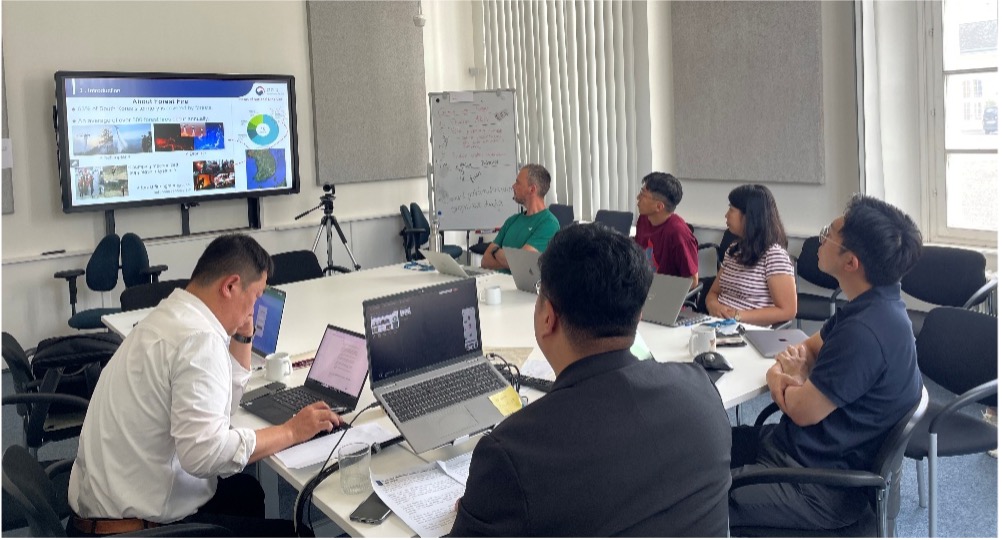 © Eunbeen Park
The NIFoS delegation was led by Dr. Chungeun Kwon and Dr. Sungeun Cha, whose work focuses on wildfire spread prediction systems and field support for fire suppression. The visit brought together NIFoS, IIASA researchers, and local wildfire response authorities in Styria, Austria, with the aim of linking Korea’s operational wildfire response experience with IIASA’s modelling expertise, particularly through the FLAM wildfire model.
At the seminar, the FLAM team introduced the Wildfire Climate Impacts and Adaptation Model (FLAM), and NIFoS presented Korea’s ICT-based wildfire management system. The discussion highlighted the potential of FLAM not as a replacement, but as a complementary system-level model for Korea’s existing prediction system for broader risk assessment, and climate change impact analysis as well as linking operational data with process-based modelling approaches to improve both prediction accuracy and practical field applicability.
Key potential collaborations were identified. The first one is an AI–process-based wildfire spread prediction framework that would help improve short-term operational prediction while also supporting long-term risk assessment under changing climate conditions. The second is the analysis of aerial firefighting effectiveness and operational strategies. Korea operates a large fleet of aerial firefighting resources, and the meeting explored how aircraft deployment data, water drop volumes, weather conditions, terrain, fuel characteristics, and final burned area could be used to evaluate the effectiveness of aerial suppression. IIASA’s suppression efficiency framework and cost-effectiveness analysis could provide a useful basis for assessing how different aerial firefighting strategies reduce wildfire damage under various conditions.
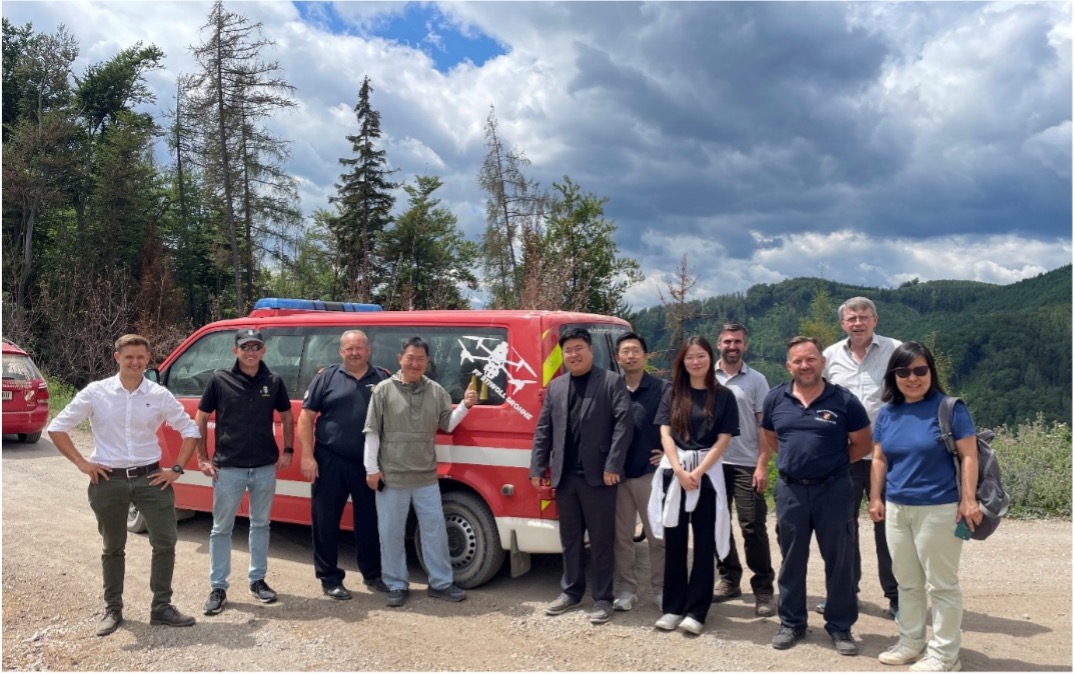 © Eunbeen Park
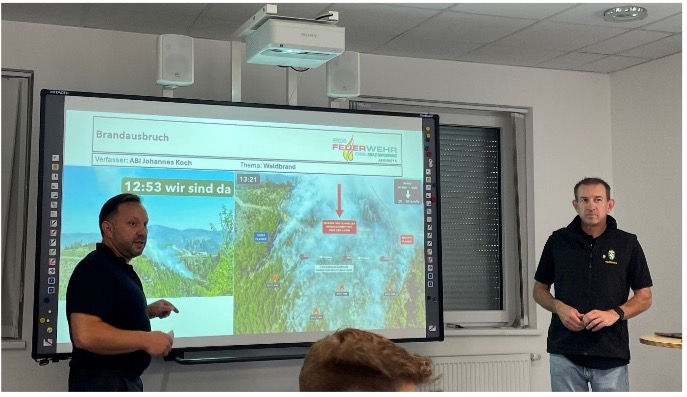
On 9 July, the delegation visited a wildfire-affected site and the Volunteer Fire Brigade in Eisbach-Rein, Styria, meeting Ing. Peter Ondrich, Officer for Environmental Monitoring, Disaster Damage Assessment and Forestry Statistics at the Provincial Forestry Directorate of Styria, and ABI Johannes Koch, Head of Operations of the local fire brigade, together with their colleagues.
The Eisbach-Rein wildfire case demonstrated that aerial suppression alone is not sufficient for complete wildfire control. Helicopters played an important role in suppressing active fire fronts, but long-term control depended on coordinated ground operations, detection of hidden hot spots, access through forest roads, water supply systems, and repeated mop-up work, with drones and thermal imaging are important for identifying hidden embers and supporting field crews in difficult terrain.
 © Eunbeen Park
The visit also emphasized the importance of linking wildfire suppression with broader forest management. Forest roads and fuel management are not only forestry infrastructure but critical components of response, evacuation, and suppression planning. This perspective is highly relevant for Korea, where large wildfires increasingly require integrated approaches that connect prediction, suppression, forest management, and community protection.
Overall, the visit strengthened the basis for future collaboration between NIFoS and IIASA. Potential areas of cooperation include joint model validation, integration of real-time wildfire data, AI–process-based spread prediction, cost–benefit assessment of suppression strategies, and long-term wildfire risk projection under climate change scenarios. As a next step, both sides discussed the possibility of establishing a formal research agreement to support continued collaboration and joint model development.
News
08 May 2025
OJERI-IIASA Symposium 2025 Wraps Up with Significant Exchanges on Wildfire and Sustainable Land-Water Management
The OJEong Resilience Institute at Korea University (OJERI) and the International Institute for Applied Systems Analysis (IIASA) successfully held the OJERI–IIASA Symposium 2025 on April 28–29 at IIASA in Laxenburg, Austria. With the theme “Forest Fire and Water-Land Management under the Carbon (Emission) Cycle”, the symposium aimed to continue the strong partnership between IIASA and OJERI@KU in advancing cross-disciplinary research for sustainable forest and land-water management.

20 January 2025
IIASA co-organized the Digital Twin and Macro-ABM International Workshop in Korea
On October 25th, 2024, EM Research Group leader Sebastian Poledna participated in an international workshop in South Korea to promote Agent-based Modelling (ABM) as a tool for economic projections. Dr. Poledna delivered a keynote speech on "Economic forecasting with an Agent-based Model". The event was attended by other organizations such as OECD, IITP and WIFO, as well as several Korean universities, to name a few, and was co-hosted and funded by the Electronics and Telecommunications Research Institute (ETRI). The objective of the multidisciplinary convergence workshop was to explore innovative solutions in the digital age for data- and evidence-based national policy, using concepts and methods such as agent-based modeling, AI-driven approaches, and methods from complex systems science.

17 October 2023
New Team Members in Focus: Advancing Research Works in Agriculture, Forestry and Ecosystem Services Group
We are pleased to announce the arrival of four new researchers to the Agriculture, Forestry, and Ecosystem Services Research Group. With varying backgrounds and research objectives, this quartet is poised to elevate the group's interdisciplinary research in global and regional agriculture, forestry, and natural land ecosystems.