



Within the next few decades, intensifying heatwaves could expose a significant share of Europe’s cattle to dangerous levels of heat stress. New research maps where and how millions of animals may be affected by mid-century.
The European cattle sector is deeply embedded in Europe’s culture, economy, and food systems. Around 1.3 million agricultural holdings rear more than 70 million cattle, making the EU one of the world’s most important dairy and beef producers. At the same time, cattle production is also the biggest emitter of greenhouse gasses and other pollutants such as nitrogen in the agricultural sector, creating tension between food production, farmer livelihoods, and ambitious EU climate goals.
Žiga Malek a researcher associated with the Novel Data Ecosystems for Sustainability (NODES) Research Group in the IIASA Advancing Systems Analysis Program and the Biotechnical Faculty of the University of Ljubljana, Slovenia, and Linda See, principal research scholar in the NODES group, set out to estimate to what extent European cattle could be impacted by heatwaves driven by climate change in the near future. They particularly focused on differences between cattle that graze outdoors and those kept indoors without access to pasture. This distinction matters because adaptation measures in systems where cattle have access to outdoor pastures are different to those for systems where they do not.
“Heatwaves already threaten cattle welfare, productivity and survival, while also disrupting grassland and feed production. Yet, despite these risks, spatially explicit assessments of how European cattle could be exposed to heatwaves in the near future, that also address the diversity of the European cattle producing types and regions were missing,” Malek explains.
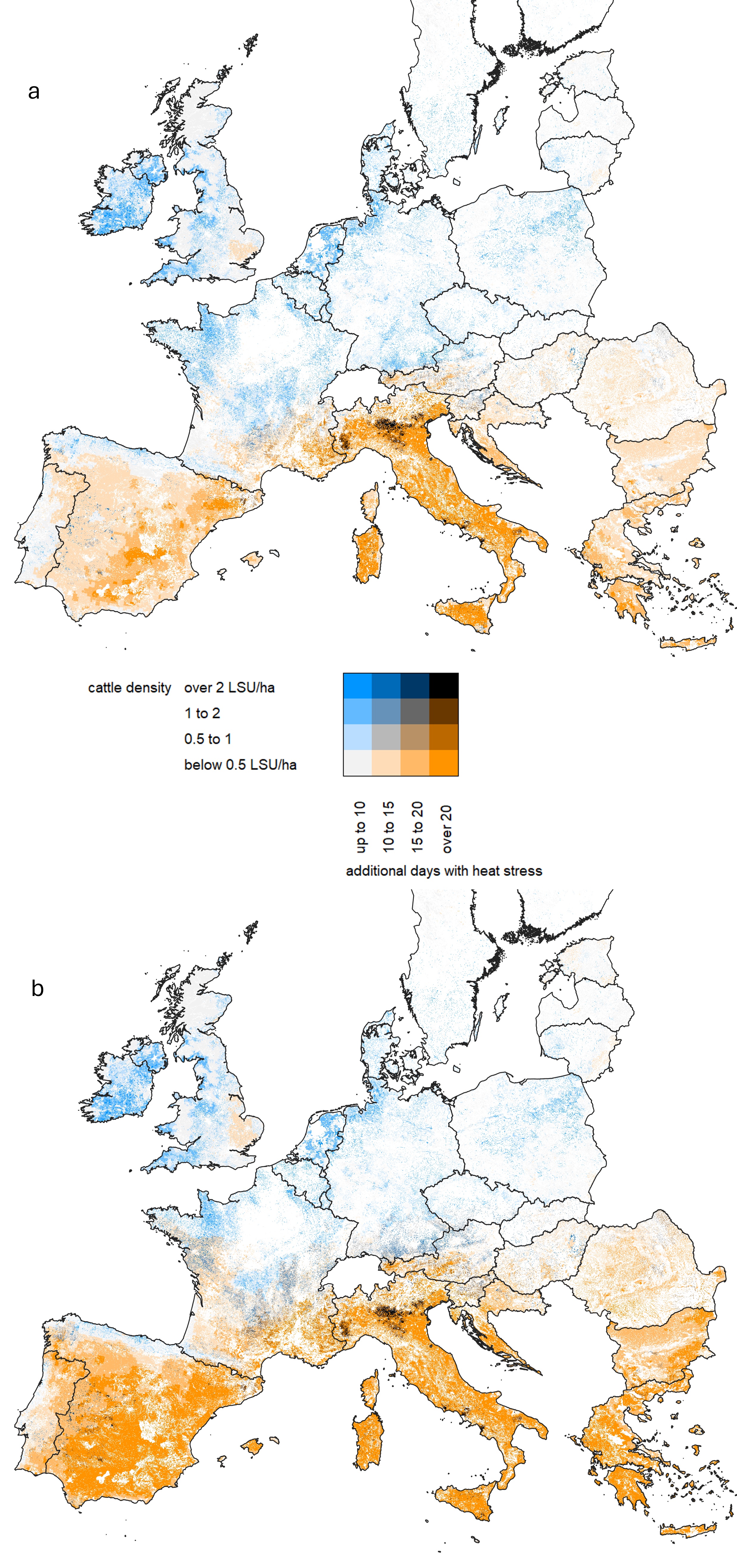 © Malek & See (2026).
Spatial distribution of cattle exposed to heatwaves. Bivariate map showing the additional days with heatwaves and cattle densities for a RCP4.5 scenario, and b RCP8.5 scenario.
The study reveals significant regional and system-level differences. Depending on future emission pathways, between 6.2 and 13.7 million cattle livestock units – representing 11 to 22% of today’s European cattle population – are projected to experience at least 15 additional heatwave days by around 2050.
Indoor systems, where cattle do not have access to outdoor grazing, emerged as particularly exposed. While 4.5 to 12% of grazing cattle are projected to face this level of increased heat exposure, the share rises sharply for cattle kept indoors without outdoor access, reaching 18 to 35%. The authors also found that regions already exposed to heat stress today could be hit hardest in the future.
“These are mostly southern European countries such as Italy, Spain, Greece, Slovenia, Romania, and Bulgaria – many of which rely heavily on cattle farming for rural economies and traditional products like protected cheeses,” notes See.
According to the authors, the findings highlight how difficult it will be to meet economic, environmental, and animal welfare goals without ambitious, timely, and spatially targeted adaptation. Measures like planting shade trees on pastures, adding landscape features such as shelters, or upgrading barns with improved ventilation and cooling cost money and time, further emphasizing the urgency of taking action. This urgency is further emphasized by the fact that in some regions farmers are already abandoning cattle rearing, partly because heatwaves – often coinciding with drought – constrain feed production and intensify pressures on farmers.
The authors further emphasize that adaptation strategies must reflect Europe’s diverse climates and production systems.
“Measures in Mediterranean Europe need to be different than those in the Alps or the Atlantic part of the region,” says See.
At the same time, the results point to potential synergies: improving barns, planting shade trees and, in the most exposed, marginal regions, reducing cattle numbers could simultaneously enhance animal welfare, support climate mitigation, and strengthen farmer resilience.
“There is no one size fits all solution when it comes to the European cattle sector. While the necessary changes may be uncomfortable, particularly in regions with very intensive cattle rearing where some farmers might potentially be required to reduce herd size or shift production, acting early can ease the transition to a more climate resilient and environmentally friendly European cattle sector,” Malek concludes.
Reference
Malek, Z. & See, L. (2026). Future heatwave exposure of the European cattle sector. npj Sustainable Agriculture DOI: 10.1038/s44264-025-00113-w
News
16 October 2026
Getting back on track to reduce methane emissions
A new study, led by IIASA researchers and coauthored by UNEP colleagues, finds that if governments fully implement their methane reduction plans, they could reduce global emissions by 11% between 2020 and 2030. This would reverse the current trend of increasing methane emissions, but would not be sufficient to achieve the goal of the Global Methane Pledge.

01 October 2026
Where the waters meet: Connecting global limits and local water management
Human activity and climate change are putting growing pressure on water resources, disrupting the predictability of the water cycle, and changing the availability and quality of freshwater. IIASA researchers and partners have developed a new framework for guiding water management and planning at the river-basin level, derived from the existing Global Water Planetary Boundary.

21 September 2026
Fairness informs how the world cuts emissions
Who cuts emissions fastest, and who supports others do so, are central questions in global climate action. New IIASA-led research shows that building fairness into climate models from the start can inform deliberations without changing the overall climate goal.