

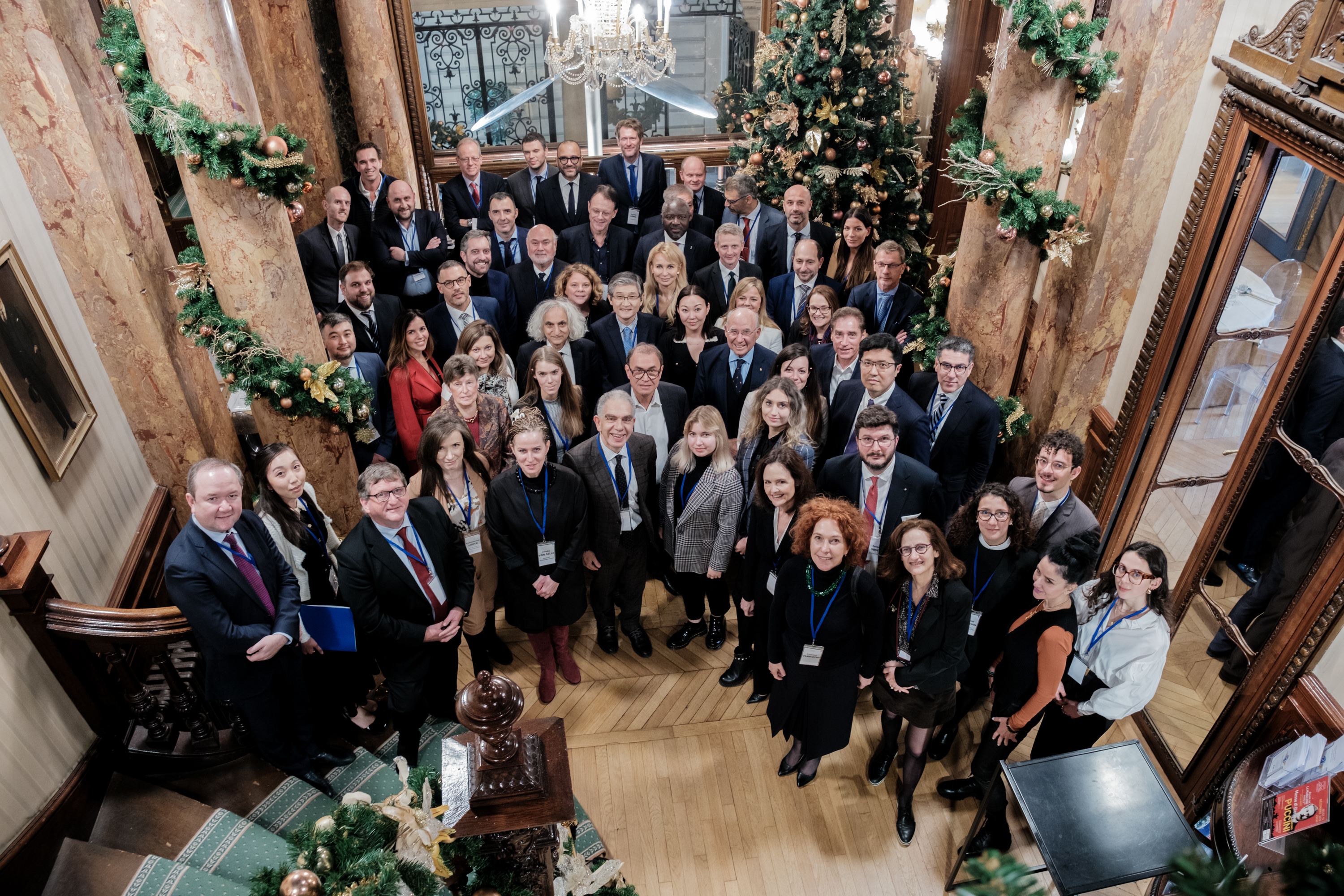
On 28 and 29 of November, Paris hosted senior policymakers, scientists, and industry stakeholders at the renowned 5th Dialogue of Continents forum. This year’s theme "The End of Abundance, The Birth of Resilience" was set in view of President Macron’s recent speech, which cautioned that the world faces depleting natural resources and technological resources and hangs at a tipping point of reform.
The forum was organized by the Reinventing Bretton Woods Committee (RBWC), Centres for European Policy Network (CEP), and the SRM Research Center for Economic Studies.
The forum welcomed esteemed politicians and diplomats such as former prime minister of Romania, Petre Roman; former prime minister of Belgium, Yves Leterme; and board member of the Ban Ki-Moon Foundation, Raekwon Chung. It also welcomed former and current governers of various central banks in Europe and Asia as well as senior industrial and academic representatives.
On the second day of the two-day event, IIASA Advancing Systems Analysis (ASA) Program Director, Elena Rovenskaya, participated in the panel session Shifting Geography of Connectivity. She presented on the key trends that decision-makers should account for as they plan for resilient pathways of trade and production. Changing trends will inevitably impact how we foresee the four key aspects of trade: what is transported to whom, by whom, and how?
Rovenskaya spoke on the impact of rising temperatures in shifting the human climate niches northward and the implications of this for foreseeable trading routes. Furthermore, she highlighted that according to some forecasts, the middle class may grow to more than 5 billion by 2030 with Asia hosting a major part of it. These two major shifts mean that the next 50 years will witness pivotal transformations in the transportation of food, necessary goods, and luxury goods between the West and Asia. As populations in Europe and the West age, Asia will become the hub of consumer demand.
Rovenskaya also discussed the future of 14 landlocked countries in Asia, their heightened challenges in trade, and the increased potential for growth with modern rail transportation routes. Her presentation commemorated the findings of ASA's project Challenges and Opportunities of Economic Integration in Eurasian and Wider European Space conducted by IIASA from 2014 until 2019. She concluded her presentation by re-emphasizing the need to take into consideration negative externalities such as environmental pollution and greenhouse gas emissions as policymakers and industrialists look to strategize the trading routes and supply chains of the nearing future.
The forum also held panel discussions on the topics of European integrations, the reconstruction of Ukraine post-war, and the signals of fragmentation of the world economy. Overall, the forum covered highly topical debates, which are shaping the next decades of the world economy and environment.
To read more about the Dialogue of Continents Forum, click here.
To watch the recorded sessions, click here.
To read the Dialogue of Continents fifth edition event report, click here.
 © IIASA
Elena Rovenskaya in the company of the other speakers in the session "The Shifting Geography of Connectivity".
 © IIASA
The participants in the 5th Dialogue of Continents forum.
News

24 September 2026
IIASA researcher joins Austrian Academy of Sciences working group on integrated carbon neutrality
On 15 September, Principal Research Scholar Thomas Schinko represented IIASA at a high-level event of the Commission on the De-Fossilization and Carbon Neutrality of the European Energy Systems (DEE) of the Austrian Academy of Sciences (OEAW). The meeting denoted the kick-off workshop of the newly established DEE Working Group "Transsectoral and Transcontinental Integration”.

23 September 2026
IIASA researchers strengthen cooperation with Kyrgyzstan on AI and industrial development
IIASA Cooperation and Transformative Governance (CAT) Research Group Leader and Senior Research Scholar Nadejda Komendantova and CAT Research Scholar Dmitry Erokhin have contributed to a series of scientific and policy forums in Kyrgyzstan in 2026. Their research on artificial intelligence in the production sector builds on IIASA’s longstanding cooperation with the country on sustainable industrial development.

10 September 2026
Emotionalization of Political Discourse: IIASA Researcher Presents Study at the Day of Parliamentary Research 2026
Dmitry Erokhin, PhD, Research Scholar at IIASA, presents a poster on the emotionalization of political discourse at the Day of Parliamentary Research 2026 at the Austrian Parliament. His study analyzes public comments on YouTube videos related to major Austrian political parties and applies sentiment and topic analysis to examine how emotions, facts, polarization, and toxicity shape online political debate. The findings provide insights into how digital media influences public perceptions of parties and democratic processes, and how parliaments can better respond to emotionally charged political communication.