


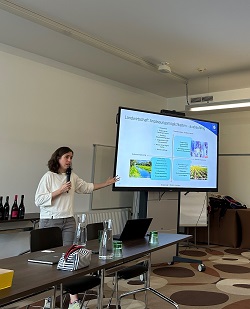
IIASA Researcher Susanne Hanger-Kopp was invited to present results from the WaterStressAT project in Illmitz-Seewinkel, Austria.
 © IIASA
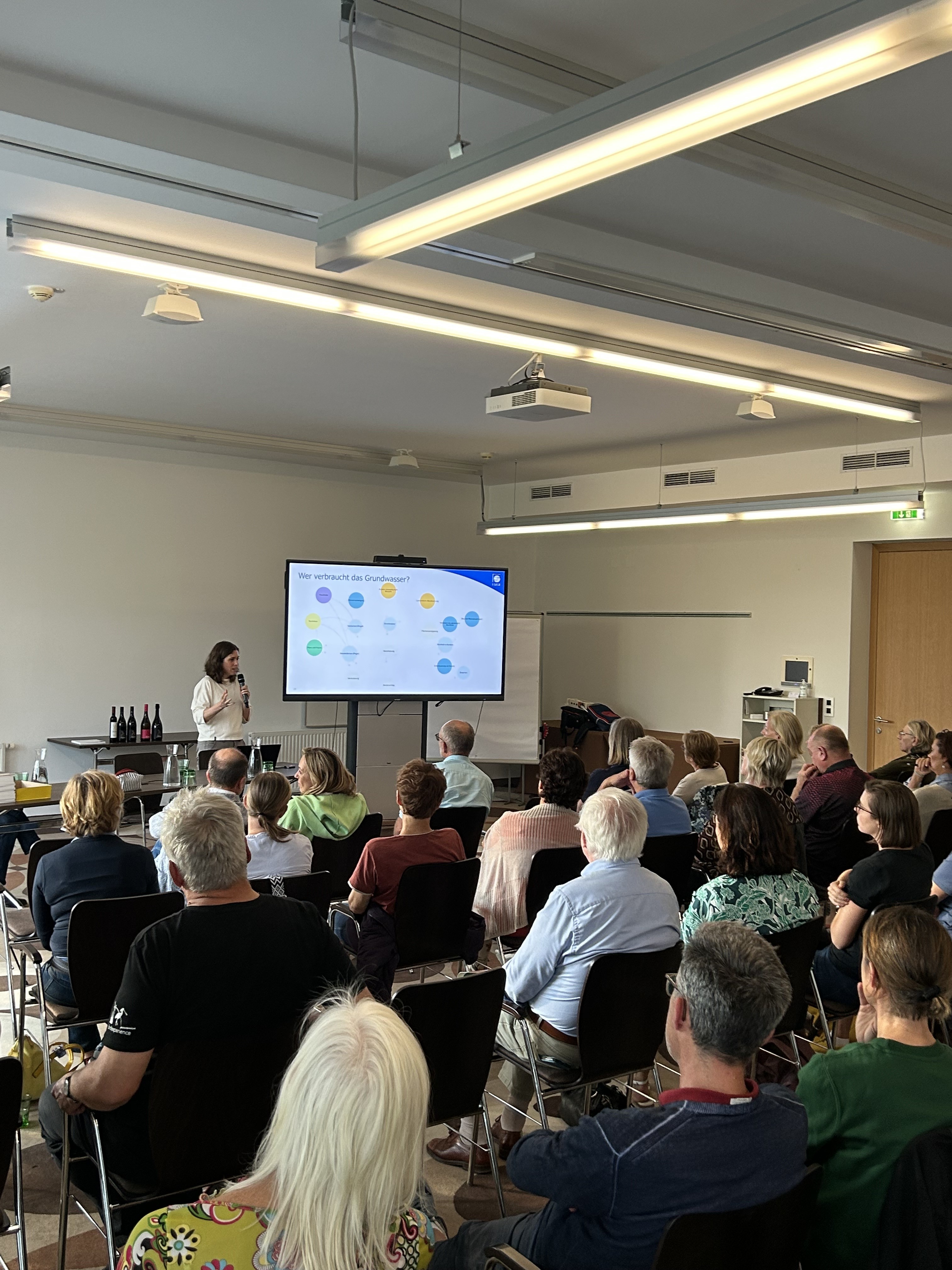
Susanne Hanger-Kopp from the Equity and Justice Research Group (EQU) was invited by "Illmitzer Gespraeche" to present the WaterStressAT project, providing the audience with practical tools to evaluate management practices in the Seewinkel region from a systems perspective. This will enable relevant stakeholders to distinguish between short-term risk management activities and long-term resilience building efforts.
 © IIACA
The event was attended by a wide range of professionals: mayors, local authority representatives, farmers, winegrowers, teachers, lawyers, real estate managers, and members of civil society. The presentation sparked a vivid conversation between the audience and the speakers, with the goal of building bridges between science and the diverse participants.
The WaterStressAT project aims at modeling local and regional water availability and demand in Austria under various regional development and climate change scenarios in two Austrian regions, Pinzgau and Seewinkel. While Austria is a water-rich country, changes in demand as well as climate change create local and regional hot-spots of water stress. It is thus of key importance to understand the current status and future development of these phenomena in order to identify potential areas of tension and inform decision-making at all levels of governance. For this purpose, WaterStressAT established a comprehensive participatory modeling process. This process is designed around regular stakeholder engagement, where key actors regularly interact with an interdisciplinary team of researchers.
News

24 September 2026
IIASA researcher joins Austrian Academy of Sciences working group on integrated carbon neutrality
On 15 September, Principal Research Scholar Thomas Schinko represented IIASA at a high-level event of the Commission on the De-Fossilization and Carbon Neutrality of the European Energy Systems (DEE) of the Austrian Academy of Sciences (OEAW). The meeting denoted the kick-off workshop of the newly established DEE Working Group "Transsectoral and Transcontinental Integration”.
23 September 2026
Eco-Welfare Network Conference
Julia Beier participated in the first in-person Eco-Welfare Network Conference, held in Brussels from 9-11 September at the Université Libre de Bruxelles as part of the Transform-Labor project.
14 September 2026
Can a warming climate put women at greater risk?
Unusually warm periods could have a link to an increased risk of intimate partner violence against women, according to a new IIASA-led study covering 31 countries in sub-Saharan Africa. The findings highlight how rising temperatures may compound existing risks of violence, with effects varying between demographic groups.