

A high-level delegation led by Senator Hon. Jonathan Reid, Barbados' Minister of Innovation, Industry, Science, and Technology, visited Schloss Laxenburg for a bilateral exchange with IIASA Director General Hans Joachim (John) Schellnhuber on applied systems science and its potential to inform transformative policy.
Earlier this month, IIASA welcomed a delegation from the Government of Barbados to Schloss Laxenburg for a substantive bilateral meeting. The delegation had travelled to Vienna to participate in the International Vienna Energy and Climate Forum (IVECF) at the Hofburg Palace – an event co-organized by UNIDO, the Austrian Federal Ministry for European and International Affairs, the Austrian Development Agency, and IIASA – and made the short journey out to Laxenburg to continue the conversations at the Institute. The minister was accompanied by senior representatives from the Ministry, Export Barbados, and UNIDO.
The discussions centered on the intersection of fundamental science and global policy, and on how rigorous, systems-based research might illuminate pathways toward a more equitable and resource-abundant world. Both the Minister and the Director General found striking convergence in the questions they had independently been working through, lending the exchange an unusually substantive character from the outset.
"The scientific thought leadership emerging from institutes like IIASA has the power to shape the political theory of our time. If we can translate the physics of what is possible into the architecture of what is pursued, we will have done something genuinely important," Minister Reid stated.
Central to the conversation was the question of how small island developing states – nations at the sharp end of climate risk and resource constraint – might engage more formally with IIASA's research programs and global membership network. Minister Reid expressed keen interest in Barbados joining IIASA as a member state, and both parties discussed the pathways and modalities through which such engagement might be formalized and made mutually productive.
The exchange also touched on emerging ideas for joint scientific initiatives, combining IIASA's modeling and analytical capabilities with Barbados' position as a vocal advocate for climate justice and innovative development policy. Discussions pointed toward the possibility of a collaborative research program addressing the conditions under which abundance, rather than scarcity, might become the organizing logic of global development, and the systemic changes in energy, technology, and governance that such a transition would require.
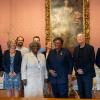
The meeting concluded with a protocol ceremony in the Elisabeth Room, including a signing of the IIASA guest book and an official photograph. Both sides expressed enthusiasm for continuing the dialogue in the near term, and Schellnhuber received an invitation to visit Barbados to advance the conversation at the highest level, including at a forthcoming international thought leadership forum focused on innovation and futures.
News
24 June 2026
Small island, big systems: Barbados and IIASA sign letter of intent to pioneer regenerative economy partnership
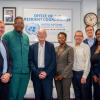
The Government of Barbados and IIASA have signed a letter of intent, formally launching Barbados’ path toward membership in the Institute and establishing a new partnership to apply advanced systems analysis and global modeling to the design of a regenerative economy.
12 June 2026
The physics of good vibrations: IIASA and Barbados explore a new model for resilient and thriving societies
IIASA Director General Hans Joachim (John) Schellnhuber visited Barbados at the end of May to deepen engagement with government, academic, diplomatic, and international partners and explore new opportunities for collaboration on resilience, innovation, and sustainable development for Small Island Developing States (SIDS).