The following statistics are from the last 5 full calendar years: 2021-2025
Publications
5
Publications about Malawi
| Title | Type | Publisher | Date Sort ascending | Journal |
|---|---|---|---|---|
| Stakeholder-informed approach improves national modelling of water resources for a Sub-Saharan African basin | article | Journal of Hydrology: Regional Studies | ||
| Herding resilience: Surveys and Bayesian spatial models for Africa’s livestock | article | Elsevier | Environmental Development | |
| Towards a socially just flood risk management in developing countries | book_section | Taylor & Francis | ||
| Do Large Estates Benefit Smallholder Neighbours? Evidence from Malawi | article | Taylor & Francis | The Journal of Development Studies | |
| Why does community-based disaster risk reduction fail to learn from local knowledge? Experiences from Malawi | article | Elsevier | International Journal of Disaster Risk Reduction |
1
Publications co-authored with institutions in Malawi
| Title | Type | Publisher | Date Sort ascending | Journal |
|---|---|---|---|---|
| Why does community-based disaster risk reduction fail to learn from local knowledge? Experiences from Malawi | article | Elsevier | International Journal of Disaster Risk Reduction |
0
Publications by IIASA researchers from Malawi
Projects
255
Projects related to Malawi
| Name | Start | End Sort ascending | Abbreviation | Classification |
|---|---|---|---|---|
| INMS: CWI-UNEP Global Nitrogen Cycle Towards INMS | 2017 | 2023 | INMS | Global |
| Medium Complexity Earth System Risk Management | 2019 | 2022 | ERM | Global |
| Management for resilience of multifunctionality in European forests in the era of bioeconomy | 2019 | 2022 | MultiForest | Global |
| Non-CO2 JRC: Non-CO2 Greenhouse Gas emissions and emission reduction potentials associated | 2021 | 2022 | Non-CO2 JRC | Global |
| Macroeconomic Modelling of Indirect Risks for Climate Risk Management | 2019 | 2022 | MacroMode | Global |
| ENVINEQUE: An Empirical analysis environmental inequality in the EU | 2019 | 2022 | EnvINEQEU | Global |
| Water Scarcity Clock 2.0 | 2022 | 2022 | WSC 2.0 | Global |
| Systematic assessment of monitoring air pollutants not covered under Directives 2004/107/EC an 2008/50/EC | 2022 | 2022 | SR15 | Global |
| World Energy Outlook 2021- Air Pollution and Emissions Analysis & Modelling Lot 2 |
2021 | 2022 | WEO2021 - Lot 2 | Global |
| Urban nitrogen cycles: new economy thinking (UNCNET) to master the challenges of climate change | 2019 | 2022 | UNCNET | Global |
Pagination
0
Projects sponsored by funders from Malawi
Engagement
4
Number of times participants from Malawi joined IIASA events
1
IIASA staff visits to Malawi
People
4
- Women
- Men
Total number of alumni from Malawi
News
18 May 2026
African Human Capital Data Sheet 2026
The African Human Capital Data Sheet 2026: Past Trends, Skills, and Future Pathways presents new evidence on population trends by level of education, skills, and demographic transitions across the African continent.
22 March 2021
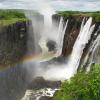
The value of cooperation for sustainable development in transboundary river basins
Can cooperation across sectors and countries help to achieve sustainable development? How do stakeholders in the Indus and Zambezi basins envision the future and how can they make that future a reality? IIASA researchers looked into these questions as part of a large-scale initiative with international partners.
Focus

Annual Report 2024
Annual Report 2024: Policy Impact Highlights
As part of its mission, IIASA aims to provide scientific guidance to policymakers by finding solutions to global problems through applied systems analysis. Through interdisciplinary research and international collaboration, the Institute delivers independent, science-based insights into critical policy issues, supporting evidence-informed decision-making on challenges such as climate change, energy security, and sustainable development.

Annual Report 2024
Annual Report 2024: Biodiversity and Natural Resources Program Highlights
Over the past year, the Biodiversity and Natural Resources Program has made significant strides in advancing our understanding of the complex relationships between ecosystems, land use, and climate.