
At the inaugural Howard Raiffa Lecture, Avril Haines argued that behavioral science and decision analysis can help governments make more ethical decisions under pressure.
Ethical failures in government are often treated as failures of character, training or compliance. Avril Haines, a former U.S. director of national intelligence, argued that they are more often failures of institutional design.
Delivering the inaugural Howard Raiffa Lecture in Vienna on Wednesday, Haines, the president-elect of the Carnegie Endowment for International Peace, called for national security institutions to draw more heavily on decision science, behavioral psychology and organizational research to strengthen ethical decision-making under pressure.
The lecture helped launch the Howard Raiffa Academy, a new initiative of the International Institute for Applied Systems Analysis (IIASA) and the Friends of IIASA dedicated to applying decision-analysis methods to public policy and governance.
“The social sciences have been telling us for decades that these assumptions are wrong,” Haines said, referring to the widespread belief that officials who receive sufficient ethics training and clear instructions will reliably make the right decisions.
 © Carnegie Endowment for International Peace
Avril Haines is president-elect of the Carnegie Endowment for International Peace and a former U.S. director of national intelligence.
Instead, she argued, ethical behavior is shaped not only by reasoning but also by institutional culture, social dynamics, hierarchy, incentives and situational pressures.
Haines, who served as director of national intelligence under former U.S. president Joe Biden and previously held senior positions at the CIA, National Security Council and State Department, framed her remarks around how to close the gap between ethical principles and actual behavior inside government institutions.
Drawing on the work of decision theorist Howard Raiffa, IIASA’s founding director, she distinguished between normative approaches that describe how people should make decisions, descriptive approaches that explain how people actually behave, and prescriptive approaches that seek to help real people make better choices under real-world conditions.
“Most institutional ethical frameworks rest on the implicit assumption that officials, when confronted with an ethical choice, will reason their way to the correct answer if they have been adequately trained, clearly instructed, and appropriately incentivized,” she said. Yet decades of research suggest that intuition, social context and situational pressures often play an equally important role.
 © Lisa Palmer | IIASA
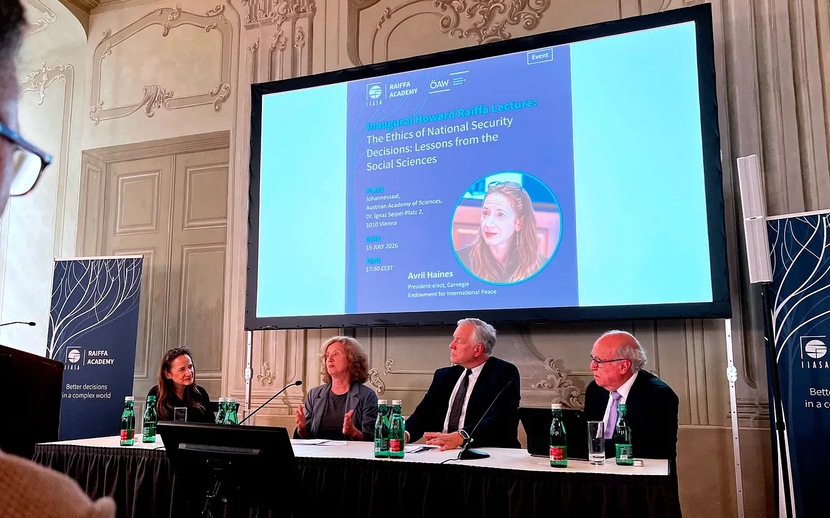
Avril Haines, left, takes part in a moderated discussion after her lecture with, left to right, Elke Weber, professor at Princeton University, Ambassador Martin Eichtinger, director of Diplomatic Academy Vienna, and Daniel Goroff, president of the Social Science Research Council on July 15, 2026, in Vienna.
The problem of institutional pressure
Throughout the lecture, hosted by IIASA and the Austrian Academy of Sciences, Haines described scenarios familiar to many large organizations. Analysts can soften judgments to avoid conflict, junior officials remain silent in meetings, employees defer to group consensus despite reservations, and staff hesitate to raise concerns because of hierarchical or cultural pressures.
In many such cases, she argued, officials already know the ethical course of action. The challenge is not a lack of knowledge but the cost of acting on it.
To explain the phenomenon, Haines drew on research by psychologist Jonathan Haidt, Stanley Milgram’s obedience experiments, Albert Bandura’s work on moral disengagement, and Thomas Schelling’s studies of how individual behavior can produce unintended collective outcomes.
The implication, she said, is that institutions should devote greater attention to the environments in which decisions are made rather than relying primarily on codes of conduct and ethics training.
Among the possible reforms she suggested were structured dissent mechanisms, “premortem” exercises that require teams to imagine why a decision might fail, leadership practices designed to encourage challenge and disagreement, psychologically informed ethics training, and decision-making processes that reduce the personal costs of speaking up.
Research on psychological safety, she noted, has shown that people are significantly more likely to report concerns and acknowledge errors when they believe doing so will not result in punishment or exclusion.
This article first appeared on The Science Diplomat.
Note: This article gives the view of the authors, and not the position of the IIASA Insights blog, nor of the International Institute for Applied Systems Analysis.