


Agriculture, Forestry, and Ecosystem Services (AFE) Group is committed to supporting and encouraging students and early career researchers with an interest in agriculture, forestry, and natural land ecosystems research.
Before applying as a YSSP researcher in the AFE Group:
- Read all information on conditions and eligibility. Review the FAQs carefully.
- Visit the AFE homepage for an overview of the research agenda and current research topics.
- Familiarize yourself with recent publications from the AFE Group to guide your proposal development.
- Browse AFE researchers and projects to understand the types of research conducted and main areas of AFE interest.
- Browse models, tools, and datasets used and created by the AFE Group.
Write and refine your application:
- Develop a project in your own area of interest. Ensure it aligns with the AFE research agenda and topics.
 © Skalsky | IIASA
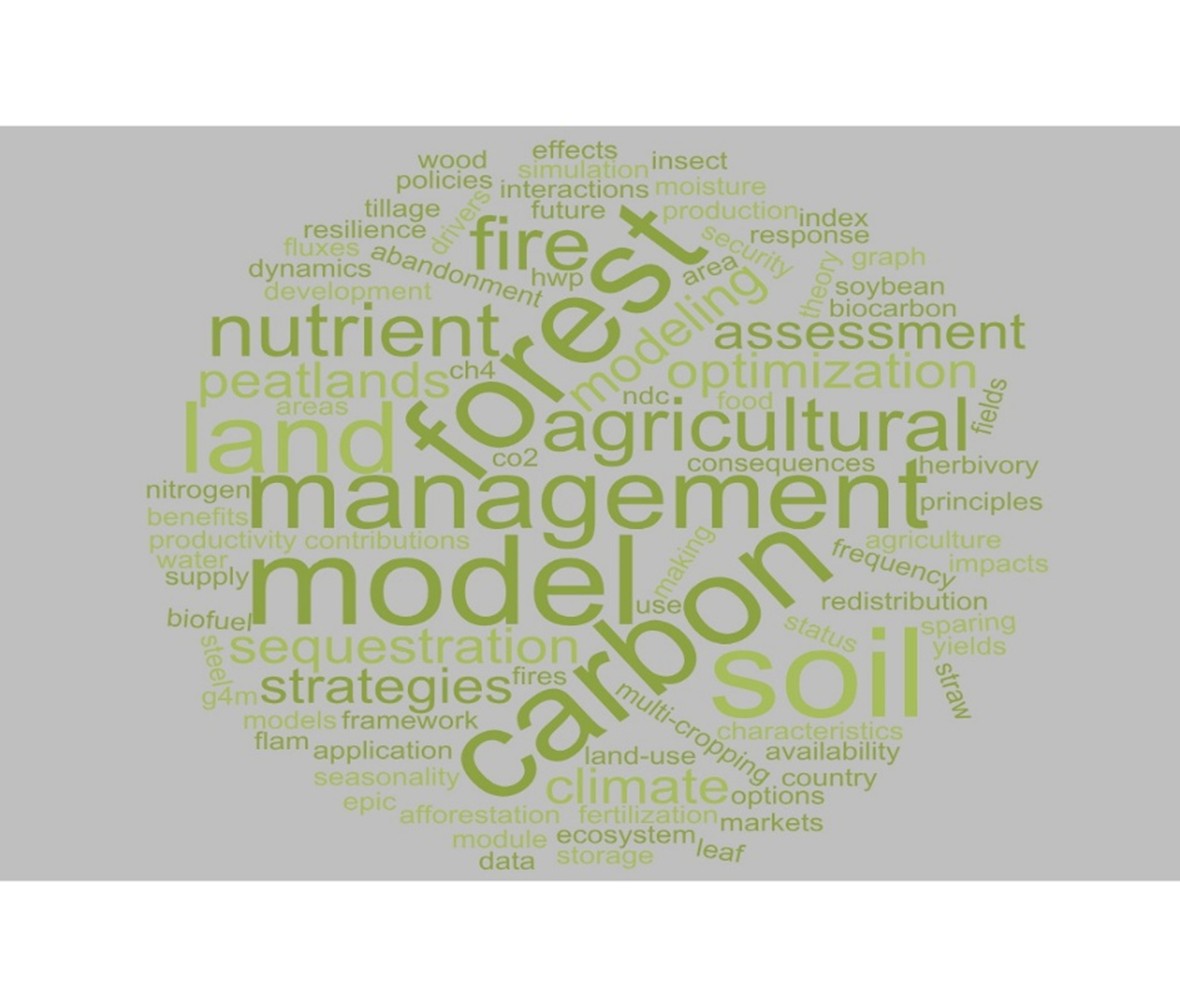
The main areas of research include:
- Biophysical process modelling in terrestrial ecosystems - understanding crop, forest, and land interactions across agriculture, forestry, and natural lands (EPIC-IIASA, G4M)
- Integrated analyses of agriculture, forestry, and natural-land ecosystems at global and regional scales to capture land-use interactions, carbon dynamics, and resource tradeoffs
- Development and integration of modelling tools and datasets for assessing land-based climate and nature-based solutions, restoration, and sustainable land management
- System optimization of spatially explicit renewable and bio-based supply chains, integrating techno-economic modeling (BeWhere) to assess optimal deployment of low-emission and CDR technologies (BECCUS, DACUS) under varying policy and sustainability scenarios.
- Sustainable management of natural resources, biodiversity, and ecosystem services, embedding biodiversity and ecosystem-service safeguards in scenario and policy analyses
- Risk of natural disturbances under climate change and socio-economic dynamics, including wildfire, bark beetle, windstorms, and drought (FLAM team). Modeling forest carbon permanence and wood supply under disturbance events
- Policy-support and scenario analysis for climate mitigation, adaptation, renewable resource supply chains, and sustainable land use
AFE is particularly interested in YSSP applicants working on the following topics:
EPIC - The Environmental Policy Integrated Climate-based global gridded crop model
- Modelling agricultural systems at site to regional and global scales using biophysical models such as EPIC, as well as data-driven modelling approaches. The focus may include crop yield, soil carbon and GHG emissions, climate change impacts and adaptation, carbon farming practices, irrigation and fertilization strategies, specific cropping systems, management of permanent grasslands, and others
- Regional assessment of agricultural systems within a broader landscape context, employing approaches such as farm or regional accounting, land-use optimization models, or integrated models that encompass other land-based sectors or biodiversity. The focus may include environmental externalities, productivity, biodiversity, and a range of ecosystem services
BeWhere - A Spatially Explicit System Optimization Tool
- Sustainable biofeedstock supply chains for bio-based products, biochar and bioenergy including BECCS
- Integrated energy system modelling for multi-sectoral decarbonization: Advancing flexibility and sustainability
- Developing supply chains to assess contribution of biogenic and DAC based CO2 in producing materials, and energy including CO2 and H2 transportation networks.
FLAM - Wildfire climate impacts and adaptation model
- Modeling: Wildfire (forest, cropland, shrubland, grassland), Bark beetle (forest), Windstorms (forest), Draughts
- Impacts: Hot Spots, Climate change scenarios, Ignition probability, Burned area, Emissions, Health impacts
- Mitigation & Adaptation: Increasing suppression efficiency, Fuel management (Prescribed burning, Grazing, Tree species substitution)
Forestry / G4M – Global Forest Model
- Regional application of the G4M, calibrated and validated for local tree species and forest management practices
- Integration of the G4M with soil, water, or biodiversity models
- Testing different hypotheses related to forest management and climate interactions using the G4M
Some of the research topics tackled within the YSSP program have previously included:
| - From Fields to Future: A Machine Learning Framework for Sustainable Carbon and Nitrogen Management in pan-European Agriculture |
| - CO2 and CH4 dynamics of European peatlands under different land-use options in future climate using process-based models |
| - Evaluating potential contributions of multi-cropping to food security and land sparing |
| - Biocarbon supply for fossil-free steel making |
| - GHG Efficient Policies for Biofuel Production on Agricultural Land |
| - Future climatic impacts on soybean yields in South America and its consequences on agricultural markets: an integrated crop, statistical and agro-economic model assessment |
| - Forest resilience and key drivers to fire in a diverse regions (Mexico, Indonesia, South Korea) |
| - Assessing optimal afforestation effect focused on carbon storage, biodiversity and wood productivity for sustainable forest management under climate risks |
| - Modeling the influence of Grazing on Regional Wildfire Dynamics in Europe |
- Forestry / G4M – Global Forest Model
| - Interactions of nutrient and water availability in the G4M global forest model |
| - Optimizing climate benefits of drained afforested boreal peatlands management strategies |
| - Leaf area index constrained by soil nutrient status with eco-evolutionary optimality principles |
Former AFE YSSP Testimonials:

My YSSP summer in 2014 was an intense, beautiful, emotional, and truly formative experience that deeply shaped me both scientifically and cosmopolitically. Being part of IIASA again, ten years later, feels like a homecoming.

My YSSP summer was extremely fantastic. I met many friends and had the opportunity to interact with legendary, world-famous researchers. Although AFE did not exist in its present form at the time, I became connected to this lovely group during that period. The IIASA staff–YSSPers football match was definitely the highlight of the program.

My YSSP took place during the late stage of the COVID epidemic, when few students could journey to Laxenburg. The resulting intimate cohort cultivated deep professional bonds, and the concentrated scientific and cultural exchange proved profoundly enriching. The IIASA scientists who supervised me offered exceptional mentorship and guidance. The contemplative solitude of long walks in the beautiful Laxenburg park provided the clarity of thought needed to develop the framework that became the foundation of my PhD thesis.

My time at YSSP encouraged me to grow, to challenge myself, and to see my research from a broader perspective. Working closely with leading researchers was an invaluable opportunity that strengthened my passion for research. Coming back to IIASA feels incredibly meaningful, bringing warmth, and a renewed sense of purpose.

My experience at YSSP was a real turning point in my academic journey. I am still building my research and academic development on the project and modeling work I began during the program. Since YSSP, I have benefited from strong academic support from friendly and supportive supervisors and peers. Just as importantly, the moral support I received broadened my global perspective and motivated me to stay active and engaged in my academic career.

My YSSP 2025 was a truly transformative experience, filled with both challenges and valuable learning opportunities. Having been part of IIASA since my internship and master’s thesis, returning for YSSP felt like a natural progression in my academic journey. Working on wildfire management and livestock grazing strategies pushed me to address complex interdisciplinary questions and consider diverse perspectives. These challenges strengthened my problem-solving abilities, while the collaborative environment enriched my research and broadened my global outlook. This programme not only enhanced my research skills but also reaffirmed my commitment to sustainability and connected me with an inspiring international network.