
What can millions of online conversations tell us about climate action? A new dashboard developed at IIASA uses AI to analyze social media discussions on food, mobility, and home energy choices, helping researchers track the social norms, barriers, and motivations that shape low-carbon lifestyles. By complementing traditional surveys with large-scale social media data, the LOW-AI project offers a new perspective on how climate-relevant behaviors are discussed and adopted in everyday life.
Climate mitigation requires more than technological solutions. It also depends on behavior change shaped by individual, social, and structural factors. That makes public conversation itself a useful place to look, because individual choices that shape climate (in)action are not made only in private; they are challenged, defended, and normalized around other people.
Social and cultural processes play an important role in shaping what actions people take on climate mitigation, interacting with individual, social, institutional, and economic drivers. Just like infrastructure, social and cultural processes can lock societies into carbon-intensive patterns of service delivery. They also offer potential levers to change normative ideas and social practices to achieve extensive emissions cuts.
Together, dietary choices in the food domain, choice of electric versus combustion engine vehicles in the transport domain, and adoption of low-carbon technologies such as rooftop solar PV in the residential energy sector account for a large share of household carbon footprints and the public choices that shape climate mitigation. The IIASA LOW-AI dashboard focuses on these three domains because they correspond to three concrete low-carbon behaviors: plant-based diets in food, electric-vehicle adoption in mobility, and rooftop solar PV adoption in homes.
 © .
© .
The promise of AI: Tracking survey questions in public Reddit discussions
Conventional ways of measuring readiness for these behavior changes, including surveys, experiments, polls, and related instruments, are useful but costly, slow, and limited in temporal resolution. They tell us what people report when a researcher asks a question; they do not always tell us which concerns become visible when people talk to each other.
Social media can complement these conventional approaches. Reddit is especially useful here because it contains large volumes of open-ended, relatively nuanced discussions about everyday choices, reasons, barriers, and public reactions. Our dashboard therefore uses Reddit posts and comments as a large-scale source of climate-relevant lifestyle discussions, rather than relying on surveys alone.
The objective is to explore the drivers and barriers of low-carbon behaviors using open-ended Reddit posts. For individual and structural drivers, the dashboard compares Reddit discussions with existing survey questions and measures how often those survey ideas appear in posts. For social drivers, it examines social influence through descriptive norms, injunctive norms, and reference groups.
AI can help identify low-carbon lifestyle choices and the factors that shape them in social-media discussions, even when the data were not originally collected for that purpose. Modern language models make it possible to analyze large-scale text through the lens of specific research questions, without the need for human labelling.
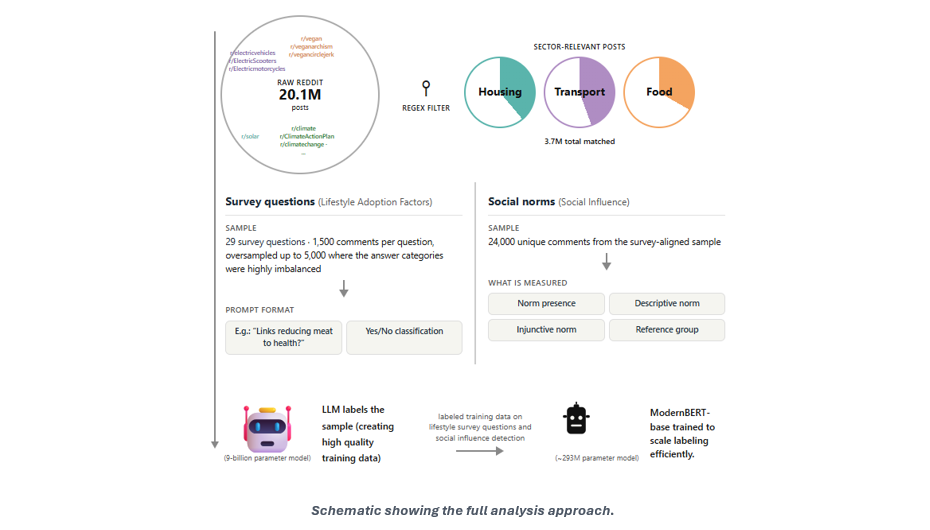
The dashboard draws on Reddit posts between 2010 and 2024. Raw data is filtered using keywords and other text patterns to isolate sector-specific discussions about food, transport, or home solar. This step removes irrelevant content and produces the dataset used for downstream analysis.
 © .
© .
As shown in the schematic, the analysis of Reddit data follows two linked pathways: survey questions and social norms. The first uses a large language model to extract insights related to established survey questions, allowing researchers to track how these topics appear in public discussion. The second examines how social norms are expressed in the same data.
A large language model first labels a sample of comments. These labels are then used to train a smaller, faster model that can analyze the much larger Reddit dataset efficiently and consistently.
Adoption factors and social influence
The analysis splits into two linked branches: survey questions (Lifestyle Adoption Factors) and social norms (Social Influence). These two views answer different questions: what barriers or motivators become prominent, and how lifestyle choices are discussed in relation to other people.
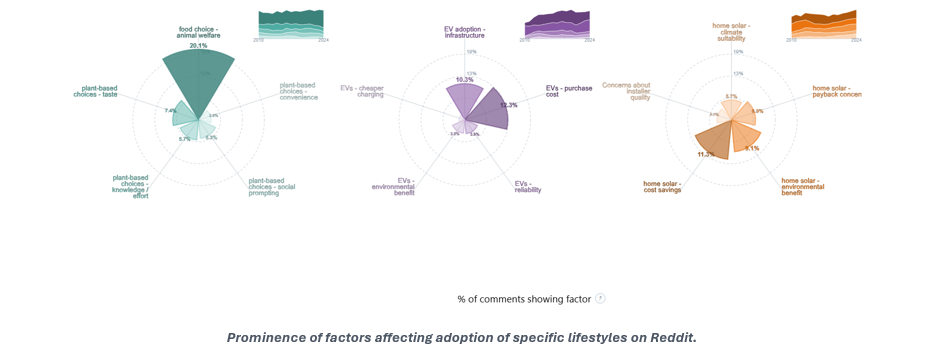
Each comment is classified according to whether it expresses the idea captured by that survey question. Here we show the percentage of Reddit comments in which a given attitude or barrier is expressed.
The social-norm branch uses unique comments from the survey-aligned sample. Four questions are asked per comment: whether the comment references a social norm, whether a descriptive norm is present, whether an injunctive norm is present, and which social group is referenced. Descriptive norm means language about what people do. Injunctive norm means language about what people should do, including approval, disapproval, praise, blame, ridicule, or other forms of social pressure.
Not public opinion, but public attention
These numbers do not measure individual preferences the way surveys do. Instead, they capture a different dimension: how prominent a factor becomes in collective attention when lifestyle choices are discussed in public.
Surveys are self-reported: they capture how people respond to structured questions about their preferences, concerns, or willingness to act. Reddit allows us to capture a different signal: which barriers, motivators, and social pressures become visible when people discuss climate-relevant choices in public.
 © .
© .
The social life of climate choices
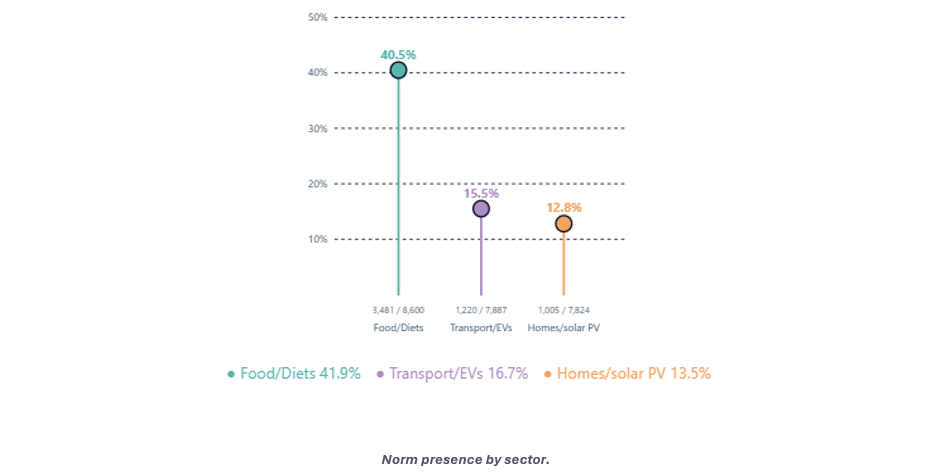
Food and diets emerges as the most norm-saturated sector, indicating that online discussion of dietary behavior is disproportionately structured around social norms. Nearly 42% of sampled food-related comments are coded as norm-relevant discourse, compared to roughly 17% for transport/EVs and 14% for homes/solar PV.
 © .
© .
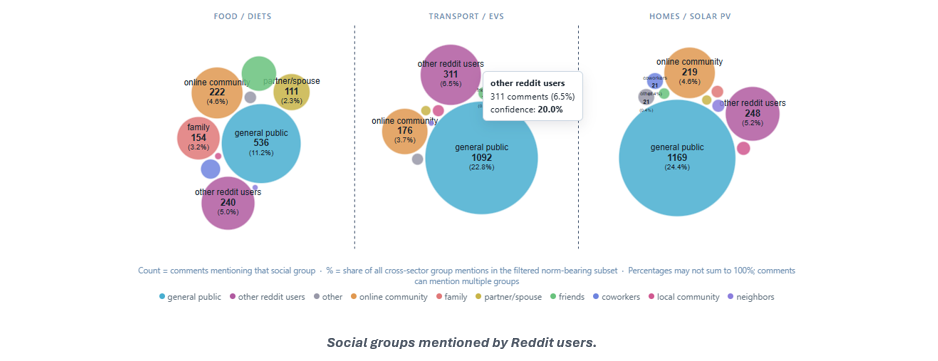
The same AI-supported workflow can also track which social groups are invoked in climate-related discussion, from broad publics to closer interpersonal ties.
 © .
© .
Food contains relatively more references to close social groups than transport or homes, suggesting that dietary behavior is discussed in relation to closer social ties rather than the general public alone. The sectors show broadly similar levels of descriptive norm presence, but Food/Diets stands out on Reddit for much stronger social expectations than Transport/EVs or Homes/solar PV.
Survey respondents tend to agree broadly that many factors influence their choices, with comparable agreement rates across questions. Reddit discourse tells a different story: it naturally differentiates between frames that dominate public conversation and those that receive far less attention.
The larger promise is that AI can help researchers track how climate-relevant choices are narrated, contested, and socially framed across large-scale textual data.
Across both parts of the workflow, reliability is checked through repeated labelling, cross-model checks, and manual review, so unstable questions can be flagged before scaling.
A larger model is used to check the outputs of a smaller model, helping ensure reliability while keeping the approach scalable and computationally efficient.
Limitations and implications
Some limitations of this study include the fact that the data were sampled from Reddit, which has been known to attract a mostly young, male demographic, although recent audience insights show a more balanced gender distribution of users. As such, the findings reported here may not be generalizable to all demographics.
More broadly, our findings should be interpreted as patterns of climate discourse on an English-language social media platform rather than as a globally representative account of low-carbon lifestyle discourse. Reddit activity is geographically uneven, with strong concentration in English-speaking countries, and location on the platform often has to be inferred indirectly from text rather than from explicit metadata.
Future work could extend this approach beyond Reddit to other platforms and media, enabling broader monitoring of public discourse on low-carbon transitions.
The interactive LOW-AI dashboard is available at https://iiasa.github.io/low-ai/.
Note: This article gives the view of the author and not the position of the IIASA Insights blog, nor of the International Institute for Applied Systems Analysis.