
Lisa Palmer reflects on the Raiffa Academy which opened with a premise that many global challenges suffer from failures in decision-making, negotiation and implementation, not a lack of data.
Scientists know more than ever about climate change, pandemics, energy transitions and other global challenges, but governments often struggle to act on that knowledge.
The inaugural Raiffa Academy opened on Tuesday with the premise that the problem is often not a lack of evidence. Instead, many of the world’s most difficult challenges are shaped by failures in decision-making, negotiation and implementation.
The three-day course at the International Institute for Applied Systems Analysis brought together dozens of scientists, diplomats, policymakers and decision theorists from 17 countries to explore how analytical methods can help bridge the gap between scientific knowledge and public action.
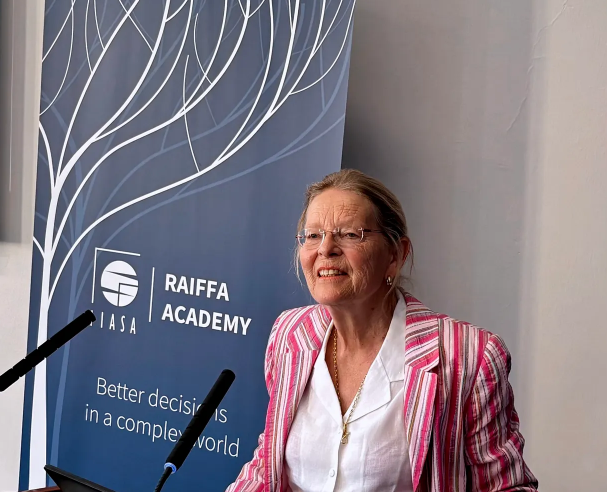 © Lisa Palmer | IIASA
Irene Giner-Reichl, a retired Austrian ambassador who represented her country in China and Mongolia and in Brazil and Suriname, shares her expertise in economic and social development, women’s rights’ issues, environment, energy, and development cooperation with the Raiffa Academy on 14 July 2026.
Participants are examining how decision science and negotiation analysis, both of which were pioneered by Howard Raiffa, IIASA’s first director, can help leaders navigate situations where interests conflict, uncertainty is unavoidable and no single solution satisfies everyone involved.
"We could be more effective, more influential, and maybe even more wise if we know more about the process of making decisions and conducting negotiations," said Daniel Goroff, president and chief executive officer of the Social Science Research Council and one of the academy's organizers.
Goroff, also a senior advisor at the Alfred P. Sloan Foundation, argued that scientific evidence alone does not automatically translate into better policy or international cooperation.
"Howard was an outstanding and inspired advocate for the belief that it matters how we go about international scientific cooperation and policy making," he said.
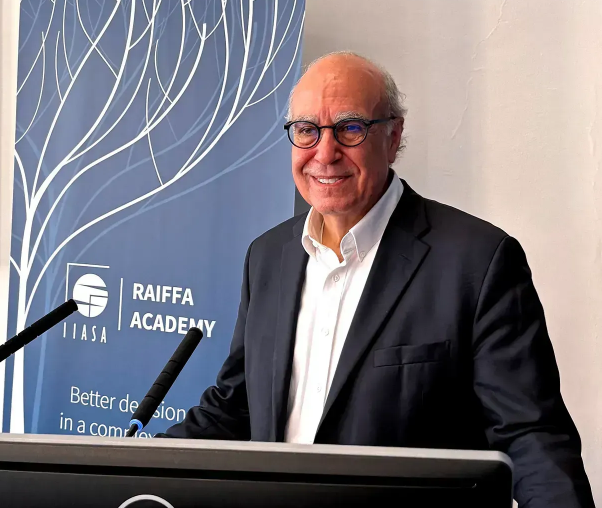 © Lisa Palmer | IIASA
Daniel Goroff, president and chief executive officer of the Social Science Research Council and a senior advisor at the Alfred P. Sloan Foundation, addresses the Raiffa Academy on 14 July 2026.
Helping decision makers navigate complexity
The academy is built around the proposition that improving decisions requires more than producing better evidence. It also requires better methods for understanding uncertainty, evaluating alternatives, managing disagreement and identifying pathways toward action.
International negotiations rarely involve disputes about evidence alone. Countries enter discussions with different interests, values, political constraints and perceptions of risk. Scientific knowledge may inform negotiations, but it does not resolve them.
The academy’s first day focused on methods designed to help decision makers navigate those realities. Participants were introduced to four complementary approaches that have shaped the field of decision science in the past several decades.
Eeva Vilkkumaa, associate professor of management science at Aalto University in Finland, examined how decision analysis can help leaders act under uncertainty.
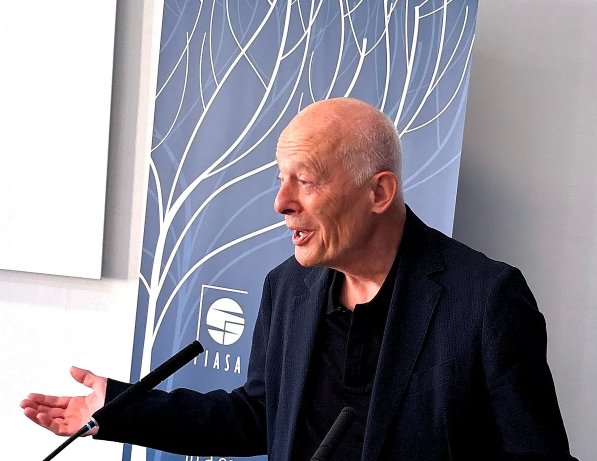 © Lisa Palmer | IIASA
IIASA Director General Hans Joachim (John) Schellnhuber speaks to the Raiffa Academy on 14 July 2026. Prior to joining IIASA in 2023, he was the founding director of the Potsdam Institute for Climate Impact Research and served as research director of the Tyndall Centre for Climate Change Research.
Detlof von Winterfeldt, professor emeritus at the University of Southern California and former director general of IIASA, explored methods for identifying and weighing competing stakeholder interests.
Elke Weber, professor of psychology and public affairs at Princeton University, focused on negotiation analysis and the behavioral barriers that often prevent agreement.
Elena Rovenskaya, IIASA program director and principal research scholar, introduced systems approaches for understanding interconnected global challenges.
Modern public policy planning focuses on complex, interconnected problems, according to Rovenskaya, who cautioned that complexity is not just a synonym for “complicated or difficult.”
Role of science
Scientific evidence can help explain what is happening and what may happen next. It can identify risks, opportunities and possible consequences. But evidence alone cannot determine which risks societies should accept, which goals they should prioritize or how competing interests should be reconciled.
That challenge is at the center of science diplomacy. The academy is launching at a time when international cooperation faces mounting pressure, said IIASA Director General Hans Joachim (John) Schellnhuber. “Rather than having a better multilateral system,” he said, “it is collapsing before our very eyes, while the global challenges … are exacerbating.”
Navigating decisions requires moving past risks and fear of the unknown. According to Weber, human biology naturally craves predictability because it historically kept us safe from danger. The short course aims to bridge that gap by giving professionals concrete analytical tools.
“What science does is help us become more comfortable with uncertainty by quantifying it,” Weber said. Models, she noted, “basically allow you to digest previous experience into something you can use.”
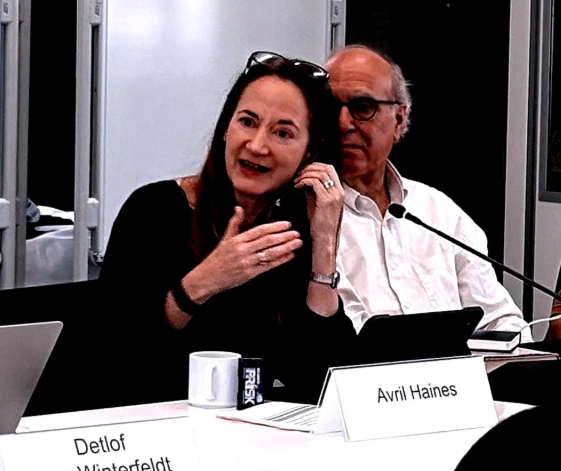 © Lisa Palmer | IIASA
Former U.S. Director of National Intelligence and president-elect of the Carnegie Endowment for International Peace Avril Haines shares her experiences with the Raiffa Academy on 14 July 2026.
Former Austrian Ambassador Irene Giner-Reichl, drawing on decades of diplomatic expertise, cautioned that scientific evidence alone rarely determines negotiating outcomes.
“Scientific evidence is usually not a factor in these E.U. meetings,” said Giner-Reichl, chair of the board of the European Forum Alpbach. “It’s really about national positions, national interests, economic interests, interests of various lobby groups.”
Her point was not that evidence is irrelevant, but that scientific information must compete with political, economic and institutional interests that shape negotiating positions.
She welcomed the academy as an effort to strengthen science diplomacy, particularly since one of the central challenges is identifying opportunities for scientific evidence to shape policy before negotiating positions become fixed.
The academy also reflects a return to one of IIASA’s founding ideas. Raiffa, the institute’s first director in 1972, helped establish modern decision analysis and negotiation analysis during a career that spanned nearly six decades at Harvard University.
His work focused on helping people make better decisions under uncertainty and finding practical approaches to negotiation in situations where interests conflict.
Organizers say the new academy seeks to apply those ideas to contemporary challenges ranging from climate change and public health to artificial intelligence and international cooperation.
Reflecting on her father’s legacy, Judy Raiffa said the academy exudes her father’s confidence that a new generation of scientists, policymakers and negotiators can tackle increasingly complex global challenges.
“The real reason that my father wanted the Raiffa Academy at IIASA to be formed was he believed in your potential to change the world for the better,” she said, adding that 25 years ago her father wrote, “The balance between war and peace may be a matter not of the nature of differences that divide us, but of the process we use to resolve these differences.”
In the day’s closing discussions, former U.S. Director of National Intelligence and president-elect of the Carnegie Endowment for International Peace Avril Haines said the academy’s sessions reflected challenges she had encountered throughout her national security career.
She noted that major policy outcomes often emerge not from a single decisive meeting but through “a sequence of smaller decisions” that progressively constrain future choices. Communicating uncertainty, she added, can be just as difficult as analyzing it, while effective negotiations often begin long before formal talks commence.
“The gap between analysis and decision is really not primarily technical but human,” Haines said. Trust, institutional incentives and creating environments where people can speak candidly are essential if rigorous decision methods are to shape policy.
Her observation echoed a theme that surfaced repeatedly throughout the day: producing better evidence is often easier than creating the conditions under which evidence can influence decisions.
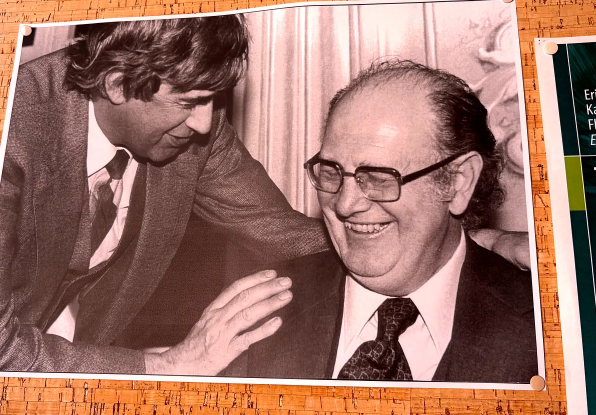 © Lisa Palmer | IIASA
A panel exhibit in IIASA’s Library featuring a photo of IIASA’s founding director, Howard Raiffa, at right, with IIASA former director general, C.S. ‘Buzz’ Holling, at left. Raiffa helped establish modern decision analysis and negotiation analysis during his career at Harvard University. Organizers say the new Raiffa Academy builds on his vision of using structured analysis to help scientists, policymakers and diplomats address complex international challenges.
Building on the Raiffa legacy
The inaugural course serves as a pilot for a broader effort to build a network of researchers, policymakers, diplomats and science advisers trained in decision analysis and negotiation methods.
Organizers hope future offerings will expand participation and strengthen connections across disciplines and regions. As global challenges become more complex, decision science can help leaders connect evidence with action.
Throughout the first day, speakers returned to a common theme. Scientific evidence can illuminate choices, but it does not make them. In an era of growing uncertainty and geopolitical strain, the challenge is learning how to turn knowledge into action.
This article first appeared on The Science Diplomat.
Note: This article gives the view of the authors, and not the position of the IIASA Insights blog, nor of the International Institute for Applied Systems Analysis.