
The IIASA Interaction Festival is an opportunity for the IIASA community to learn from each other. IIASA researchers Xiran Dong, Veronika Schick, and Elliott Woodhouse share their experiences and insights from the session they presented at the most recent installment of this annual event.
It is imperative for us as IIASA scientists to recognize and identify our own beliefs and potential biases. While we strive for objectivity, we are part of the systems we study and are shaped by our surroundings and social norms. Members of the Equity and Justice Research Group (EQU) therefore used the second iteration of the annual IIASA Interaction Festival as an opportunity to pilot and showcase methods for capturing and identifying justice and value-of-nature preferences. In doing so, we tried to better understand what IIASA researchers think about these questions, while also highlighting the importance of being able to understand and articulate our personal views and preferences.
 © IIASA
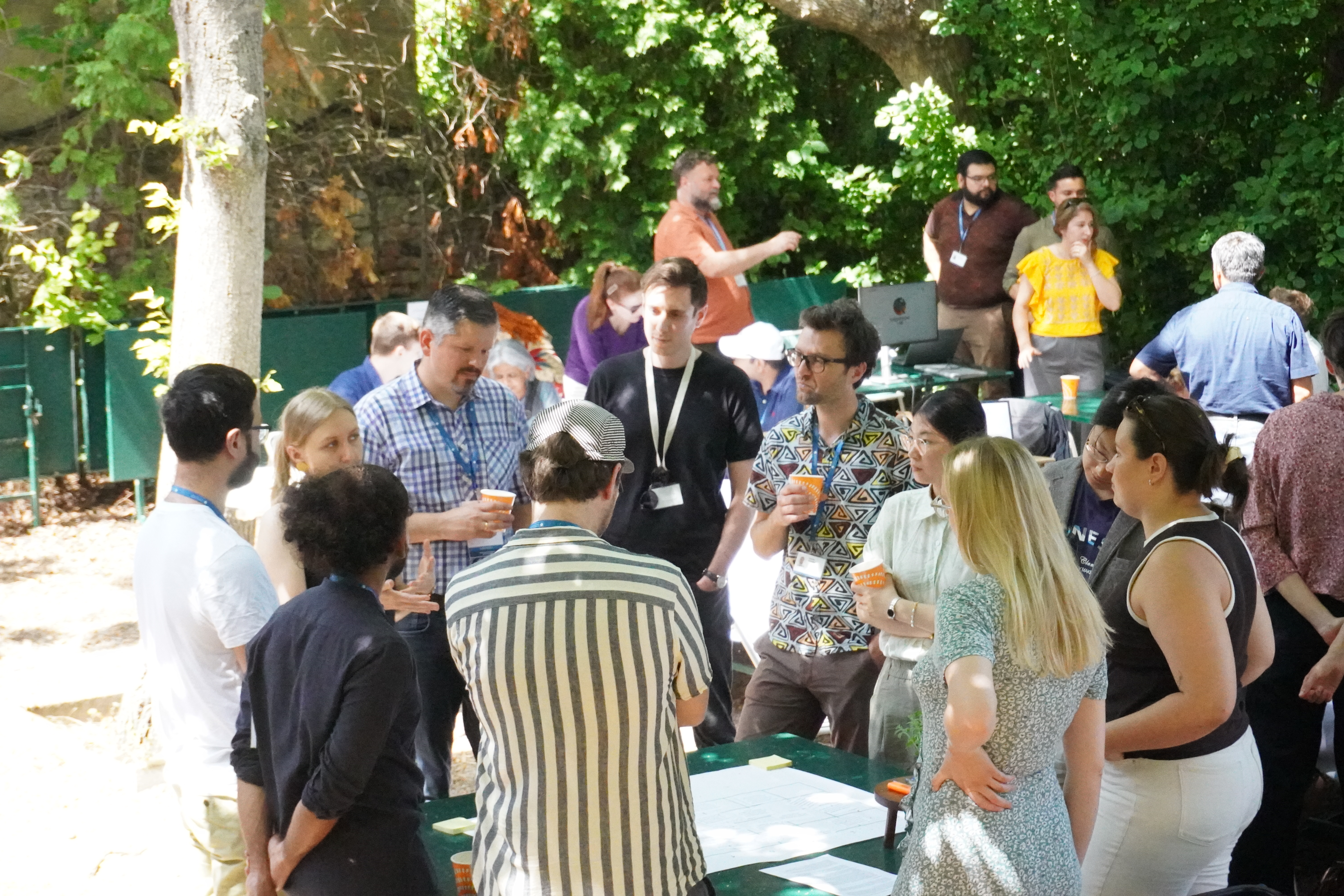
Participants at the EQU session during the 2025 IIASA Interaction Festival
“Living Q”
To explore perceptions of justice and nature’s value, we applied a participatory approach derived from the Q methodology (more info on “living Q”) to study subjectivity. Q helps participants to elicit their priorities and captures the nuances of decision-making processes. It can be applied in low-resource settings and in flexible ways, adjusting to the characteristics and local contexts of the participants using pictures, symbols, or even real objects. Especially suitable for “wicked problems”, Q has been applied in various contexts, such as stakeholder priorities in waste-water treatment, marine spatial planning, and flood risk management.
For the interactive session, we developed two Q-sets including statements on valuations of either nature or justice, based on findings from research projects, including the Horizon Europe projects Rainforest and Firelogue, where we analyze different values attributed to nature in the context of peatland conservation and wildfire risk management; and the SNF-funded project Trebridge, which explored people’s distributive justice preferences in natural hazard management. The definitions of key distributive justice preferences of the IIASA Applied Justice Taxonomy and Assessment Framework (AJUST) were also integrated, providing a systematic tool for identifying and assessing justice considerations within research.
We randomly divided participants into two groups and gave them the same set of statements to sort into a bell-curve-shaped grid to ensure a clear preference. We had two rounds with two groups ranking statements on values of nature and on justice in relation to natural hazards.
Statements positioned at the ends of the grid reflect either strong support or strong opposition, while those placed in the middle reflect a neutral stance. The participants first discussed where to place the statements and expressed their opinions, with a show of hands confirming the final decision (agree, neutral, disagree). When opinions differed, the most votes determined where to place the statement. To make the results easier to analyze, we later added colors to each statement, with each color representing one of the three justice principles.
Justice aspects in natural hazard adaptation
IIASA researchers have spearheaded techniques for including justice considerations into their modeling studies. A key step was the recognition that a just world looks different to different people. Recognizing this is essential for the continued policy relevance of the Institute’s work, as evidence shows that perceptions of a policy’s fairness are a key determinant of its success. This means that when developing scenario or modeling depictions of “Just Futures” or a “Fair Anthropocene”, we cannot proceed with a single conceptualization of justice in mind – we have to actively consider that a particular vision of fairness may not be perceived as fair by somebody else.
Researchers at IIASA have pioneered methods to incorporate plural accounts of justice into scenario and modeling studies, particularly through the development of the AJUST framework.
The statements relating to justice were based on three distributive justice principles: egalitarianism, sufficientarianism, and utilitarianism. Each of the three principles offers a different rationale for how benefits and burdens should be shared.
Egalitarians view justice as demanding the minimization of inequalities by distributing resources benefits and burdens equally. For example, luck egalitarianism holds that individuals should only be compensated for disadvantages caused by circumstances beyond their control, but not for outcomes resulting from their own informed choices. Sufficientarianism is unconcerned with equality, instead arguing that all justice demands are that everyone has “enough”, for instance, a sufficient distribution of resources to provide all with the resources needed to reach some threshold level of minimum, basic, or decent level of human needs. Utilitarianism aims to create the greatest overall benefit for society. As its focus is on maximizing total welfare, utilitarian thinking is common in policymaking and research.
The results of the Q-method analysis, shown in Figure 1, suggest that IIASA researchers have clear and consistent preferences when it comes to justice principles. The statements are grouped by color, showing a clear pattern. Egalitarianism emerged as the most preferred principle, followed by sufficientarianism, while utilitarianism was the least favored. One researcher even commented during the group discussion, “Sentences that begin with ‘The market should decide…’ are never good,” highlighting a general skepticism toward market-based, utilitarian approaches.
 © IIASA
Figure 1 shows the results in relation to distributive justice (pink = utilitarian, green = egalitarian, blue = sufficientarian)
This stands in contrast to the often implicit utilitarian assumptions underlying many research models, which tend to prioritize maximizing total utility. Many participants disagreed with the statement, “greatest benefit for the greatest amount of people”, because it is not clear what “greatest benefit” entails and there is a need to consider the most vulnerable groups.
Valuations of nature
In recent years, scenario and modeling studies have increasingly aimed to incorporate social and non-scientific values into their design. It has now been almost ten years since the Intergovernmental Science-Policy Platform on Biodiversity and Ecosystem Services (IPBES) published their methodological assessment report, which called for new methods for incorporating different perspectives on the value-of-nature into scenarios and modeling studies. This call stemmed from the recognition that existing approaches often overlooked the diverse ways people relate to nature, limiting their relevance and legitimacy across different cultural and social contexts. This is important as these values shape how people imagine desirable futures and which policies they support. This initiated the process that culminated in the development of the Nature Futures Framework – a tool for categorizing and identifying different ways in which people value nature, which in turn conditions how they interpret the success conditions of the Kunming-Montreal Global Biodiversity Framework and thus the Biodiversity Convention – which sets the goal of a “World Living in Harmony With Nature”.
The Nature Futures Framework differentiates between 1) the instrumental values of nature to society (Nature for Society); 2) the intrinsic values of nature (Nature for Nature); and 3) the relational values weaving human-nature relationships together, which is important for cultural identity (Nature as Culture/One with Nature).
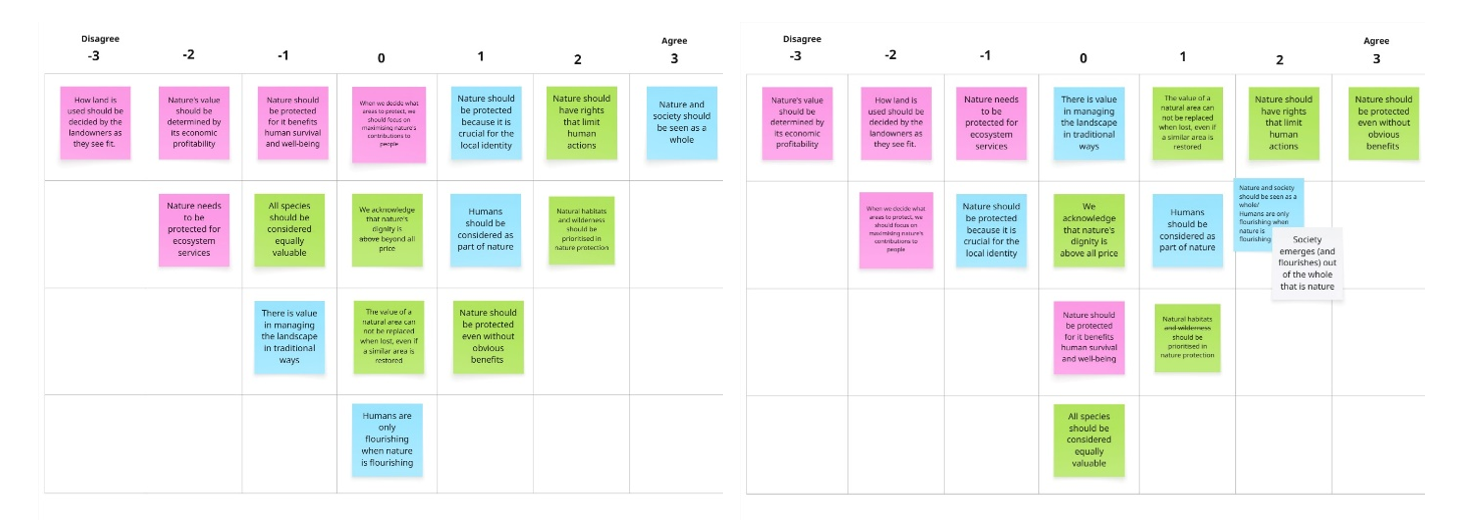
The results show that both groups of participants equally disagreed with valuing nature foremost for its instrumental values. However, one group preferred the “Nature as Culture” principle, while the other agreed most with valuing nature for its intrinsic values. Participants emphasized the human-nature connection and rejected putting a price tag on nature. Fostering co-benefits and synergies were considered most important.
Changes in wording have been suggested emphasizing the principle of “One with Nature”. Furthermore, it has been raised that the term “wilderness” is problematic when viewed from a post-colonial perspective. Many “wilderness” areas have cultural significance and are stewarded by indigenous communities who were driven off their land. Changing the wording from equality to equity, also in the context of protecting species, was suggested because some species need more protection from an ecological point of view, while others can adapt better than others, or are invasive. Landownership was another point of discussion, which was considered too broad a term.
 © IIASA
Figure 2 shows the results in relation to values attributed to nature (pink = instrumental values, green = intrinsic values, blue = relational values)
A major discussion revolved around the statement, “nature needs to be protected for ecosystem services”. Participants agreed least with seeing nature’s instrumental value as foremost when confronted with nature’s intrinsic and relational values.
Some researchers reflected that despite the orientation towards nature’s contributions to society, such as cost-benefit analyses and the maximization of ecosystem services, they prioritized the other valuations of nature during the exercise, emphasizing the need to protect nature for the sake of nature conservation and seeing human and nature as a whole. As some remarked, even if humans can flourish without nature, it is not long-term.
Reflections and conclusions
In our session at the Interaction Festival, we found that IIASA researchers tend to share similar views on justice and values of nature. The Q-method can be applied in a wide range of contexts to help make subjective preferences explicit. Yet, we need to keep in mind the social-desirability bias, and that minority voices are often overlooked. Such exercises help to clarify ambiguous terms and establish a shared language, for example, what “adequate” or “the greatest benefit” actually mean, what “nature” and “ecosystem services” entail, and what we mean when we say that a policy was “just” or “fair”. What we have tentatively identified is that there are biases/preferences within the IIASA community against certain accounts of justice and ways of valuing nature. We need to keep this in mind when we conduct our research.
Additionally, stakeholders in industry, NGOs, or policymaking, may hold different justice principles and value orientations. This session served as a first step in exploring the potential of Q in participatory settings to evaluate justice and value preferences. In the future, the method will be used more inductively by the EQU group to uncover and compare the diverse value systems and normative justice preferences held by different actors. Being aware of our own personal values and preferences, and how they may differ from stakeholders and the wider public, will help us critically reflect on the assumptions underlying our work, ultimately making us better researchers and rendering our research more relevant for policies.
References
|
Arneson, R. (2009). Luck Egalitarianism Interpreted and Defended. Philosophical Topics, 32(1), 1–20. https://doi.org/10.5840/philtopics2004321/217
Bergquist, M., Nilsson, A., Harring, N., & Jagers, S. C. (2022). Meta-analyses of fifteen determinants of public opinion about climate change taxes and laws. Nature Climate Change, 12(3), 235–240. https://doi.org/10.1038/s41558-022-01297-6 Hanger-Kopp, S., Kikstra, J., Mintz-Woo, K., Scheifinger, K., Schinko, T., Wallimann-Helmer, I., Wong, C., Woodhouse, E., & Zimm, C. (2024). IIASA/EQU Justice Framework: A descriptive guideline for science and policy. IIASA Working Paper. Laxenburg, Austria: WP-24-012 Huseby, R. (2009). Sufficiency: Restated and Defended. Journal of Political Philosophy, 18(2), 178–197. https://doi.org/10.1111/j.1467-9760.2009.00338.x IPBES (2023) Foundations of the Nature Futures Framework. A flexible tool to support the development of scenarios and models of desirable futures for people, nature and Mother Earth. IPBES/9/14 Kim, H., Peterson, G. D., Cheung, W. W. L., Ferrier, S., Alkemade, R., Arneth, A., Kuiper, J. J., Okayasu, S., Pereira, et al. (2023). Towards a better future for biodiversity and people: Modelling Nature Futures. Global Environmental Change, 82, 102681. https://doi.org/10.1016/j.gloenvcha.2023.102681 Pereira, L. M., Davies, K. K., den Belder, E., Ferrier, S., Karlsson-Vinkhuyzen, S., Kim, H., Kuiper, J. J., Okayasu, S., Palomo, M. G., Pereira, H. M., Peterson, G., Sathyapalan, J., Schoolenberg, M., Alkemade, R., Carvalho Ribeiro, S., Greenaway, A., Hauck, J., King, N., Lazarova, T., et al. (2020). Developing multiscale and integrative nature–people scenarios using the Nature Futures Framework. People and Nature, 2(4), 1172-1195. https://doi.org/https://doi.org/10.1002/pan3.10146 Ripken, M., Keijser, X., Klenke, T., & Mayer, I. (2018). The ‘Living Q’—An Interactive Method for Actor Engagement in Transnational Marine Spatial Planning. Environments, 5(8), 87. https://doi.org/10.3390/environments5080087 Rittelmeyer, P. (2020) Socio-cultural perceptions of flood risk and management of a levee system: Applying the Q methodology in the California Delta, Geoforum, 111, 11-23. https://doi.org/10.1016/j.geoforum.2020.02.022. Thaller, A., Fleiß, E., Brohmer, H., Poschid, A., & Athenstaedt, U. (2023). When perceived fairness and acceptance go hand in hand–Drivers of regulatory and economic policies for low-carbon mobility. PLOS Climate, 2(5), e0000157. https://doi.org/10.1371/JOURNAL.PCLM.0000157. Zimm, C., Mintz-Woo, K., Brutschin, E., Hanger-Kopp, S., Hoffmann, R., Kikstra, J.S., Kuhn, M., Min, J., Muttarak, R., Pachauri, S., Patange, O., Riahi, K., & Schinko, T. (2024). Justice considerations in climate research. Nature Climate Change, 14, 22-30. 10.1038/s41558-023-01869-0. |
Note: This article gives the views of the authors, and not the position of the Nexus blog, nor of the International Institute for Applied Systems Analysis.