
As climate risks intensify, fostering community resilience has become a global priority but a fundamental question remains for practice and policy: how can resilience be defined, measured, and proven to inform implementation? Together with the Zurich Climate Resilience Alliance, IIASA researchers have spent more than a decade developing and scientifically validating a universally-applicable framework to measure community resilience, turning a concept into an evidence-based tool to guide real-world implementation in the most vulnerable communities across the globe.
When NGOs and development agencies allocate funding to climate adaptation and disaster risk management they face a fundamental challenge: how do we know which interventions will make communities more resilient to climate-related disasters? And what does resilience actually mean, and how will we know it when we see it?
For decades, such critical decisions have often relied on frameworks that, while conceptually sound, lack comprehensive implementation or rigorous validation in practice. Despite extensive research on disaster and climate risk reduction and adaptation, policymakers and practitioners have lacked a scientifically validated, globally applicable method to measure whether resilience investments are working at local scales and over time.
For over a decade now, IIASA has been working with development partners in the Zurich Climate Resilience Alliance (formerly the Zurich Flood Resilience Alliance), to develop and validate a globally applicable framework and tool for measuring community disaster resilience in the most vulnerable communities across the globe.
The challenge of measuring resilience in community systems
Defining and measuring disaster resilience presents significant challenges for researchers, policymakers, and practitioners alike. In this regard, the Zurich Flood Resilience Alliance defines disaster resilience as "The ability of a system, community, or society to pursue its social, ecological, and economic development and growth objectives, while managing its disaster risk over time in a mutually reinforcing way". It is now well understood that community disaster resilience is multi-dimensional, encompassing interactions across human, social, economic, natural and built environment systems. Resilience is also latent, and until tested, many of these dimensions of resilience are invisible potential. The complex dynamics inherent in resilience are revealed in times of stress. For example, a community with high flood resilience might be characterized as one that recovers rapidly from flood damage, but it might equally be a community that has systems in place to prevent floods from causing disasters in the first place. The complexity increases when we consider that communities exhibit different combinations of strengths and gaps. Some have robust financial capital but limited social cohesion. Others maintain strong community networks despite deteriorating physical systems. Developing a measurement approach that captures this multidimensional nature while remaining practical for implementation requires careful scientific consideration.
For the past 13 years, we at IIASA have been working on the most widely applied community disaster resilience measurement approach in the world. The Flood Resilience Measurement for Communities (FRMC) is a holistic methodological approach, rooted in Sustainable Livelihoods Framework thinking, that assessed resilience across five interdependent types of community "capitals" or capacities: human (education, skills, health, and awareness), social (networks, governance, and cooperation), physical (infrastructure and emergency systems), natural (ecosystems and resource use), and financial (income, savings, and financial access).
Understanding resilience in 325 communities
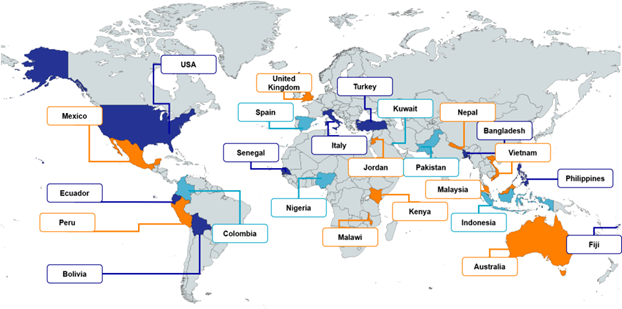
The FRMC has become a standardized, indicator-based approach for measuring community resilience. The Alliance applied the FRMC (and an earlier version, the FRMT) across the globe, generating an unprecedented dataset: information from 325 communities across 22 countries – from rural villages in Bangladesh to urban neighbourhoods in Germany. We analysed over 2.5 million data points, tracking how different aspects of resilience changed over time and informed resilience grades.
But how do practitioners know if what they’re measuring is actually resilience in line with our conceptual framing? This is where IIASA’s validation approach comes in. We applied advanced statistical techniques to this massive dataset and coupled it with qualitative research done with FRMC users. A unique feature of the FRMC has allowed us to validate it like no other resilience measurement framework in the world: when flood events occur during the study period, users conduct post-event analyses to determine whether communities with higher resilience scores experience fewer losses and damages. This "realized resilience" analysis has been essential for establishing the framework's predictive validity – demonstrating that our measurements correlate with actual post-disaster outcomes.
 © .
© .
Map of the countries that participated in the validation study (FRMC Phase 2)
Results: realized resilience
We found strong evidence that the FRMC measures what it says it does: communities with stronger baseline resilience genuinely experience fewer losses during floods. Communities with robust natural, physical, and financial capital perform better across most outcomes, and those with strong social capital perform better with regards to governance-related outcomes. While human capital shows smaller gains than these other capitals, it nonetheless plays a foundational role, influencing social, natural, and physical capital and making it a critical entry point for building overall resilience.
We also uncovered evidence about how resilience works. The five types of capital don't operate independently – they're interconnected. Social capital, for instance, influences all other types. When people trust each other and work together, they're more likely to maintain infrastructure, protect the environment, and support each other economically.
This finding validates what many communities know instinctively: resilience isn't just about having the right equipment or enough funding. It's about having the appropriate social fabric and fit-to-purpose local governance arrangements that allow communities to use their resources effectively.
Why this matters for evidence-building through science
Our validation work at IIASA has provided the scientific foundation that community-based organizations, practitioners, development agencies, and governments need to make evidence-based decisions about resilience investments. By demonstrating that resilience measured by the FRMC predicts real-world flood outcomes, we've transformed what was once unvalidated input and often educated guesswork into evidence for data-driven practice and policy.
 © Practical Action
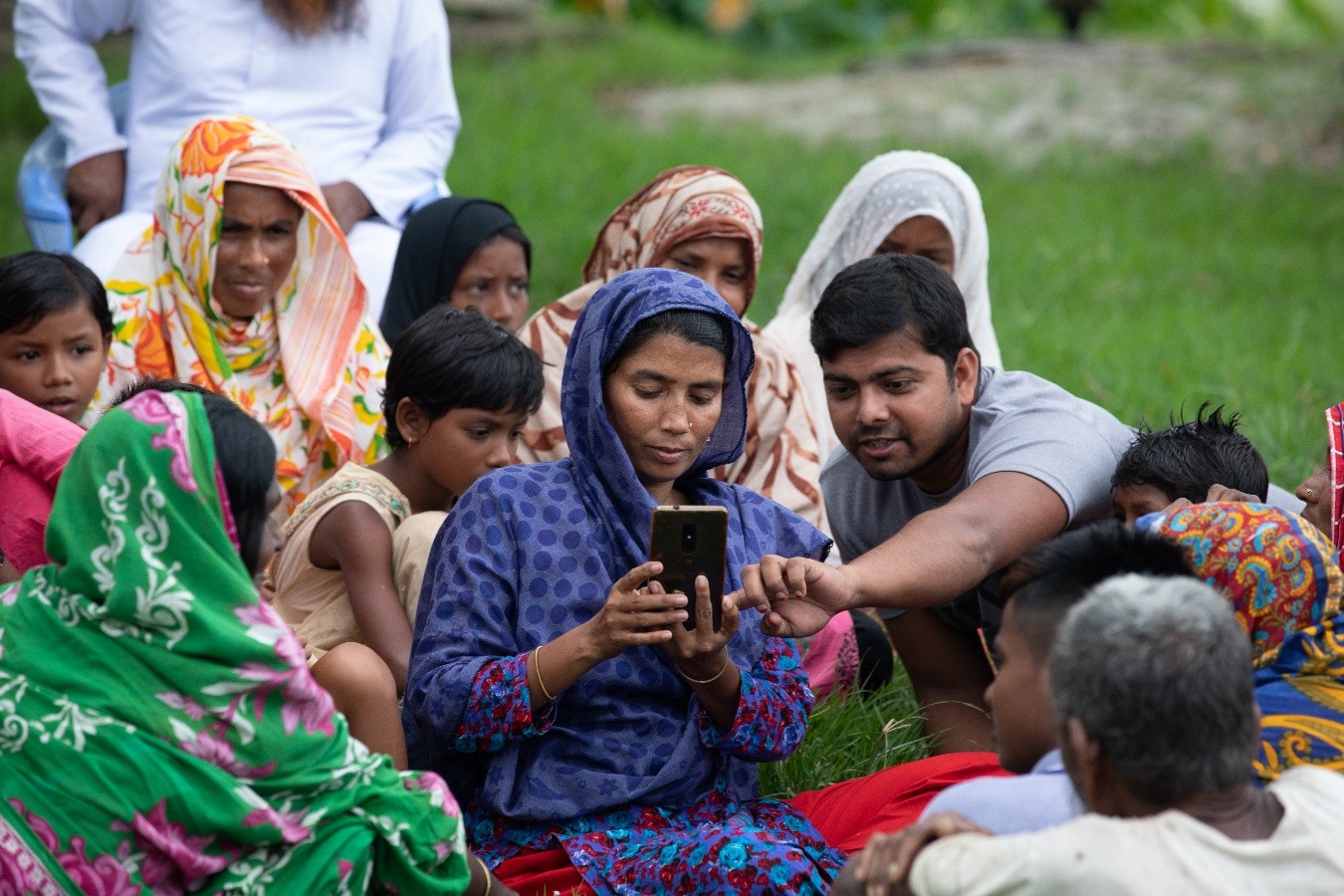
Rehana, a Local Resilience Agent in Bangladesh, uses an app-based alert system to warn community members about flood events.
Looking forward: informing systemic decisions
Our validation work has established a crucial scientific foundation for resilience measurement through the FRMC, which many now consider a gold standard in the field. Also, IIASA's empirical validation gave the Z Zurich Foundation the confidence to expand the measurement framework beyond floods. Now called the Climate Resilience Measurement for Communities (CRMC), this approach is being applied worldwide to assess community resilience to multiple hazards including floods, heatwaves, wildfire and storms. This first ever 'multi-hazards in parallel' approach is breaking new ground in resilience programming.
The path from "we think this works" to "we know this works" took years of rigorous testing at local scale across multiple continents. But now, for the first time, at-risk communities across the globe have a scientifically validated way to measure and modify disaster resilience – and more importantly, to build it systemically across the set of capacities, multiple hazards and locally-defined development priorities based on evidence rather than assumptions.
Policymakers and practitioners do not have to rely on guesswork about where to allocate scarce resources. They have validated and user-driven science to guide their decisions.
Alliance references
Zurich Flood Resilience Alliance. (2025). The Zurich Flood Resilience Alliance Phase II: Impact report, 2018–2024. Z Zurich Foundation.
References (ZCRA-IIASA publications in 2024-2025)
Chapagain, Dipesh, Stefan Hochrainer-Stigler, Stefan Velev, Adriana Keating, and Reinhard Mechler (2025). “Realized Resilience after Community Flood Events: A Global Empirical Study.” International Journal of Disaster Risk Reduction 118 (February): 105246. https://doi.org/10.1016/j.ijdrr.2025.105246.
Chapagain, D., Hochrainer-Stigler, S., Velev, S., Keating, A., Hyun, J.H., Rubenstein, N., & Mechler, R. (2024). A taxonomy-based understanding of community flood resilience. Ecology and Society 29 (4) e36. 10.5751/ES-15654-290436
Guimaraes, Raquel, Reinhard Mechler, Stefan Velev, and Dipesh Chapagain (2025). “The Effect of Community Resilience and Disaster Risk Management Cycle Stages on Morbi-Mortality Following Floods: An Empirical Assessment.” Natural Hazards and Earth System Sciences 25 (10): 3803–26. https://doi.org/10.5194/nhess-25-3803-2025.
Hochrainer-Stigler, S., Keating, A., Velev, S., Chapagain, D., Hyun, J.H., Laurien, F., Guimaraes, R., Clercq-Roques, R., & Mechler, R. (2025). Assessing Community Resilience: Validating a Universally Applicable Flood Resilience Measurement Framework and Tool. International Journal of Disaster Risk Science 10.1007/s13753-025-00652-3
Hyun, J-H., Velev, S., Hochrainer-Stigler, S., Mechler, R. (in review). Empirical insights from community disaster resilience-building interventions. Mitigation and Adaptation Strategies for Global Change
Keating, A., Hochrainer-Stigler, S., Mechler, R., Laurien, F., Rubenstein, N., Deubelli, T., Velev, S., Szoenyi, M. & Nash, D. (2025). Reflections on the large-scale application of a community resilience measurement framework across the globe. Climate Services 38, e100562. 10.1016/j.cliser.2025.100562.
Mechler, R, Venkateswaran, K, Deubelli-Hwang, T. Disaster resilience & transformation. Science, practice and policy perspectives. Springer, forthcoming.
Paszkowski, A., Laurien, F., Mechler, R., & Hall, J. (2024). Quantifying community resilience to riverine hazards in Bangladesh. Global Environmental Change 84 e102778. 10.1016/j.gloenvcha.2023.102778
Rubenstein, N., Keating, A., MacClune, K. & Norton, R. (2024). Measuring community heatwave resilience: A comprehensive framework and tool. Climate Risk Management 46, e100662. 10.1016/j.crm.2024.100662.
Yang, Y., Keating, A. & Sourn, C. (2024). Measuring community disaster resilience for sustainable climate change adaptation: Lessons from time‐series findings in rural Cambodia. Disasters 48 (4), e12647. 10.1111/disa.12647.
Note: This article gives the views of the authors, and not the position of IIASA Insights, nor of the International Institute for Applied Systems Analysis.